

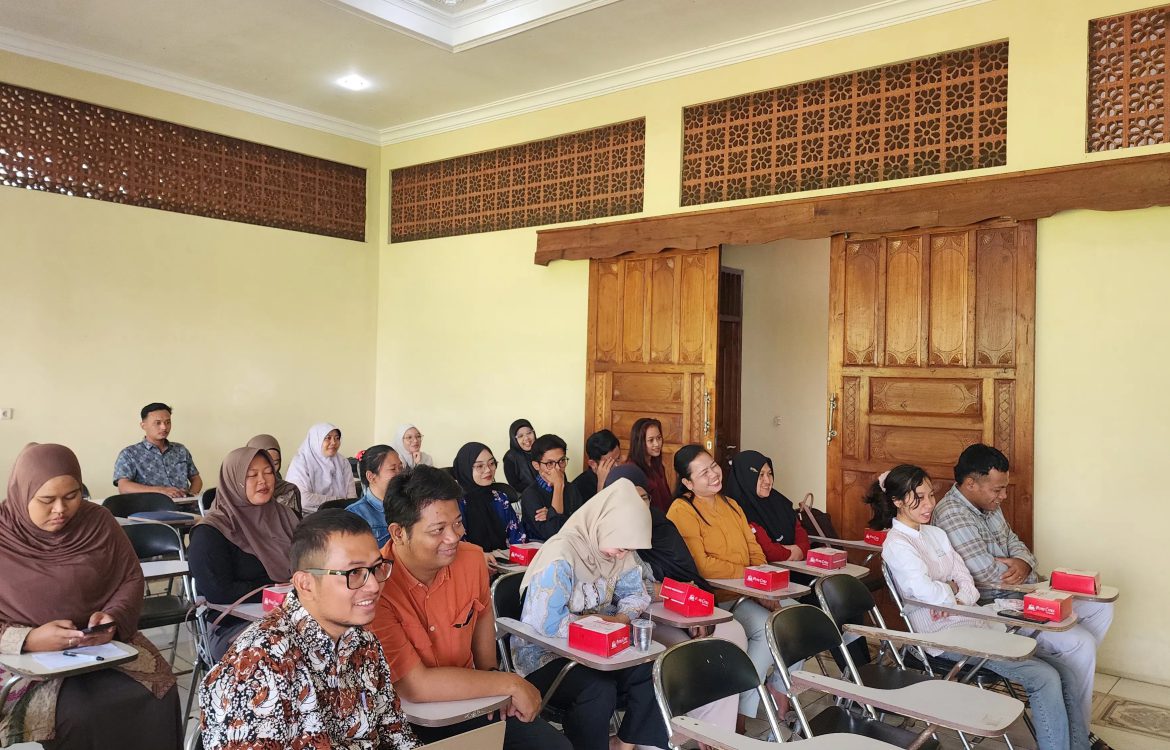
FEB UNS Sustainability Accounting and Governance Research Group Assists Cangkringan SPPG in Strengthening Sustainable Governance
The implementation of Indonesia’s Free Nutritious Meals Program (MBG) requires not only the capacity to provide safe and nutritious meals but also strong institutional governance, effective internal controls, and accountable recording and reporting systems. Sound governance is essential because the operations of the Nutrition Fulfillment Service Unit (Satuan Pelayanan Pemenuhan Gizi/SPPG) involve food procurement, inventory management, meal production, food distribution, and accountability for the use of public funds.
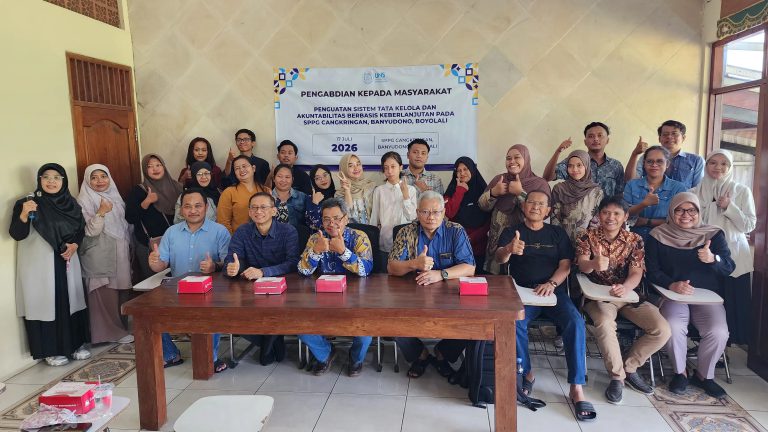
As part of its contribution to strengthening institutional governance, the Sustainability Accounting and Governance Research Group (RG) of the Faculty of Economics and Business (FEB), Universitas Sebelas Maret (UNS), conducted a Community Service program titled “Strengthening Governance and Accountability through a Sustainability-Based Approach.” The program was held at SPPG Cangkringan, Banyudono District, Boyolali Municipality, Central Java, on Friday, July 17, 2026.
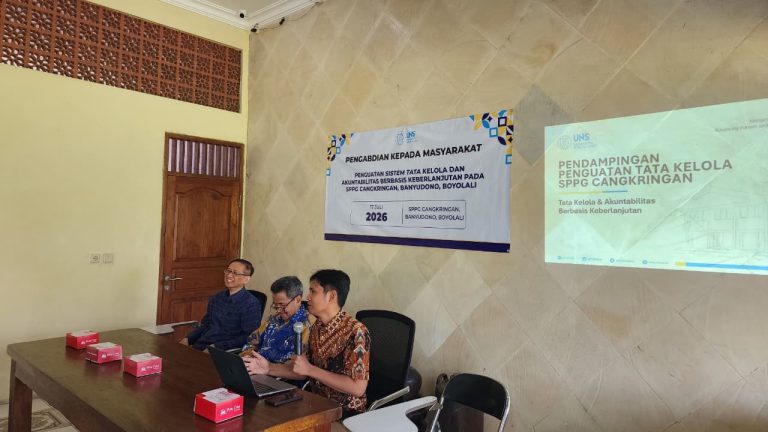 The Community Service program was led by Dr. Wahyu Widarjo, S.E., M.Si., with team members Prof. Djoko Suhardjanto, M.Com. (Hons)., Ph.D., Ak.; Prof. Bandi, M.Si., Ak., CA, CPA, CTA; Dr. Jaka Winarna, M.Si., Ak.; Prof. Agung Nur Probohudono, S.E., M.Si., Ph.D., Ak., CA., CFrA; and Nur Chayati, S.E., M.Sc.
The assistance focused on strengthening the five principles of good governance: transparency, accountability, responsibility, independence, and fairness. These principles were emphasized in task allocation, decision-making, food procurement, financial management, and communication with stakeholders.
Opening the program, Dr. Wahyu Widarjo highlighted that good governance is a fundamental prerequisite for ensuring the effectiveness, credibility, and sustainability of nutrition service delivery. “SPPGs are expected not only to provide safe and nutritious meals but also to operate with transparent, accountable, and well-documented governance. Every operational process, financial management activity, and reporting mechanism should be conducted systematically and remain fully accountable,” he explained.
During the program, the Community Service team also emphasized the implementation of the Five Assurance Principles (5 Pas) established by the National Nutrition Agency (Badan Gizi Nasional/BGN) for the Free Nutritious Meals Program: Safe, Guaranteed, Credible, Sustainable, and Transparent. The Safe principle focuses on complying with food safety standards throughout production and distribution. Guaranteed refers to maintaining food quality, nutritional value, taste, and compatibility with local food culture. Credible highlights the importance of documenting all SPPG activities, including raw material receipt, production, distribution, and reporting. Sustainable emphasizes the continuity of food supplies and resilient supply chains, while Transparent requires open communication with both internal and external stakeholders.
Regarding financial accountability, the team provided guidance on fund management procedures, proper transaction documentation, and the preparation of daily, biweekly, and monthly reports. Internal control practices were strengthened by recommending a clear separation of responsibilities between the maker, who initiates expenditure requests, and the approver, who authorizes them. This mechanism helps ensure that every expenditure is verified, approved, supported by appropriate documentation, and aligned with its intended purpose.
 From the perspective of sustainability accounting, SPPG was encouraged to prioritize food procurement from local farmers, livestock producers, MSMEs, cooperatives, and village-owned enterprises within its operational area. In addition to supporting supply continuity, this approach contributes to strengthening the local economy. The team also emphasized efficient food utilization, minimizing food waste, and implementing responsible waste management practices. Public transparency was another key topic discussed during the program. The team recommended enhancing openness by publishing meal menus and nutritional information, documenting meal distribution activities, conducting organoleptic testing, and utilizing information systems and social media as communication channels for beneficiaries and the wider community.
This initiative supports Sustainable Development Goal (SDG) 2: Zero Hunger by strengthening the delivery of safe and high-quality nutritious meals. It also contributes to SDG 12: Responsible Consumption and Production through efficient food utilization, responsible waste management, and the development of local supply chains. Furthermore, efforts to strengthen transparency, accountability, and internal control align with SDG 16: Peace, Justice and Strong Institutions.
Through this Community Service program, the Sustainability Accounting and Governance Research Group at FEB UNS reaffirms its commitment to applying expertise in accounting, governance, internal control, and sustainability to enhance the capacity of SPPG Cangkringan managers while supporting accountable and sustainable nutrition service delivery.