

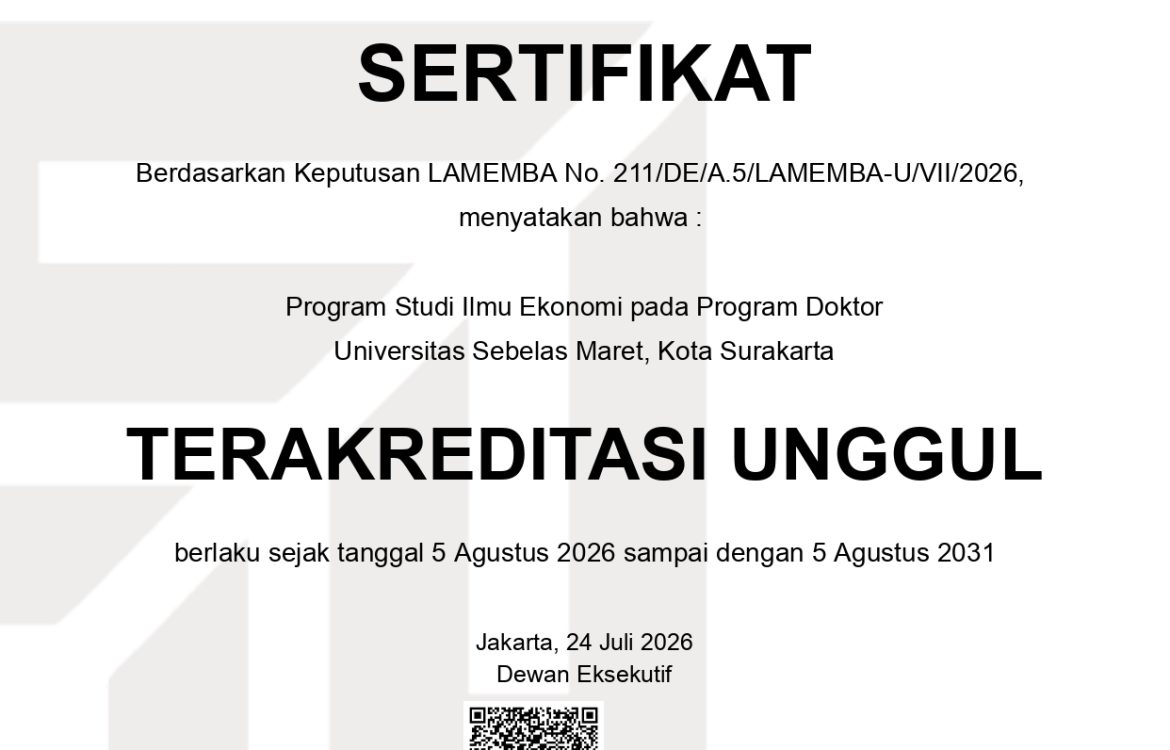
PDIE FEB UNS Retains LAMEMBA “Excellent” Accreditation
The Doctoral Program in Economics (PDIE), Faculty of Economics and Business (FEB), Universitas Sebelas Maret (UNS), has successfully retained the “Excellent” accreditation from the Independent Accreditation Agency for Economics, Management, Business, and Accounting (LAMEMBA) for a five-year period, effective from 5 August 2026 to 5 August 2031. This achievement marks another important milestone for PDIE FEB UNS in strengthening its quality assurance system and advancing continuous improvement. Prior to receiving the accreditation decision, the program underwent the LAMEMBA Site Assessment on 25–26 June 2026.
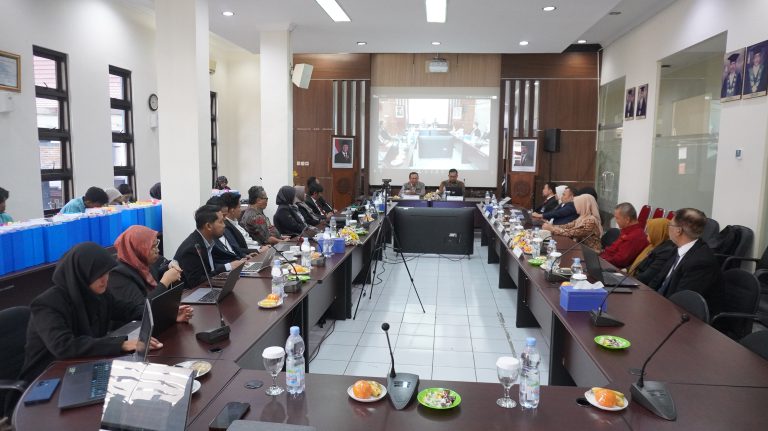
Opening Session of the LAMEMBA Assessment, 25 June 2026
During the assessment, the assessors verified the Self-Evaluation Report and Study Program Performance Report, conducted on-site observations, and held discussions with the faculty leadership, lecturers, Academic Support Staff, students, alumni, and graduate employers as part of the comprehensive quality evaluation process.
Responding to the achievement, Prof. Bhimo Rizky Samudro, Dean of FEB UNS, explained that the accreditation process is a shared responsibility between the faculty, as the Study Program Management Unit (UPPS), and the PDIE management team, which is responsible for preparing the required documentation. He emphasized that retaining the Excellent accreditation reflects the collective commitment of the entire FEB UNS community.
“We are grateful to have maintained our Excellent accreditation. However, this achievement is not merely something to celebrate. Over the next five years, we have the responsibility to continuously conduct self-evaluation and implement gradual improvements based on the recommendations provided by the assessors,” he said.
Prof. Bhimo further explained that the accreditation process is built upon a comprehensive self-evaluation document that serves as the foundation for the study program’s development. In addition, LAMEMBA provides recommendations that must be addressed through continuous improvement initiatives. “Each year, we are required to submit progress reports, including updates on how we have addressed the assessors’ recommendations. Throughout the five-year accreditation period, there are continuous stages of improvement that must be carried out in preparation for the next accreditation cycle,” he explained.
According to Prof. Bhimo, PDIE’s success in retaining the Excellent accreditation is supported by the faculty’s strong human resources, institutional governance, infrastructure, and well-established quality assurance system.
“Alhamdulillah, in terms of human resources, governance, infrastructure, and the quality of educational services, we are in a strong position. These strengths provide a solid foundation for all study programs within FEB UNS,” he said.
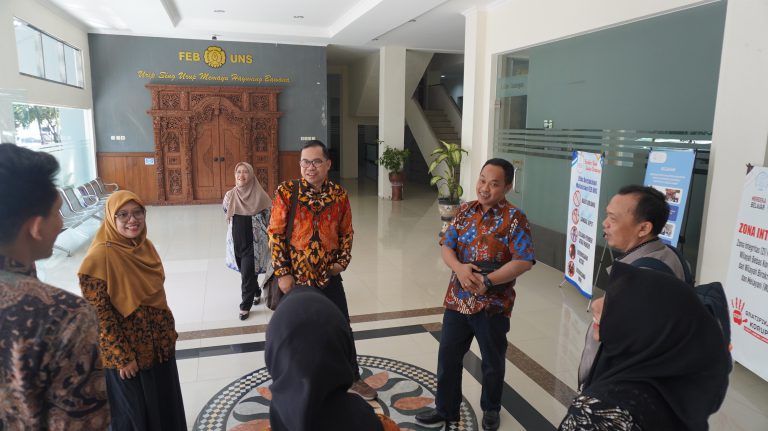
Inspection of PDIE Facilities, 26 June 2026
Nevertheless, the assessment also identified several areas for further development, particularly regarding the implementation of Outcome-Based Education (OBE) to ensure that educational outcomes create greater impact. The assessors also encouraged the program to further strengthen its scientific publications and Community Service activities, particularly by expanding their impact through international-level initiatives.
Prof. Bhimo added that maintaining the Excellent accreditation also brings significant benefits to students and the broader community. The accreditation is expected to further enhance public confidence in the quality of education offered by FEB UNS while strengthening the institution’s reputation. “Our students will have greater confidence knowing that their study program has achieved Excellent accreditation. They also become ambassadors for the institution through their networks, which we hope will increase interest among prospective students, particularly those seeking master’s and doctoral education,” he stated.
As a follow-up, FEB UNS remains committed to strengthening its quality assurance system, including the implementation of an early warning system to monitor students’ academic progress and identify potential study completion delays at an early stage.
“Quality assurance must continue to be strengthened, including continuous evaluation of the learning process and students’ study progress, so that potential delays can be identified early rather than requiring special intervention near the end of the study period,” he explained.
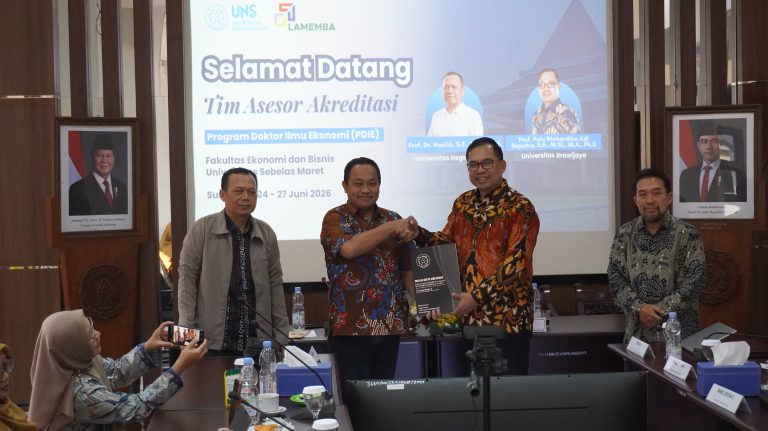 Prof. Bhimo concluded by expressing his appreciation to everyone who contributed to the accreditation process. “I would like to extend my deepest appreciation to the entire academic community, including the Dean Office, the PDIE management team, the task force, lecturers, Academic Support Staff, students, alumni, and our partners who supported this accreditation process. This achievement reflects our collective effort and is a responsibility that we must continue to uphold through ongoing quality improvement,” he concluded.
The successful renewal of the Excellent accreditation for PDIE FEB UNS supports the achievement of Sustainable Development Goal (SDG) 4: Quality Education by strengthening the quality assurance system and continuously improving the quality of higher education. The achievement also contributes to SDG 17: Partnerships for the Goals, reflecting the collaborative efforts of the academic community, alumni, and institutional partners in maintaining and advancing the quality of higher education.