

FEB UNS Islamic Economics and Finance Research Group Delivers Session on the Role of Accounting in Zakat Calculation
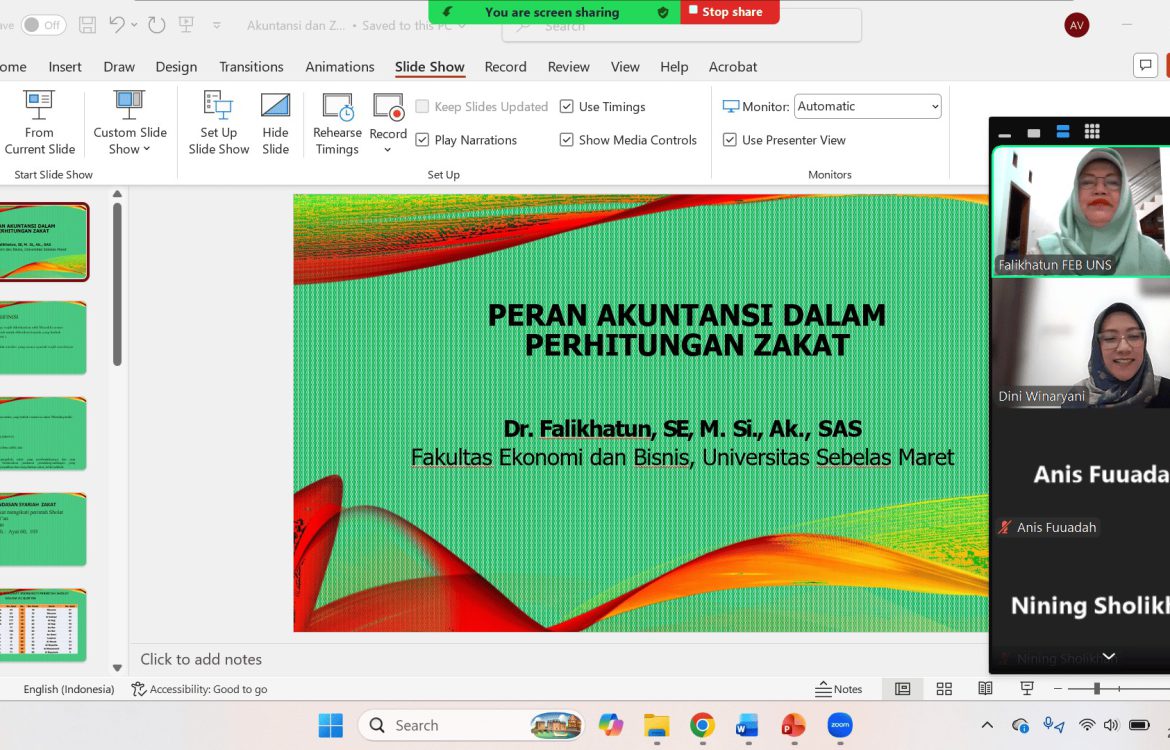
The Islamic Economics and Finance Research Group (RG) of the Faculty of Economics and Business (FEB), Universitas Sebelas Maret (UNS), in collaboration with the Surakarta Regional Board of the Masyarakat Ekonomi Syariah (MES) and the Central Java Regional Board of the Ikatan Ahli Ekonomi Islam (IAEI), organized an Islamic Economics and Finance Study Forum on Tuesday, 22 July 2026. The event was conducted virtually and attended by members of the Regional Board and the Alumni Forum of HMI Wati (Forhati) Solo Raya, Central Java, under the leadership of Presidium Coordinator Nining Sholikhah, S.E., M.Si.
During the session, Falikhatun presented a lecture on the importance of accounting in the calculation of zakat maal (wealth zakat). She explained that accounting plays a fundamental role in zakat calculation by supporting asset identification, asset valuation, the recording of liabilities and other obligations, as well as the determination of haul and nisab.
Falikhatun explained that asset identification enables individuals to distinguish between assets subject to zakat, such as cash and cash equivalents, precious metals, securities, and trading current assets and assets that are exempt from zakat, including fixed assets used for daily operational purposes.
She further noted that asset valuation is essential for determining the fair value of any assets as the object of zakat. This includes using current market prices for gold and the current cash equivalent value for trading inventories and investment assets. In addition, the proper recording of short-term liabilities and other obligations allows due debts payable within one year to be deducted from the total wealth of a zakat object.
Finally, she emphasized the role of accounting in determining haul and nisab by ensuring accurate records of the date on which ownership of assets begins (haul) and verifying whether the minimum threshold of wealth required for zakat (nisab) has been reached.
The study forum was expected to encourage members of the Regional Board and the Alumni Forum of HMI Wati (Forhati) Solo Raya, Central Java, to develop a deeper understanding of the role of accounting in zakat calculation, particularly for zakat maal. In the long term, the insights shared during the session are also expected to serve as a practical reference for Muslims in fulfilling one of their religious obligations as muzakki (zakat payers).