


UNS Researchers Enhance Geographical Indication Protection for Lemukih Robusta Coffee
Collaborative effort to improve legal protection and the economic value of regional flagship products continue through the Applied Research with Prototype Output – Kemdiktisaintek 2025 entitled “A Regulatory Model for Regional Flagship Products Based on Sustainable Tourism.” This study represents a cross-disciplinary collaboration between Sarjiyanto, S.E., MBA., Ph.D., from the Faculty of Economics and Business (FEB) and Dr. Abdul Qodir Jaelani, SH., MH., from the Faculty of Law, Universitas Sebelas Maret (UNS).
According to the Directorate General of Intellectual Property (DJKI) of the Ministry of Law and Human Rights of the Republic of Indonesia, a Geographical Indication (GI) is a sign indicating the area of origin of a product that possesses a certain reputation, quality, or characteristics attributable to geographical environmental factors, including natural factors, human factors, or a combination of both. A GI may take the form of a place name, word, image, letter, or a combination of these elements attached to a product.
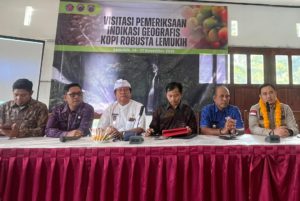
Research Team, DJKI Geographical Indication Expert Team, Regional Officials, and Village Stakeholders explaining the verification stages to the Lemukih Robusta Coffee GI Protection Community (MPIG), Buleleng
This research is driven by the need to enhance regional economic development through the protection of communal intellectual property, enabling regional flagship products to achieve stronger reputations and higher economic value. In 2025, the two UNS researchers completed a mentoring process for Robusta coffee farmer groups in Lemukih Village, Sawan Sub-district, Buleleng Municipality, Bali, to obtain GI recognition from the Ministry of Law and Human Rights of the Republic of Indonesia.
The assistance was conducted comprehensively, covering institutional development through the establishment of the Lemukih Buleleng Robusta Coffee Geographical Indication Protection Community (MPIG); mentoring in business management from production processes to marketing; preparation of the Geographical Indication Description Document outlining the product’s reputation, quality, and characteristics as a prerequisite for GI submission; and field verification by DJKI.

Identity Board of the Lemukih Coffee Geographical Indication Protection Community
From 24–27 November 2025, the DJKI Geographical Indication Expert Team led by Gunawan, S.Si., carried out field verification. This activity was supported by both UNS research team members, Sarjiyanto, Ph.D., and Dr. Abdul Qodir Jaelani. The verification process also involved various regional stakeholders, including the Head of the Buleleng Municipality Agriculture Office, Gd. Melandrat; the Head of the Buleleng Municipality Tourism Office, Gede Dody Sukma Oktiva Askara, S.Sos., M.Si.; the Village Head of Lemukih, Drs. I Nyoman Singgih; and the leaders and members of Subak Gunung Sari and Subak Manik Galih.
Through this series of processes, Lemukih Robusta Coffee is now approaching official recognition as a Geographical Indication product. This recognition is expected to create broader opportunities for improving farmers’ welfare, supporting village-level economic development, and promoting local potential managed in a sustainable manner.

Lemukih Robusta Coffee as a Regional Flagship Product that requires protection and optimization of its economic value as a foundation for regional economic development
Sarjiyanto, Ph.D., as a member of the research team and Advisor to the Lemukih Coffee MPIG, stated that the involvement of FEB UNS lecturers reflects the university’s commitment to providing direct community assistance.
The involvement of undergraduate lecturers from the Development Economics Study Program, FEB UNS, in assisting the Lemukih Village community represents one of the commitments of the FEB UNS academic community in supporting the achievement of the Sustainable Development Goals (SDGs), particularly SDG 1 (No Poverty), SDG 8 (Decent Work and Economic Growth), SDG 9 (Industry, Innovation and Infrastructure), SDG 11 (Sustainable Cities and Communities), SDG 12 (Responsible Consumption and Production), and SDG 16 (Peace, Justice and Strong Institutions).