

Promoting Reputable Publications, P4M FEB UNS Discusses Big Data Writing Strategies
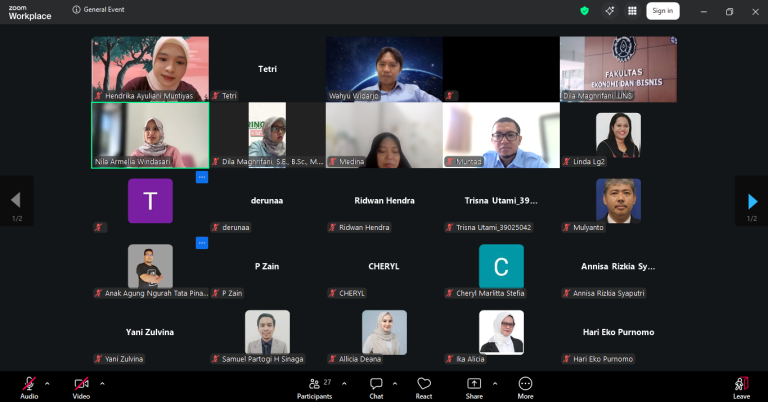
Center for Research and Community Engagement Development (P4M) at the Faculty of Economics and Business (FEB), Universitas Sebelas Maret (UNS), organized the Phase 2 Article Assistance Workshop carrying the theme “Strategies for Writing Big Data Analysis Articles” on Tuesday (14/4/2026) virtually via a Zoom Meeting. The event, which featured Nila Armelia Windasari, S.A., MBA., Ph.D., PCM., a faculty member from the School of Business and Management (SBM) ITB as the keynote speaker, was attended by faculty members and students of FEB UNS. The workshop aimed to enhance the ability of faculty members and students to compose high-quality scientific articles based on Big Data Analysis that are ready for publication in reputable journals.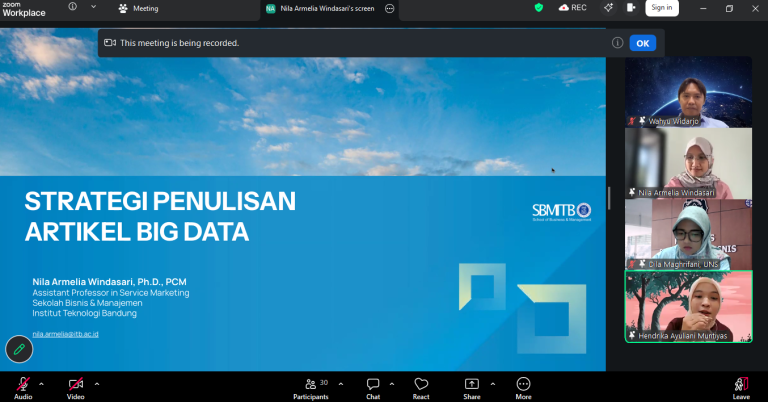
“Through this workshop, hopefully the participants can acquire a deeper understanding of writing strategies for big data-based articles, ranging from data acquisition, data processing, to publication techniques,” stated Dr. Wahyu Widarjo, S.E., M.Si., Head of P4M FEB UNS in his opening remarks.
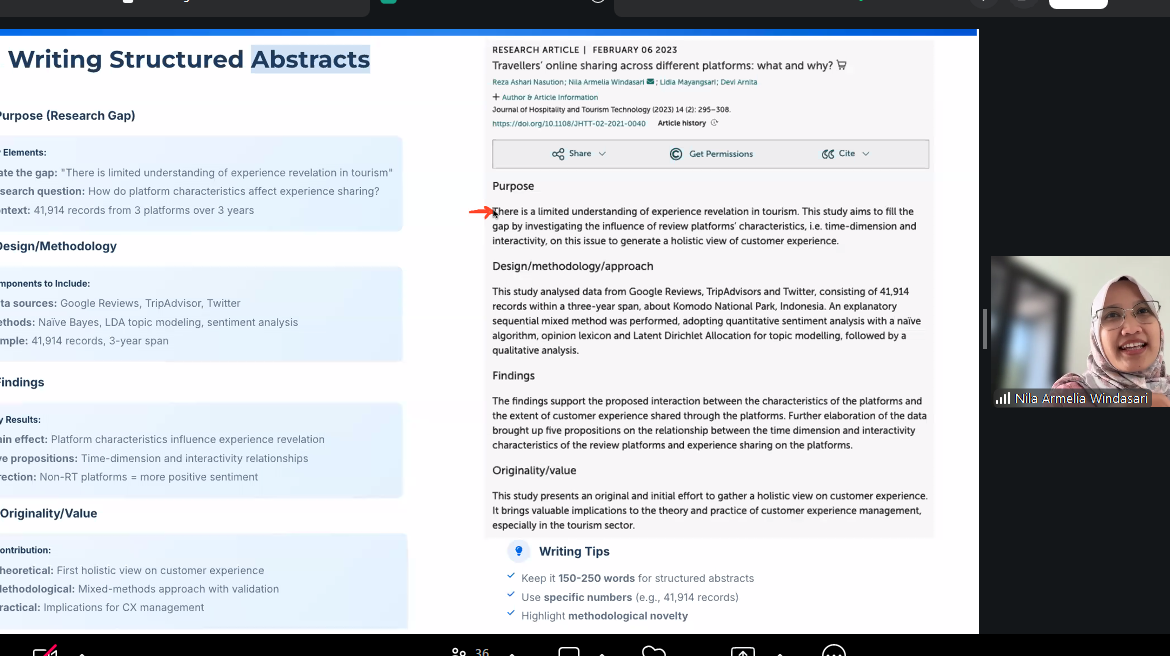
Nila Armelia Windasari presented strategies for writing scientific articles by emphasizing the importance of proper structure, methodology, and data presentation. She explained that article titles should be specific and contain no more than 16 words, while the abstract must capture attention and indicate the research positioning clearly. “The abstract must state the research positioning clearly, and the methodology needs to be explained transparently, including data processing procedures,” she explained.
 Furthermore, she reminded researchers to report research findings clearly without excessive descriptions, and to avoid claiming causal relationships that cannot be proven within large-scale observational data. During the session on research and publication strategies, she emphasized that publication quality holds more significance than quantity. She shared her routine of regularly reading articles from top-tier journals and incorporating multi-method approaches to build editor confidence in research findings. She also presented examples of secondary data-based research utilizing platforms such as Twitter, Google Maps, and TripAdvisor.
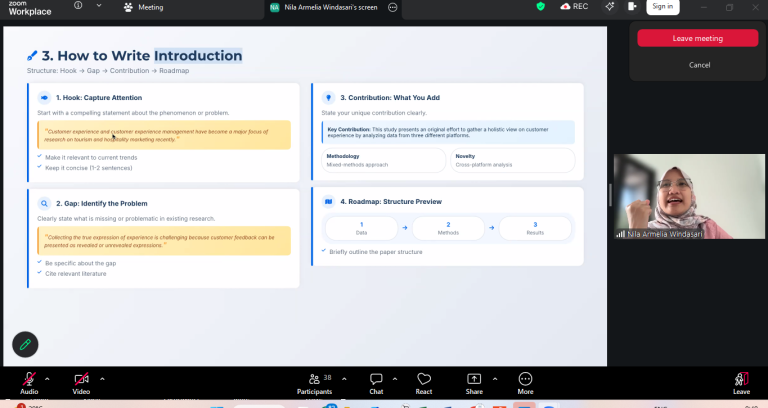
In discussing social media data research, she illustrated a study on Komodo National Park visitors that utilized more than 42,000 data records. She stressed the importance of clarity in the title, confidence in delivering the research contribution, and using keywords relevant to the academic community. Additionally, she outlined the structure for writing an effective academic introduction, which includes a hook, gap, contribution, and roadmap. She demonstrated that a good introduction contains only one main idea per paragraph and spans no more than 2.5 to 3 pages.
 Regarding the writing aspect, she also emphasized the importance of avoiding jargon and structuring the literature review based on conceptual logic rather than chronology, utilizing “forward snowballing” and “backward snowballing” techniques to track references. In the methodology session, she explained the necessity of transparency and accuracy in Big Data research, including data pre-processing steps such as tokenization, data cleaning, topic analysis, and validation. She asserted that the documentation of the research process must be done in detail, including disclosing research limitations. “It is important not to claim causality in observational research and to ensure the entire process is well-documented,” she remarked.
This activity is hopefully going to strengthen the academic capacity of FEB UNS faculty members in producing high-quality scientific publications that are globally competitive. More broadly, this workshop also contributes to the attainment of the Sustainable Development Goals (SDGs), particularly Goal 4 (Quality Education) through the development of academic competencies, and Goal 9 (Industry, Innovation, and Infrastructure) through the strengthening of data and technology-driven research.