

Guest Lecture Welcomes Three Speakers from RUDN University, Russia
Discussions around sustainability, inequality, and the role of the digital economy have become increasingly relevant in light of the rapid pace of digitalization and technological transformation. This dynamic shift raises critical questions about how technological advancements can support the sustainable use of resources.
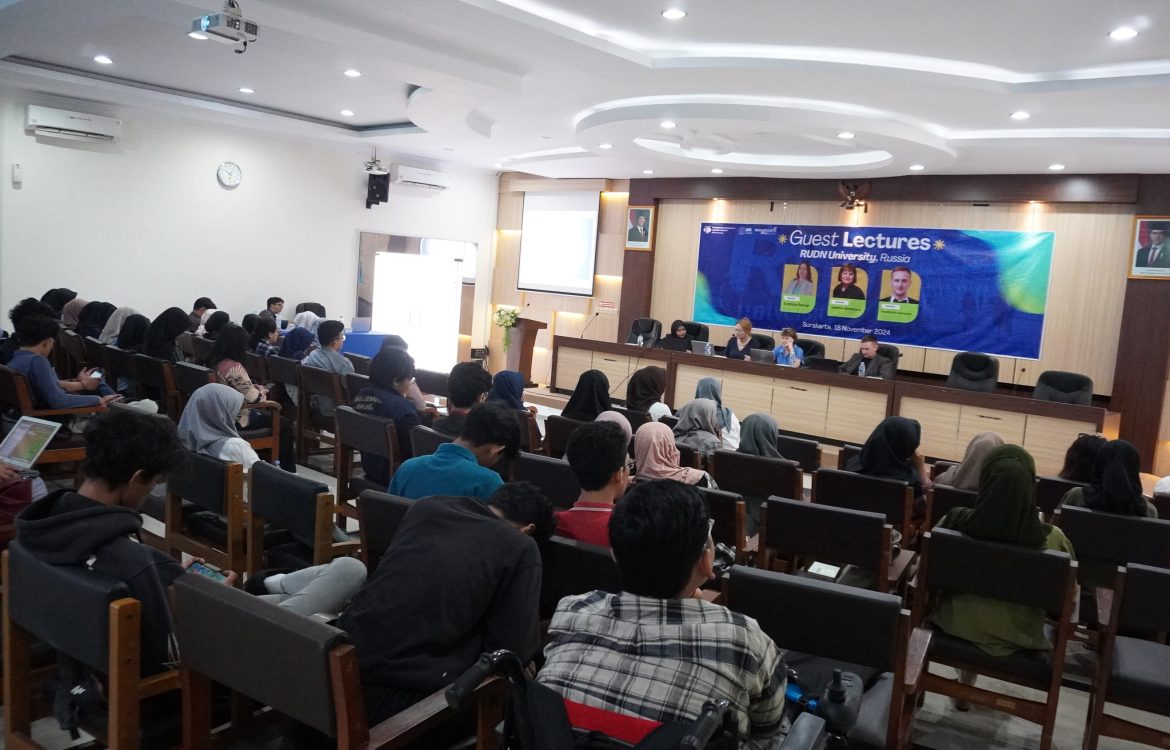
To explore these topics further, the Faculty of Economics and Business (FEB), Universitas Sebelas Maret (UNS) held another Guest Lecture session, featuring three speakers from RUDN University, Russia. The event took place on Monday, November 18, 2024, at the Konimex Hall, FEB UNS.
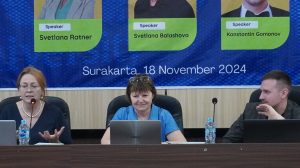
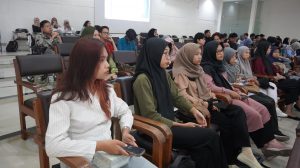 The three invited speakers were Prof. Svetlana Ratner from RUDN University; Assoc. Prof. Svetlana Balashova, Head of the Department of Economic and Mathematical Modelling at RUDN University and Executive Director of the International Center for Emerging Markets Research (ICEMR); and Assoc. Prof. Konstantin Gomonov, also representing RUDN University.
Prof. Svetlana Ratner opened the session with a presentation titled “ESG Investments for a Sustainable Future: Financial Instruments for Green Projects.” She introduced ESG as a method of selecting portfolio assets based on environmental, social, and governance criteria. Her talk also delved into the historical development of ESG and the barriers that currently hinder its growth.
 Following her, Assoc. Prof. Svetlana Balashova presented “Inequality and Digitalization.” Her session focused on three key topics: methods of measuring inequality, the definition of opportunity inequality, and the impact of digital transformation on inequality. She emphasized that access to information and communication technology, along with the development of digital skills within communities, has become a growing concern in many modern societies. However, reducing digital inequality requires more than just expanding ICT infrastructure; improving quality of life also depends on enhancing digital literacy and technical proficiency.
Assoc. Prof. Konstantin Gomonov then delivered a presentation titled “Analysis of the Level of Development of the Circular Economy (Using the Example of the European Union Countries).” According to him, the circular economy aims to align economic activities with ecological sustainability. In his research, he noted that circular economy performance is frequently assessed using tools such as Data Envelopment Analysis (DEA) and the Object-Oriented Approach.