

Master of Accounting FEB UNS Discusses Carbon Tax in the Journal of Accounting, Governance, and Organization Working Paper Forum
The carbon tax is one policy option that can be adopted by a country to reduce carbon emissions. This tax functions similarly to other taxes applied to specific products or activities, with calculations based on the level of contribution to carbon emissions produced by business or manufacturing activities.
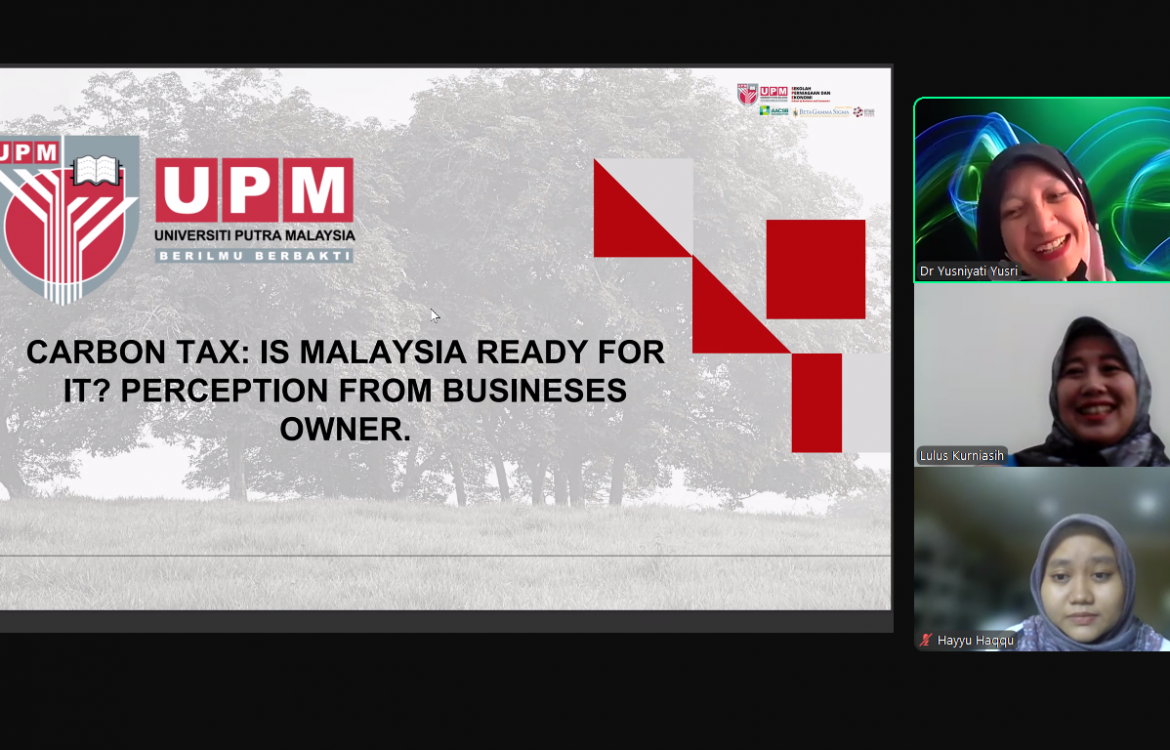
 This topic was discussed by Dr. Yusniyati Yusri during the Journal of Accounting, Governance, and Organization Working Paper Forum, held online on Friday, December 6, 2024. On this occasion, Dr. Yusniyati presented research titled “Carbon Tax: Is Malaysia Ready for It? Perception from Business Owner”, which explored the readiness of business owners in Malaysia ahead of the implementation of a carbon tax in the country.
“Carbon tax is related to a country’s carbon emissions. It is imposed to regulate emissions, with the cost paid by emitters—typically manufacturing companies or business owners. The amount is determined by each country,” explained Dr. Yus.
 However, she added that a deeper understanding of the carbon tax is essential, especially for business actors who will become the primary subjects of the policy. The key question then becomes: is a country truly ready to implement a carbon tax? This question formed the basis for Dr. Yusniyati’s quantitative descriptive research, conducted as a faculty member at Universiti Putra Malaysia.
In her study, Dr. Yus used a questionnaire distributed to business owners in the Petaling Jaya area of Malaysia. The findings showed that around 50% of respondents expressed concern about environmental issues. “About 50% of respondents believe the government is responsible and should take an active role in reducing environmental impacts, while 32% believe that households or individuals should be the ones taking responsibility,” she explained.
 Furthermore, the study found that 55% of respondents were already aware of the carbon tax, but only around 44% had a clear understanding of what it involves. In terms of carbon tax implementation in developing countries, 50% of respondents acknowledged its existence, but only 25% stated that they understood its effectiveness, while the rest either lacked confidence or had no knowledge about how effective the policy might be.
These findings reflect business owners’ level of acceptance toward carbon tax implementation, where the majority of respondents agreed that business actors should support the government’s policy plans.
At the end of the session, Dr. Yus expressed her gratitude to the organizing committee. “Thank you to the committee for inviting me to this working paper event. I hope this research will be valuable for the learning process in Indonesia,” she said.
Reflecting on Dr. Yus’s hopes, Dr. Lulus Kurniasih, Head of the Master of Accounting (MAKSI) Study Program, also shared her thoughts during the opening remarks. “Thank you to Dr. Yusniati and Prof. Agung Nur Probohudono. Today’s working paper session aims to provide insights into how to write academic articles and to explore current trends in tax research. The carbon tax topic is still very new, making it a promising subject for discussion and research with high novelty,” said Dr. Lulus.