

Visiting OJK, FEB UNS Students Encouraged to Become Financial Literacy Agents
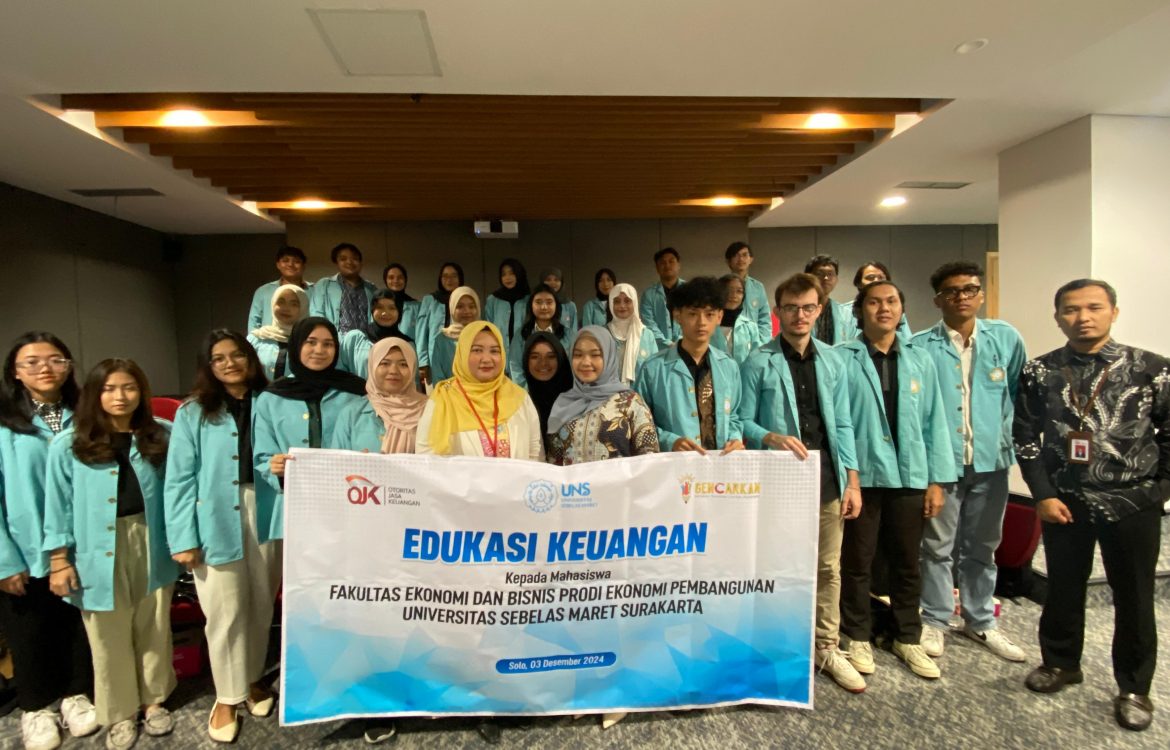
Thirty undergraduate students from the Development Economics Study Program (DESP), Faculty of Economics and Business (FEB), Universitas Sebelas Maret (UNS) conducted a field observation visit as part of their “Banking and Financial Institutions” course. The visit took place on Tuesday, December 3, 2024, at the Financial Services Authority (OJK) Office in Solo.
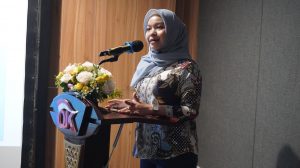 Ayya Agmulia Asmarani Islam, S.E., M.E., the course instructor for “Banking and Financial Institutions,” expressed her appreciation on behalf of the Head of the Development Economics Program, Muhammad Yusuf Indra Purnama, S.E., M.Rech., Ph.D. She extended sincere thanks to OJK Solo for warmly welcoming the students of FEB.
She noted that this visit was not only an academic activity but also a practical step in bridging the gap between classroom theory and real-world practice. The goal is to help students better understand how financial sector supervision contributes to and supports economic growth in Indonesia. Additionally, the session provided essential education about legal and illegal investments to help students avoid fraudulent or illegal schemes.
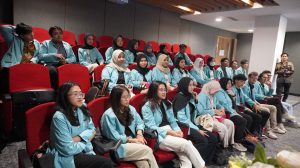 “Today, we are visiting the OJK Solo office to gain insights and education for our students. I encourage you all to actively participate during this financial literacy session. If you have any questions for the experts from OJK—such as how to avoid illegal investments or what it takes to build a career at OJK—this is the right time to ask. I hope all of you gain valuable insights from today’s experience,” she emphasized.
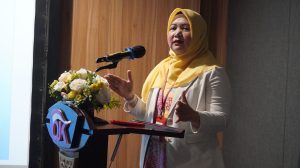 Susan Diah Kusumaningrun, Head of the Subdivision of Banking Supervision at OJK, welcomed the students and expressed hope that they would gain a deeper understanding of OJK and financial literacy in general. She cited data from the 2024 National Survey on Financial Literacy and Inclusion (SNLIK), which shows that Indonesia’s financial literacy index has reached 65.43%, nearly on par with its financial inclusion index of 75.02%. For comparison, in 2022 the financial literacy rate was at 49.68% while inclusion stood at 85.10%.
“Previously, our financial literacy was around 40%, and now it has reached about 65%, whereas financial inclusion, which used to be at 85%, has decreased to around 75%. These figures show a shift. This year, we see promising progress in literacy—people are becoming more educated,” she noted.
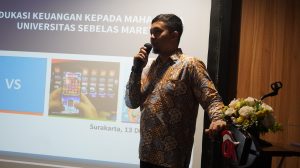 This is an achievement to be proud of. The educational efforts are evidently having an impact on the public. She expressed hope that the students, having received this education, would become extensions of OJK—spreading financial literacy in their communities.
Susan also advised students to be cautious when using digital financial services. She warned them about the rising danger of online gambling, which has already claimed many victims. According to her, gambling does not lead to wealth; instead, it leads to loss. “It might seem like you win at first, but in the end, you’ll lose even more,” she reminded the students.
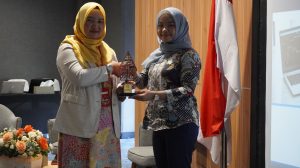 “One of our hopes from this visit is that you become more aware when encountering investment offers, whether online or offline. You need to critically assess whether the offer make sense. Nothing in life is instant—it takes effort. Learn about the product, check who regulates it, look at the results, and verify whether it’s legitimate. Search online to see if it’s ever been associated with fraud,” she advised.
During the visit, students also received further education on digital finance and internship opportunities at OJK, delivered by several speakers from the institution.