

FEB UNS Working Paper Forum Discusses Economic Valuation as the Basis for Payment Schemes for Environmental Services
Center for Research and Community Service Development (P4M), Faculty of Economics and Business (FEB), Universitas Sebelas Maret (UNS), held a virtual Working Paper Forum on Thursday, 5 March 2026. The forum featured Prof. Dr. Evi Gravitiani, S.E., M.Si., CBEc., from the Green Economy and Sustainable Development Research Group of FEB UNS, who presented findings from a study entitled “Ecology to Economy: Economic Valuation as the Basis for Designing a Payment for Environmental Services Scheme: A Field Study in the Pusur Sub-Watershed, Klaten.”
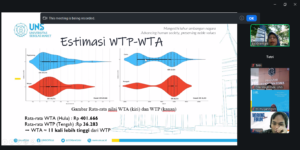
In her presentation, Prof. Evi explained that the research departs from the interconnection between ecological and economic dimensions in natural resource management, emphasizing that an economic valuation approach is necessary to assign measurable value to environmental services that have long remained invisible within conventional economic systems. She noted that environmental degradation in watershed areas can adversely affect water quality and availability, with upstream areas serving as providers of environmental services while mid- and downstream areas benefit economically from those water resources. “
Ecology and economics are inherently interconnected. Economic valuation serves as a bridge for understanding how environmental services can be assigned economic worth,” she explained.
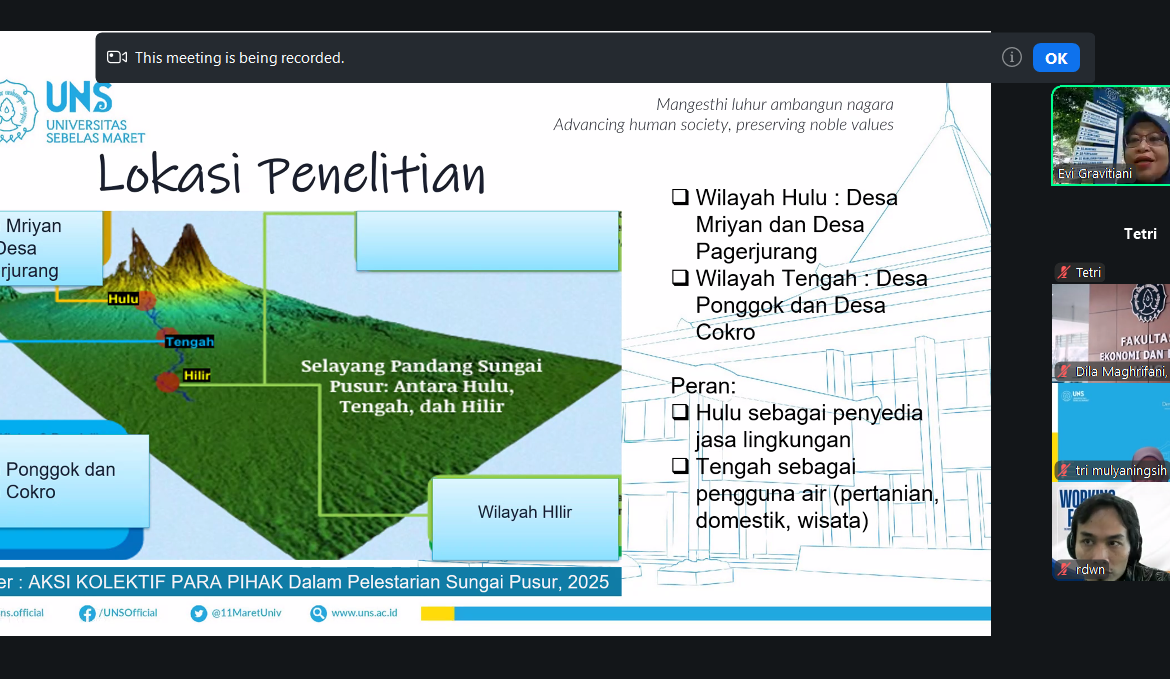
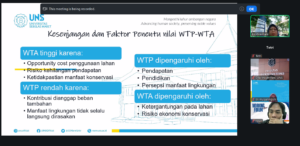 The study, conducted in the Pusur Sub-Watershed in Klaten Regency, involved community surveys to assess residents’ willingness to support environmental conservation efforts through a Payment for Environmental Services (PES) scheme. The research team measured two primary approaches: Willingness to Pay (WTP), referring to the readiness of water users to contribute financially to conservation efforts, and Willingness to Accept (WTA), referring to the readiness of upstream communities to receive compensation in exchange for maintaining environmental sustainability. The research sites encompassed upstream villages of Mriyan and Pagerjurang, as well as the mid-watershed villages of Ponggok and Cokro in Klaten Regency. All villages are selected for their direct involvement in the utilization and management of water resources within the Pusur Sub-Watershed. Employing a field survey methodology through the Contingent Valuation Method (CVM), the study engaged hundreds of respondents to identify community perceptions of the PES scheme.
The findings revealed a discrepancy between the willingness-to-pay values of water users and the compensation expectations of upstream communities, indicating that the effective implementation of a PES scheme requires policy support and institutional strengthening. Through the forum, participants had the opportunity to discuss the development of economic valuation-based environmental policy frameworks, while deepening their understanding of the importance of integrating ecological, economic, and social dimensions in natural resource management.
The Working Paper Forum also forms part of FEB UNS’s broader efforts to advance research and academic discourse contributing to sustainable development. In alignment with the Sustainable Development Goals (SDGs), the activity supports SDG 6 (Clean Water and Sanitation) through efforts to sustain water resources, as well as SDG 13 (Climate Action) and SDG 15 (Life on Land) through the strengthening of scientific inquiry into environmental conservation and sustainable ecosystem management.
In her closing remarks, Prof. Evi stressed the importance of preserving water resources, cautioning that while many assume water will never run out due to its natural cycle, that cycle can be disrupted if its supporting ecosystems, such as trees and water catchment areas, are no longer maintained. She explained that as long as the water cycle remains intact, water may be classified as a renewable resource. However, should that cycle be broken, water would exist only as a finite stock and risk becoming a non-renewable resource. To prevent this, she advocated for water conservation and the adoption of sustainable water use practices, including circular water use concepts such as repurposing ablution water for irrigating plants.
Prof. Evi expressed her hope that awareness of the need to preserve water would continue to be cultivated, ensuring that future generations are not confronted with water scarcity or prohibitively high-water costs, and called upon all participants to collectively safeguard water as a fundamental source of life.