

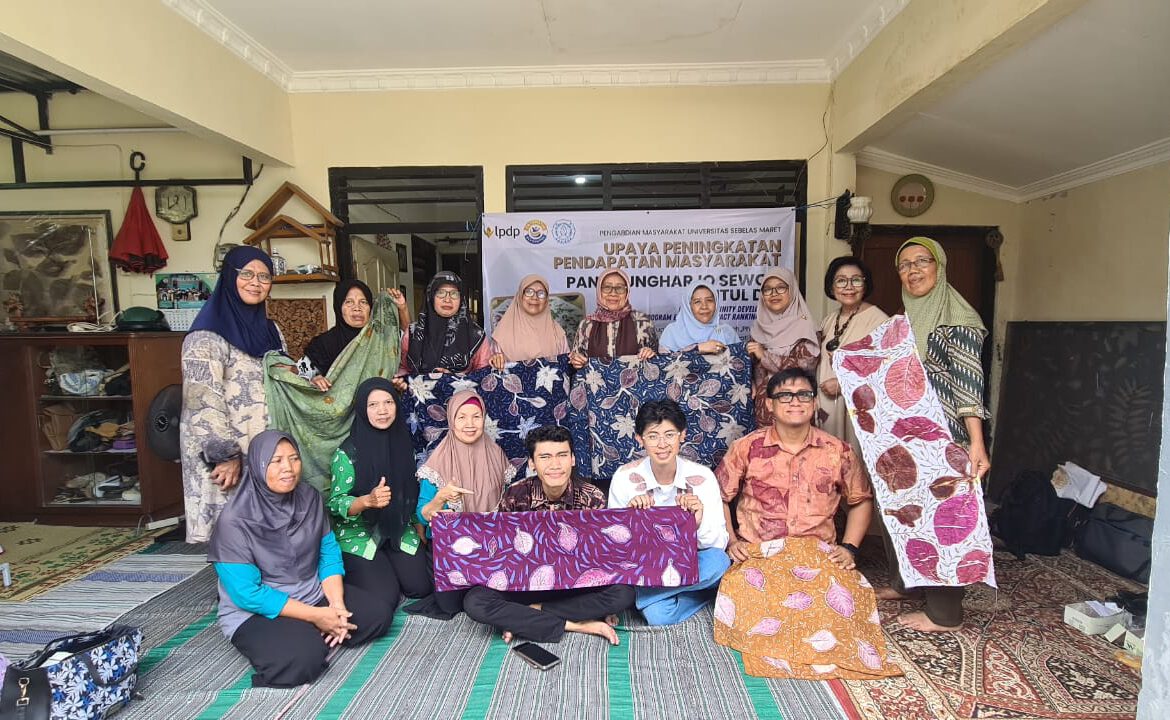
FEB UNS Team Conducts Community Service Program: Improving Batik Artisans Revenue in Panggungharjo, Bantul
A research team from the Faculty of Economics and Business (FEB), Universitas Sebelas Maret (UNS), implemented a Community Service Program under the “Equity the Impact Rankings 2025” scheme, aimed at enhancing the business capacity and income of communities in Panggungharjo, Sewon, Bantul, Special Region of Yogyakarta. The program was carried out by a team comprising Catur Sugiarto, Rahmawati, Hunik Sri Runing Sawitri, and Ratna Endah Santoso, in collaboration with international collaborator Junaid M. Shaikh from Universiti Teknologi Brunei, Brunei Darussalam.
The program was motivated by a number of challenges faced by the partner small and medium enterprises (SMEs), particularly in the production of natural dye-based batik. Prior to the program, production processes were carried out entirely by hand, resulting in limited production capacity and inconsistent dye quality, while the natural dyeing techniques that characterize the products were also prone to reduced colorfastness. In addition, a relatively simple business management system had led to poorly structured task allocation, and digital marketing had yet to be utilized to its full potential, conditions that collectively impacted production efficiency and constrained market expansion.
Through the program, the community service team implemented a series of integrated activities, beginning with socialization and field observation to map the needs of the partner community. This was followed by technical training in ecoprint and exotic batik production, including the optimization of the mordanting process, a chemical process to prepares fibers, using more environmentally friendly materials. The team also provided managerial mentoring covering basic bookkeeping, production planning, and the application of the plan–do–check–act management cycle. On the marketing front, partners were assisted in conducting SWOT analyses, developing promotional materials, and optimizing their use of social media and online marketplaces.
A key component of the program was the handover of appropriate technology assistance in the form of a batik feeder machine and supporting production equipment. This contribution is expected to improve work efficiency, accelerate the production process, and maintain quality consistency without compromising the artistic value of nature-based batik. The partner artisans also succeeded in developing a new product innovation through this program, exotic batik, a hybrid technique combining batik and ecoprint methods utilizing locally sourced natural dyes. This product offers superior colorfastness, greater design variety, and added value as a sustainable regional specialty product.
One of the partner artisans expressed appreciation for the mentoring provided by the UNS team, noting that the dyeing machine contributed significantly to the production process. “Thank you to Prof. Rahmawati and the team from UNS Solo for guiding us over the past several months. We also received a machine to assist with the dyeing process. The color results are finer and the process is more efficient compared to before, when everything was done manually, so the outcomes are far better,” she conveyed.
The community service program is expected to drive improvements in community business capacity while strengthening the development of creative products grounded in local resources. The activity is also consistent with the university’s commitment to advancing the United Nations Sustainable Development Goals (SDGs), particularly SDG 8 (Decent Work and Economic Growth) and SDG 12 (Responsible Consumption and Production), through the strengthening of community economic capacity and the development of environmentally responsible products.