

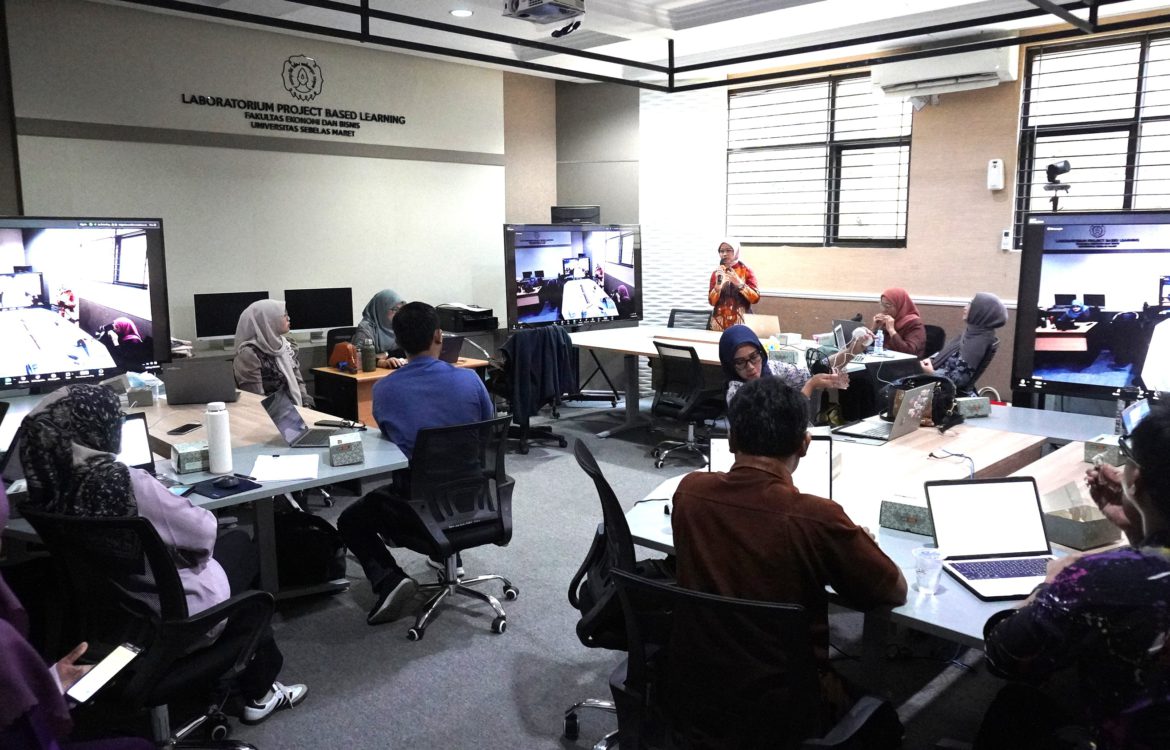
FEB UNS Project-Based Learning Laboratory Holds Workshop on Developing Semester Learning Plan and Teaching Materials for English in Economics and Business
The Project-Based Learning (PBL) Laboratory, Faculty of Economics and Business (FEB), Universitas Sebelas Maret (UNS), organized a Workshop on Developing Semester Learning Plans (RPS) and English Teaching Materials in Economics and Business on Friday, 19 September 2025, at the PBL Laboratory, FEB UNS. The workshop, attended by lecturers representing various study programs within FEB UNS, featured Dr. B. Yuniar Diyanti, S.Pd., M.Hum., lecturer of the Department of English Education, Faculty of Languages, Arts, and Culture, Yogyakarta State University (UNY), as the main speaker.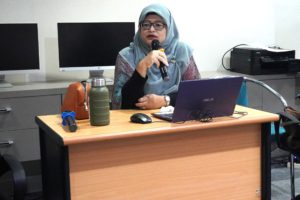
The workshop aims to enhance lecturers’ understanding and skills in developing contextual syllabi and English teaching materials tailored to the learning needs in economics and business. The outcomes of this workshop are expected to enrich students’ learning experiences and improve the overall quality of teaching at FEB UNS.
In her remarks, Prof. Tri Mulyaningsih, S.E., M.Si., Ph.D., Vice Dean of Academic and Research Affairs at FEB UNS, emphasized that graduates’ English proficiency still needs to be strengthened. This conclusion is based on feedback from employers and stakeholders, highlighting the need for stronger English skills among graduates. “This is one of the main motivations behind holding this workshop,” she stated.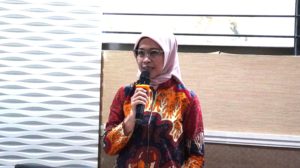
Prof. Tri also explained that at the faculty, English learning process solely relies on UPT P2B, to administers placement tests for new students. Test results are then converted into grades ranging from A to E, with students scoring below 60 provided one opportunity to attend a short training. As a result, many students settle for a grade of “C” and are less motivated to further improve their English skills. Aside from this provision, in accordance with Rector’s regulations, every study program is required to offer at least one English course designed specifically to fulfil its respective discipline needs. FEB thus needs to design an English for Economics and Business course that applies across all study programs. “It will be much easier if we have English learning modules that meet the needs of each study program,” Prof. Tri added.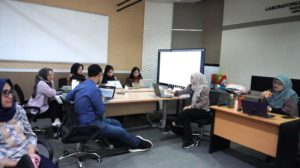
Meanwhile, Siti Khoiriyah, S.E., M.Si., Head of the PBL Laboratory, underlined the importance of strengthening English teaching materials to support graduate learning outcomes (CPL). “English proficiency is crucial in supporting our students’ competencies. Therefore, the syllabi and teaching materials must be designed to align with the needs of each study program and the CPL that have been formulated,” she said.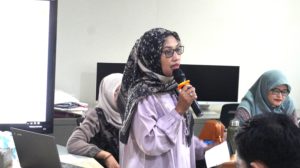
She further noted that this activity is part of a series of initiatives by the PBL Laboratory to support the Tri Dharma of Higher Education. Previously, the PBL Laboratory held a workshop on developing case-based and project-based learning modules. In the fourth quarter of this year, it will continue with a mentoring program for developing these modules. As one of seven laboratories within FEB UNS, the PBL Laboratory is dedicated to advancing collaborative and applied learning innovations.
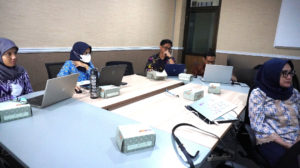 The workshop, which spanning from morning until late afternoon, was highly interactive. Participants actively engaged in discussions, Q&A sessions, and hands-on practice in developing syllabi and teaching materials. Their enthusiasm and active involvement reflected a strong commitment to enhancing the quality of English teaching within the faculty.
This initiative also supports the achievement of the Sustainable Development Goals (SDGs), particularly SDG 4: Quality Education, by strengthening lecturers’ capacity to provide relevant, internationally-oriented teaching materials. In addition, it contributes to SDG 8: Decent Work and Economic Growth, by improving the quality of graduates in economics and business who are ready to compete in the global market.