

FEB UNS Facilitates Students’ Skill Development Through Training and Certification of Competency
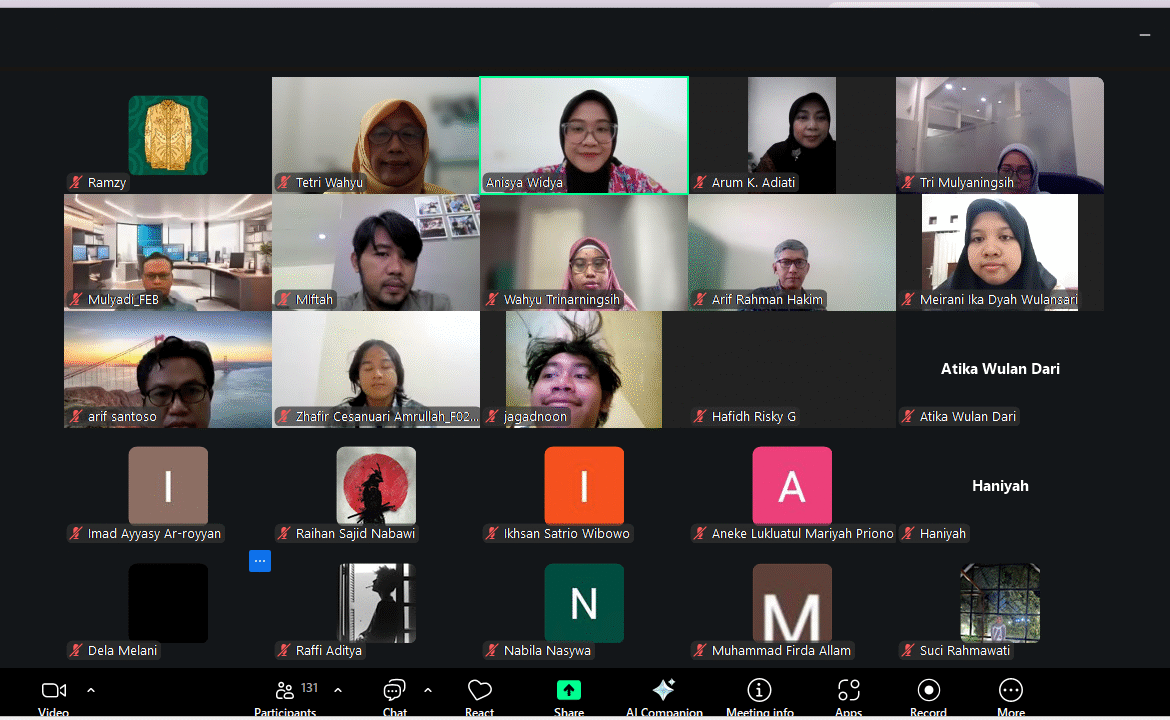
Faculty of Economics and Business, Universitas Sebelas Maret (FEB UNS), organized a Program Dissemination Session on Training and Certification of Competency offered by the various laboratories within FEB UNS. The session, held virtually via Zoom Meeting, was mandatory for all students of the 2022, 2023, and 2024 cohorts.
 In her opening remarks, Vice Dean of Academic and Research Affairs FEB UNS, Prof. Tri Mulyaningsih, S.E., M.Si., Ph.D., cited several survey results and news reports highlighting the major challenges in Indonesia’s labor market. She noted that job growth in Indonesia remains focused on quantity rather than quality, leading many job seekers to face difficulties due to a mismatch between their skills and industry needs.
A survey by Bank Indonesia showed that the national labor market is weakening, with around 44 million young people struggling to secure employment because of this skills gap. This phenomenon underscores the urgent need for relevant and competitive competency enhancement.  “We are striving to provide students with a wide range of extracurricular training programs that can strengthen their skills. Certification from these training programs is also a requirement to sit for the thesis examination. Students are required to join at least one, or more depending on their interests and the field they wish to explore further,” explained Prof. Tri.
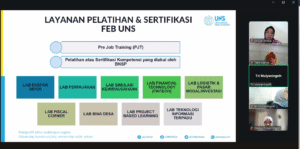
 She further expressed hope that the dissemination would provide students with comprehensive information to increase both their participation and the quality of engagement in training and certification programs. Currently, nine active laboratories at FEB UNS offer training and certification recognized by the National Professional Certification Agency (BNSP). These include: the Export-Import Laboratory, the Taxation Laboratory, the Entrepreneurship Simulation Laboratory, the Financial Technology (Fintech) Laboratory, the Logistics and Capital Market/Investment Laboratory, the Project-Based Learning Laboratory, the Information Technology Laboratory, the Village Empowerment Laboratory, and the Fiscal Corner Laboratory.
Each laboratory provides certification programs that are mandatory for students before their final thesis examination. These certifications are valid for three years and nationally recognized by BNSP, giving students a valuable advantage in the labor market.
“We hope these training and certifications will not only serve as a formality but also provide students with practical skills that they can apply in building successful and meaningful careers,” Prof. Tri added.
Vice Dean of Student and Alumni Affairs FEB UNS, Dr. Tastaftiyan Risfandy, S.E., M.Sc., Ph.D., also emphasized that seventh-semester students are required to participate in Pre-Job Training (PJT) as part of the training program. He further highlighted the collaboration with Universitas Gadjah Mada (UGM) on the topic of Green Jobs Skills for Impact. Green jobs, he explained, are not only environmentally friendly but also socially, economically, and ecologically impactful, integrating employment, environmental quality, and sustainable economic growth.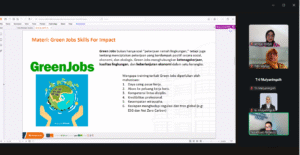
“Green Jobs training is essential for students to strengthen their competitiveness in the labor market, open new job opportunities, develop interdisciplinary competencies, build professional credibility, and even pursue entrepreneurship,” he stated.
The session proceeded with presentations from the heads of the nine FEB UNS laboratories, who detailed the training and certification programs available to students along with their schedules, enabling students to select the most suitable programs based on their interests and skill development needs.
The Training and Certification Program of FEB UNS laboratories is in line with the Sustainable Development Goals (SDGs), particularly Goal 4: Quality Education, which emphasizes access to quality education and skill development. In addition, with its focus on Green Jobs and village empowerment, the program also contributes to SDG 8: Decent Work and Economic Growth, and SDG 11: Sustainable Cities and Communities, by promoting inclusive and sustainable economic development.