

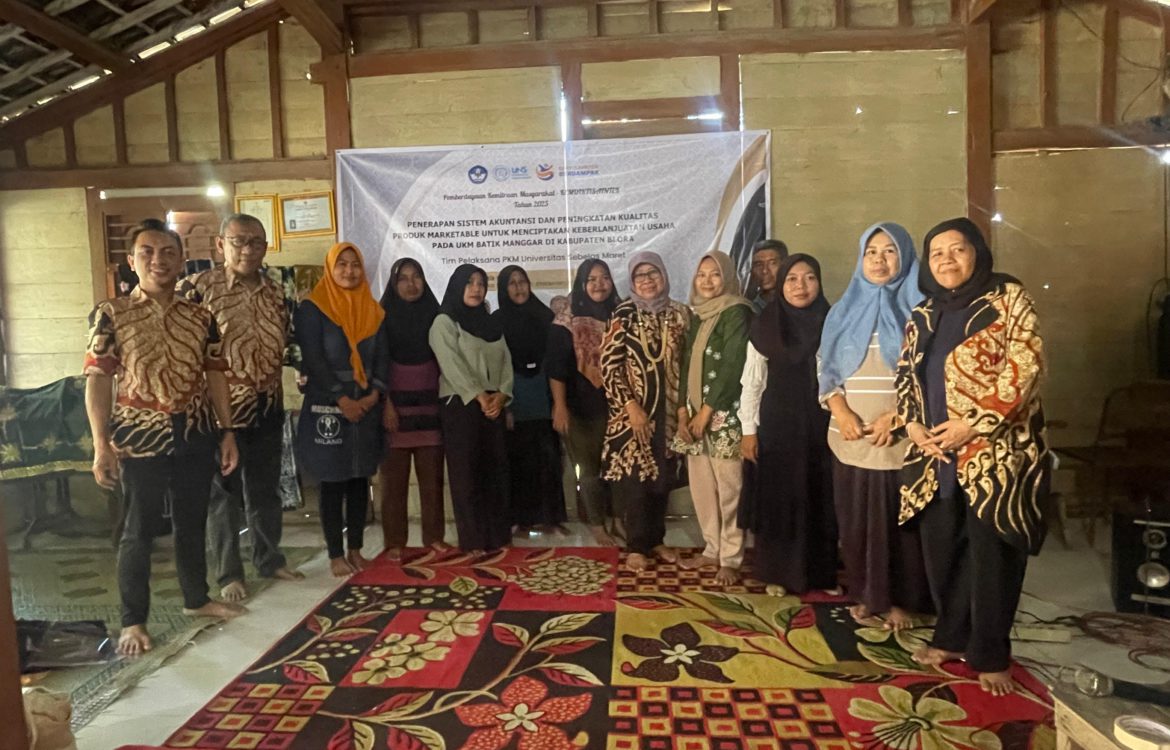
UNS Community Partnership Program Supports the Transformation of Batik Manggar Blora SMEs into Competitive Creative Economy Actors
Universitas Sebelas Maret (UNS) Surakarta maintains to strengthens support in empower Small and Medium Enterprises (SMEs). This time, the UNS Community Partnership Program (PKM) collaborated with Batik Manggar SMEs in Blora Regency, Central Java, through an assistance program designed to improve overall business management.
Led by Dr. Sri Hartoko, MBA., Ak., CACP., the research group team consisted of Prof. Dr. Hunik Sri Runing Sawitri, M.Si., a lecturer at the Faculty of Economics and Business (FEB) UNS, and M. Rudianto, S.E., S.Sn., M.Sn., a lecturer at the Faculty of Fine Arts and Design UNS. The program also involved two FEB UNS students, Salma Nadia Putri and Tsabita Widya Waskito. More than just training, the program aims to drive the transformation of SMEs into sustainable businesses.
The initiative, entitled “Implementation of Accounting Systems and Enhancement of Marketable Product Quality to Create Business Sustainability for Batik Manggar SMEs,” featured Prof. Dr. Rahmawati, M.Si., Ak., and Prof. Dr. Dra. Hj. Endang Dwi Amperawati, MM., as speakers. The program focused on three main aspects: strengthening business accounting systems, fostering product innovation, and expanding marketing channels.
According to Dr. Hartoko, Batik Manggar’s market is currently limited to local consumers in Blora. Therefore, innovative measures are needed to enable its products to compete in broader markets. “To improve efficiency and quality, we introduced paper stamp techniques in motif-making, developed prototypes for new products, and introduced feeder equipment to accelerate the production process,” he explained.
Beyond production, the team also enhanced marketing strategies and brand identity. Initiatives included the production of a business profile video, the development of an official website, social media management, and the opening of e-commerce channels. These steps are intended to expand Batik Manggar’s reach to regional and even national markets.
The program also created new job opportunities by involving local communities in the production process, thus fostering an inclusive economic ecosystem. Equally important, the collaboration served as a platform for knowledge transfer from the university to business practitioners, particularly in management, finance, digital marketing, and human resource development. “Batik Manggar has great potential. With better governance and innovative products, we hope this SME can become a role model for regional creative economy development,” added Dr. Hartoko.
Funded by the Ministry of Higher Education, Science, and Technology (Kemdiktisaintek) in 2025, this program supports the achievement of the Sustainable Development Goals (SDGs), particularly Goal 1 (No Poverty) and Goal 9 (Industry, Innovation, and Infrastructure). It also contributes to the university’s Key Performance Indicators (IKU), namely student involvement in off-campus activities and the direct application of lecturers’ research results in society. With this comprehensive approach, UNS hopes Batik Manggar will advance further as a creative economy icon of Blora, capable of competing in national markets.