

UNS Inaugurates New Professor: Prof. Dwi Prasetyani Highlights the Strategic Role of Women Entrepreneurs in Sustainable Development
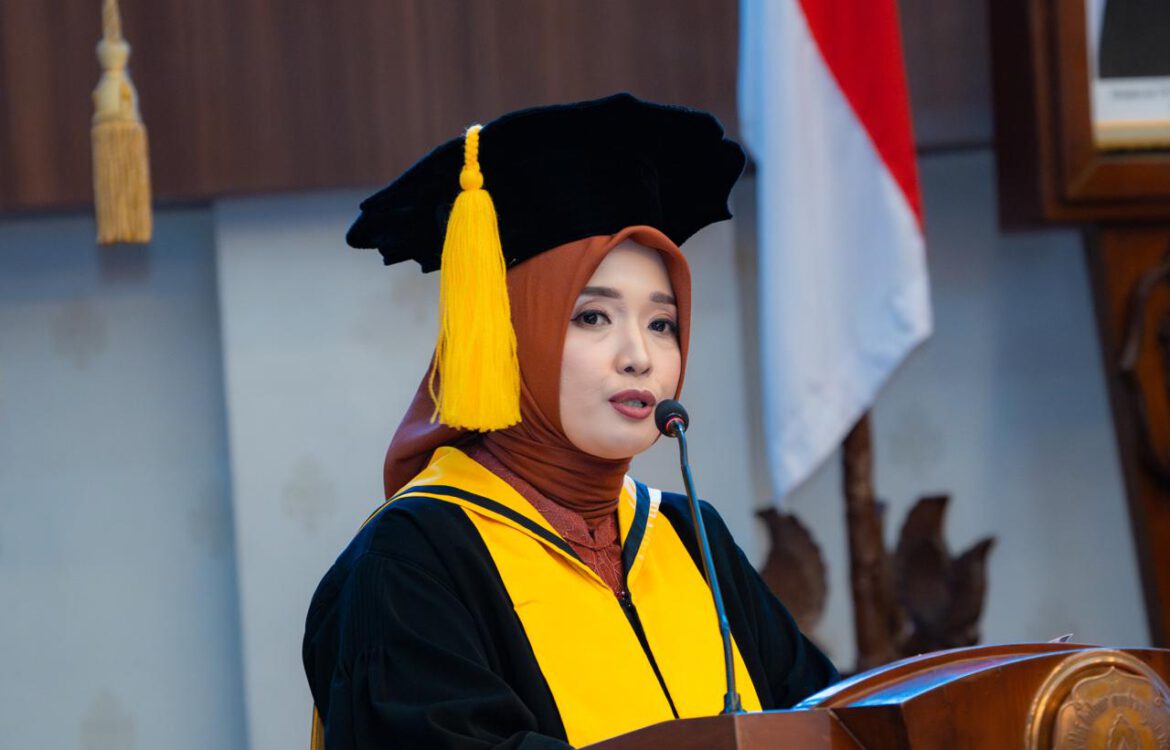
Universitas Sebelas Maret (UNS) once again inaugurated a new full professor in an official ceremony held at the Auditorium G.P.H. Haryo Mataram UNS on Tuesday (10/2/2026). Prof. Dr. Dwi Prasetyani, S.E., M.Si., CIPE., CPRM., was officially conferred the title of Professor in Entrepreneurship and Women’s Empowerment by the Rector of UNS, Prof. Dr. Hartono, dr., M.Si., alongside five other newly appointed professors within the university.
In her inaugural scientific oration titled “The Role of Women Entrepreneurs in a Holistic Perspective: Between Business, Family, Religion, Society, and Sustainable Development,” Prof. Dwi emphasized the strategic position of women entrepreneurs as both economic drivers and guardians of societal values.
At the outset of her address, she presented empirical data indicating progress in gender development in Indonesia, including improvements in the Gender Development Index (GDI), Gender Empowerment Index (GEI), and women’s participation in higher education. Nevertheless, she underscored that substantial gaps persist, as reflected in disparities in labor force participation rates, wage inequality, and women’s political representation that has yet to reach affirmative quotas.
“Progress has been achieved, but substantive equality still requires collective effort,” she asserted.
Prof. Dwi explained that married women often experience dual roles as mothers and professionals, frequently leading to tension between domestic and occupational responsibilities. In this context, entrepreneurship offers an empowering alternative, providing flexibility and autonomy.
Entrepreneurship, she argued, creates space for women to integrate business and family roles. Women’s entrepreneurial motivations often center on autonomy and flexibility, alongside economic necessity and self-actualization.
However, women entrepreneurs continue to face significant structural challenges, including gender bias, limited access to capital, domestic workload burdens, technological gaps, and restricted professional networks. Therefore, women’s empowerment strategies must be contextual, gender-sensitive, value-based, and culturally grounded rather than partial or fragmented.
A central theme of her oration was the integration of Islamic values into women’s entrepreneurial practices. Drawing from her research on Muslim women entrepreneurs in Surakarta, Prof. Dwi identified three principal domains of value implementation: business management, employee management, and financial management.
In business management, orientation extends beyond profit to encompass barakah (blessing) and the pursuit of divine approval. In employee management, principles of justice, timely fulfillment of rights, and spiritual development shape organizational culture. In financial management, prudence regarding riba (usury) and adherence to Islamic commercial principles (muamalah) serve as guiding frameworks.
“Business success is no longer measured solely by asset growth or revenue, but also by inner peace, role balance, and blessing,” she stated.
She described this shift as a behavioral transformation—from material orientation toward falah (holistic success in this world and the hereafter)—integrating business, family, and spirituality into a unified framework.
From a sustainable development perspective, Prof. Dwi affirmed that women entrepreneurs contribute meaningfully to the achievement of the Sustainable Development Goals (SDGs). Their contributions include poverty alleviation through job creation and local economic strengthening, promotion of gender equality, innovation in environmentally sustainable business practices, and community education and training initiatives.
According to her, women entrepreneurs are not merely economic actors but social change agents who generate systemic impacts on societal welfare.
Concluding her oration, Prof. Dwi emphasized the necessity of a holistic approach to women’s entrepreneurship development. She proposed five key dimensions: value-based entrepreneurship education; alignment with sustainable development principles; inclusive access to financing (including sharia-compliant schemes); support for local cultural and religious contexts; and reinforcement of religious values.
“Business can run in harmony with worship, economic achievement can coexist with family happiness, and sustainable development can be rooted in noble values,” she concluded.
Her oration ultimately reflects that women entrepreneurs are pillars of national development—not only as business actors, but as custodians of family harmony, preservers of culture, and practitioners of spiritual values within modern economic practice.