

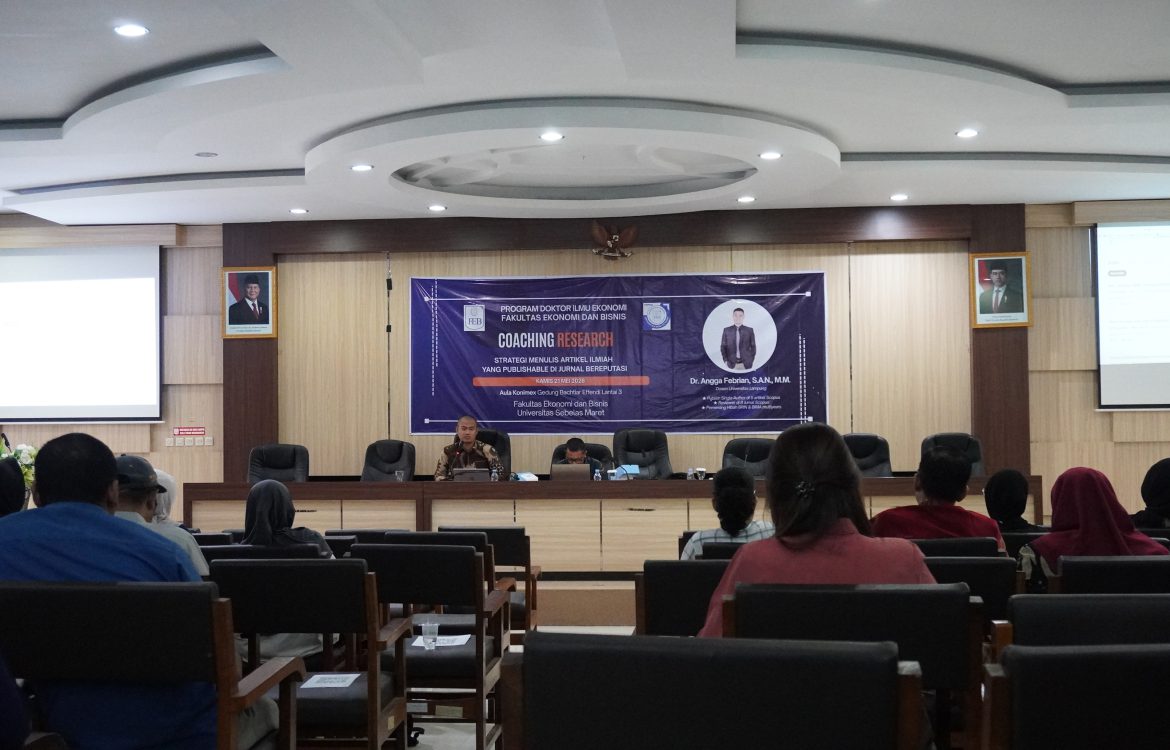
Research Coaching by Doctoral Study Program in Economics FEB UNS, Takes on the Strategies to Publish in Internationally Reputed Journals
The Doctoral Study Program in Economics (PDIE), Faculty of Economics and Business (FEB), Universitas Sebelas Maret (UNS), organized a research coaching event titled “Strategies for Writing Publishable Scientific Articles in Reputed Journals” on Thursday (21/5/2026) at the Konimex Auditorium, Bachtiar Effendi Building, FEB UNS. This event, organized in collaboration with the Doctoral Study Program in Economics Student Association (HMPDIE), featured Dr. Angga Febrian, a faculty member from Universitas Lampung who possesses an extensive publication record in reputable international journals and experience as a Scopus journal reviewer.
The Head of PDIE Study Program at FEB UNS, Prof. Agung Nur Probohudono, stated in his opening remarks that this research coaching serves as a platform to strengthen the academic capacity of doctoral students, particularly in meeting scientific publication requirements for graduation. He informed the speaker that the participants were at various stages of their doctoral studies, ranging from students still taking theoretical coursework to those preparing for their final closed dissertation defense. He further explained that the Doctoral Study Program in Economics at FEB UNS implements two curricula, the old curriculum and the new curriculum, both of which emphasize the significance of high-quality scientific publications.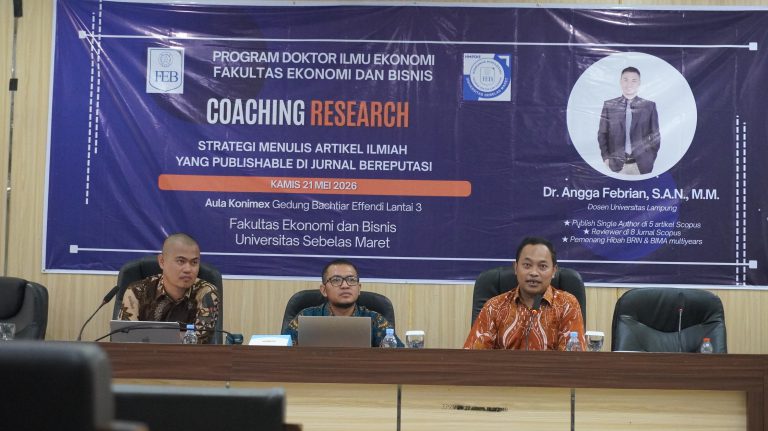
Prof. Agung also introduced the profile of the program, which currently has approximately 200 active students divided into three specializations: accounting, management, and development economics, alongside various sub-specializations within each field. The program also accommodates students from the PMDSU scholarship scheme, international classes, and collaborative classes with various institutions and corporate professionals.
During his speech, he highlighted the importance of maintaining the quality of scientific publications amidst the widespread rise of predatory journals. “Therefore, hopefully through this knowledge-sharing session with Dr. Angga, students can gain valuable strategies and tips to make their articles more acceptable and avoid falling into the trap of predatory journals,” he remarked.
He added that UNS has implemented a publication board or publication dissertation board mechanism to review articles prior to submission. Additionally, UNS maintains a journal whitelist to guide students in selecting appropriate target journals.
As the main speaker, Dr. Angga Febrian shared his experiences and practical strategies for writing scientific articles that meet the standards of internationally reputed journals. Based on his presentation, writing a scientific article requires strict attention to the IMRaD structure (Introduction, Methods, Results, and Discussion) to ensure a systematic research flow.
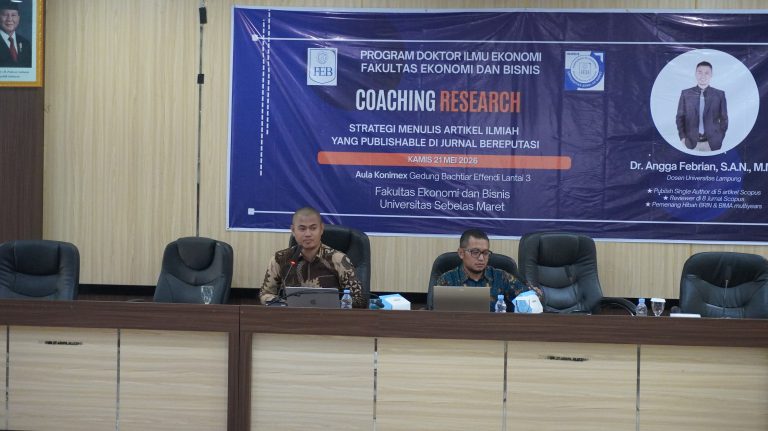 He emphasized the necessity of defining the research topic, model, constructs, and research instruments from the very beginning of the research process. Furthermore, he noted that researchers must demonstrate a clear sense of novelty by identifying various types of research gaps, including evidence gaps, theoretical gaps, methodological gaps, and empirical gaps.
In his presentation, Dr. Angga also pointed out several common mistakes in scientific writing, such as overly lengthy manuscripts, a lack of logical coherence, and the use of outdated or less credible references. He encouraged participants to utilize recent literature and to compose their articles in a concise, clear manner that focuses directly on the contribution of the study.
Dr. Angga himself has an established track record of publishing in Scopus Q1 to Q3 journals, serves as a reviewer for several reputable international journals, and is a recipient of multi-year research grants from BRIN and BIMA.
Through this event, the Doctoral Study Program in Economics at FEB UNS hopefully prepares doctoral students to produce high-quality, high-integrity scientific publications that contribute to the advancement of the institution’s global academic reputation. This academic initiative aligns with the achievement of the Sustainable Development Goals (SDGs), particularly Goal 4 regarding Quality Education and Goal 9 regarding Innovation and Research Development.