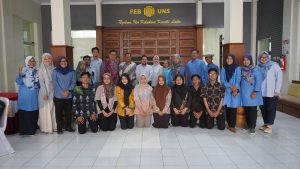
Reaccreditation of Master of Accounting Program at FEB UNS: LAMEMBA Assessors Conduct On-Site Visit
The reaccreditation process for the Master of Accounting (MAKSI) Study Program, Faculty of Economics and Business (FEB), Universitas Sebelas Maret (UNS), was held through an on-site assessment by the Institute of Accreditation for Economics, Management, Business, and Accounting Programs (LAMEMBA) on Monday–Tuesday, 24–25 February 2025. The assessors were Prof. Aulia Fuad Rahman, S.E., M.Si., D.B.A., Ak., CA., from Universitas Brawijaya and Dr. Arie Pratama, S.E., M.Ak., from Universitas Padjadjaran.
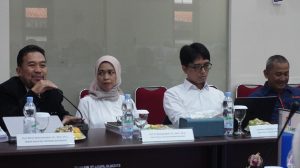 On the first day of the visit, the assessors were welcomed by representatives from the Institute of Educational Quality Development and Assurance (LPPMP) UNS, FEB UNS Dean Office, and the Head of the MAKSI Study Program. The team then proceeded to FEB for the field assessment.
In his welcoming remarks, Prof. Bhimo Rizky Samudro, S.E., M.Si., Ph.D., Dean of FEB UNS, expressed his appreciation and hope that the reaccreditation assessment would enhance the quality of the MAKSI Study Program. 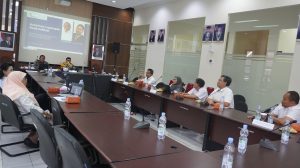
“We warmly welcome Prof. Aulia and Dr. Arie. Through this assessment, we sincerely hope to receive valuable input from the assessors, especially to help advance the MAKSI Program. This process will benefit not only the program’s management but also its students,” he said.
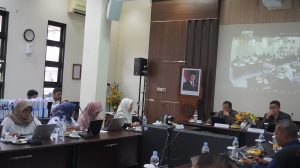 Prof. Aulia stated that the purpose of the assessment was to confirm the contents of the Self-Evaluation Document (DED) and the Study Program Performance Report (DKPS) that had been submitted by the accreditation team to LAMEMBA.
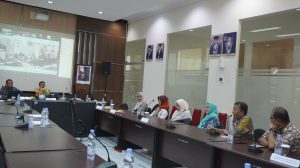 “We have received a substantial amount of information from the DED, DKPS, and other sources such as the website. This visit is primarily to confirm what has been presented. Essentially, field assessments are a routine part of our quality assurance process—specifically, external quality assurance. From what we observed in the DED, internal quality assurance is already functioning well,” he explained.
 The first day of the assessment included confirmation sessions with the Management Unit of the Study Program (UPPS), Internal Quality Assurance team, a review of supporting documents, and meetings with faculty members, alumni, external stakeholders, and students.
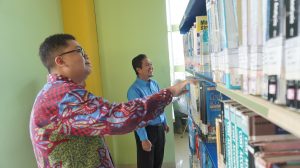
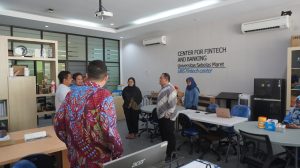 On the second day, the assessors visited several facilities at UNS and FEB, including the University Library, UNS Fintech Center, UNS International Office, P4M Room, FEB International Office, Fiscal Corner, Professors’ Room, various laboratory rooms, and MAKSI classrooms.
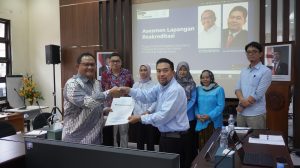 The visit concluded with the assessors’ independent work session, followed by the presentation of their recommendations and the signing of the official visitation report.