

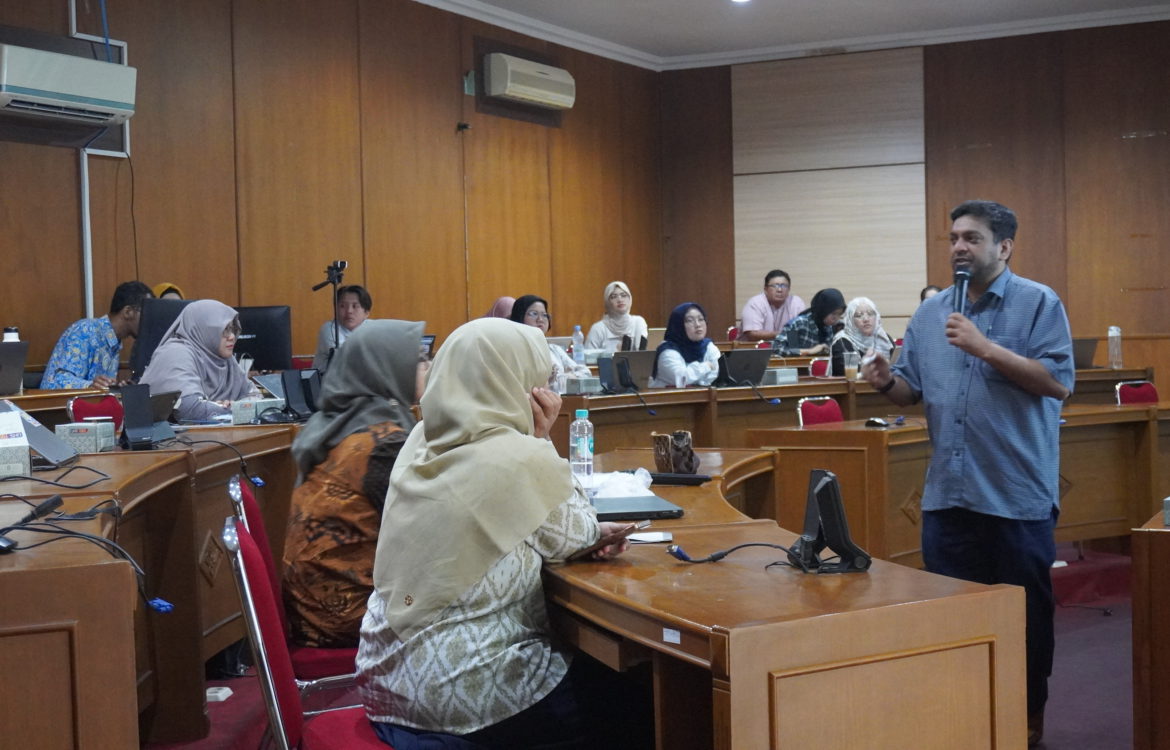
P4M FEB UNS Organizes Workshop on Creativity and Innovation in Business
The Center for Research and Community Engagement Development (P4M) of the Faculty of Economics and Business (FEB), Universitas Sebelas Maret (UNS), organized a workshop entitled Creativity and Innovation in Business on Thursday, 5 December 2025. The activity, held at the FEB UNS Teleconference Room, was attended by FEB UNS lecturers and students as part of efforts to strengthen academic and practical perspectives in the field of business innovation. The workshop featured Associate Professor Dr. Anuar Shah bin Bali Mahomed from the Faculty of Economics and Management, Universiti Putra Malaysia, as the main resource person.
 On this occasion, Dr. Anuar delivered a presentation highlighting the importance of creative thinking in driving business innovation amid rapid changes in the economic environment and technological development. He emphasized that there are two key aspects that determine the success of business innovation, namely technology and culture.
According to him, current technological advancement has provided easier access and substantial benefits for both business actors and consumers. This condition has become one of the main factors causing traditional businesses to face increasing difficulty in competing with digital-based enterprises.
In his presentation, Dr. Anuar discuss the development of e-hailing services such as Grab, Uber, and Gojek in Malaysia as an example. Based on empirical studies conducted, the emergence of e-hailing services has been shown to reduce the income of traditional taxi drivers. However, at the same time, these digital business applications proved its impact in reducing service costs borne by customers.
“Let us observe the emergence of e-hailing applications. This technology aims to provide convenience for users while also reducing the cost of delivering services. A similar situation can be seen in the banking industry today, as more and more banks moved away from physical office, they no longer open branch offices, because all processes can be conducted through applications,” Dr. Anuar explained.
Aside from discussing technological aspects, Dr. Anuar also examined the importance of cultural factors in business innovation. Referring to the cultural dimensions proposed by Hofstede, he emphasized that understanding the cultural context of a particular region is essential for business actors. Cultural differences influence consumer behavior and preferences, requiring business strategies to be aligned with local cultural characteristics.
 Concluding the workshop session, Dr. Anuar encouraged business actors and young generations who intend to enter the business sector to remain adaptive to change, particularly by understanding the consumption patterns of younger generations who will become the primary market in the future. “If businesses are unwilling to change and adjust to the preferences of younger generations, they will lose that market,” he stated.
Through this activity, FEB UNS contributes to the achievement of the Sustainable Development Goals (SDGs), particularly SDG 8 (Decent Work and Economic Growth) through strengthening business innovation capacity, as well as SDG 9 (Industry, Innovation, and Infrastructure) through the development of creative thinking and technological adaptation in the business sector.