


Collaboration of FEB UNS and Wageningen University & Research Presents: Impact Evaluation Workshop, Using Evidence in Policy Making
Faculty of Economics and Business (FEB), Universitas Sebelas Maret (UNS), in collaboration with Wageningen University & Research, organized the Using Evidence in Policy Making: Impact Evaluation Workshop on Tuesday, 2 December 2025, at UNS Tower. The activity featured Associate Professor Robert Sparrow from Wageningen University & Research as the main resource person. The workshop was attended by FEB UNS lecturers, postgraduate students from the Doctoral Program in Economics (PDIE), as well as undergraduate students with an interest in policy evaluation and social program impact analysis.
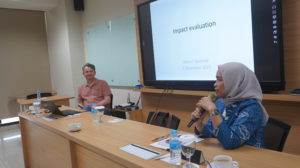 The event was opened by the Vice Dean for Academic and Research Affairs FEB UNS, Prof. Tri Mulyaningsih, S.E., M.Si., Ph.D., who expressed appreciation for the presence of Assoc. Prof. Robert Sparrow at FEB UNS. In her remarks, Prof. Tri emphasized that the workshop provided a valuable opportunity for the academic community to deepen their understanding of impact evaluation, particularly in supporting the formulation of public policies grounded in scientific evidence.
Previously, Assoc. Prof. Robert Sparrow had also contributed as a resource person in the Intensive Workshop on Applied Macroeconomics for Global Health. In the main session, Assoc. Prof. Robert Sparrow presented the fundamental concepts of impact evaluation, its objectives, and various methods commonly used to assess the impact of social policies. He explained that impact evaluation focuses on analyzing the causal effects of policies designed to address social problems or improve public welfare.
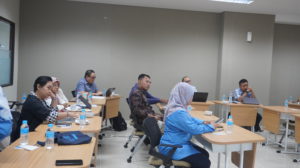 Several evaluation methods were introduced, including quasi-experiments, propensity score matching, instrumental variables, and difference-in-difference. In this workshop, Robert placed particular emphasis on the application of difference-in-difference and propensity score matching, which are frequently used in public policy research.
The workshop proceeded in an interactive manner through case study discussions, where participants were invited to analyze potential challenges in the evaluation design of social projects and to compare the application of two different impact evaluation methods.
Robert highlighted that the primary challenge in impact evaluation lies in identifying a credible control group. According to him, the presence of an appropriate comparison group is an essential prerequisite before conducting a scientific impact evaluation. “The main challenge in impact evaluation is related to the identification of a control group. The first question you need to answer before conducting an impact evaluation is whether you have a credible control group,” Robert explained.
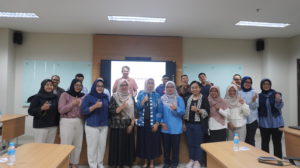 Through this activity, FEB UNS expects to enhance the capacity of academics and students in understanding and applying evidence-based policy evaluation, thereby contributing to the formulation of more effective public policies with measurable impact.
This activity supports the achievement of the Sustainable Development Goals (SDGs), particularly SDG 4 (Quality Education) through the advancement of academic and research capacity, as well as SDG 16 (Peace, Justice, and Strong Institutions) by promoting public policies grounded in evidence and scientific evaluation.