

Organizational Behavior Practitioner Lecture at FEB UNS Explores the Bright and Dark Sides of Corporate Culture in the Banking Industry
Management Study Program, Faculty of Economics and Business (FEB), Universitas Sebelas Maret (UNS), welcomed another industry expert in its Organizational Behavior Practitioner Lecture titled “The Bright and Dark Side of Corporate Culture: Perspective from the Banking Industry,” held virtually via Zoom Meeting on Saturday, 27 June 2026. The session featured Joko P. Fitriyanto, Senior Manager of Human Capital at Bank Mandiri Region VII/Jawa 2, who shared practical insights into the implementation of corporate culture within the banking industry.
Opening his presentation, Joko expressed his appreciation to FEB UNS for the opportunity to share his professional experience. He also hoped to meet students and faculty members in person during future practitioner lectures. “I am delighted to be part of this practitioner lecture. I actually wish we could have held it offline so we could better experience the atmosphere together. Hopefully, we will have the opportunity to meet in person in the future,” he said.
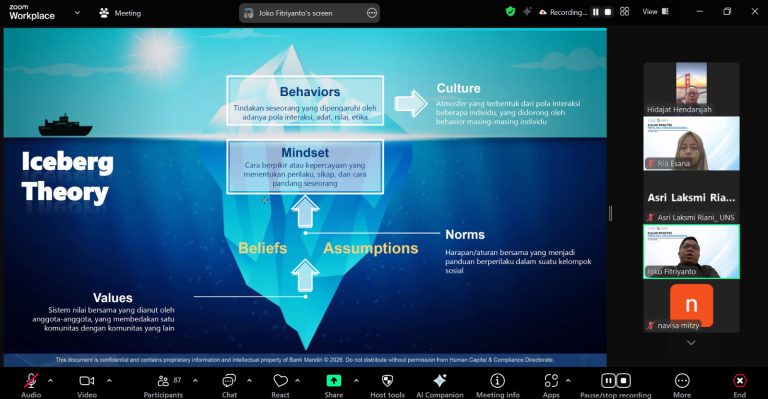 During the session, Joko explained that culture extends beyond social life and serves as a fundamental element of every organization. According to him, corporate culture comprises the values and norms that shape employee interactions while supporting the achievement of organizational goals. “Corporate culture is established in alignment with a company’s business objectives, vision, and mission,” he explained.
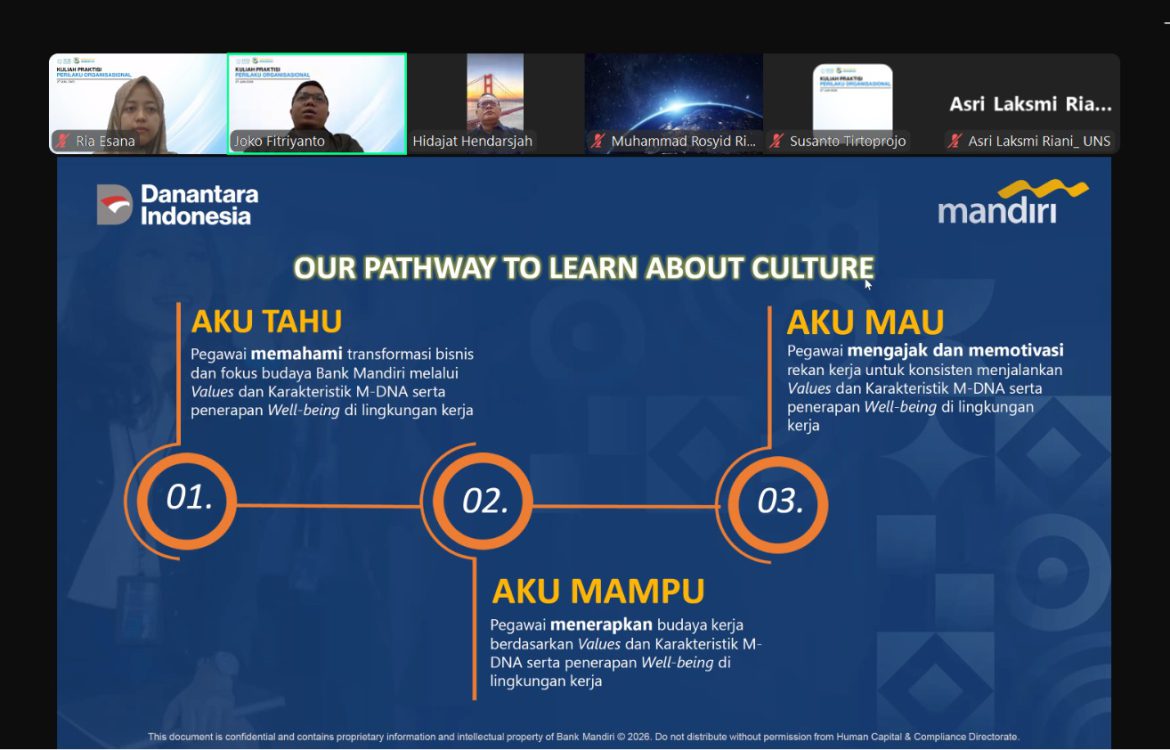
He noted that Bank Mandiri’s corporate culture is built upon three core principles: Aku Tahu (I Know), Aku Mampu (I Can), and Aku Mau (I Will). These principles encourage employees to understand the company’s business transformation, apply corporate values in their daily work, and inspire colleagues to consistently uphold those values. Joko also introduced the iceberg theory of organizational culture, explaining that observable behaviors are shaped by the underlying values, norms, and mindsets embedded within an organization.
“What people see is behavior, but that behavior is driven by the organization’s values, norms, and mindset,” he remarked.
In the banking industry, he emphasized that corporate culture cannot be separated from business strategy. A company’s long-term vision, he explained, can only be achieved when supported by a strong culture grounded in integrity. “Corporate culture and business strategy cannot be separated. Cultural values and business strategy must move forward together,” he stressed.
Joko also discussed the evolution of Bank Mandiri’s corporate culture following its establishment in 1998 through the merger of four state-owned banks: Bank Bumi Daya, Bank Exim, Bank Dagang Negara, and Bank Pembangunan Indonesia. During its early years, Bank Mandiri adopted the TIPCE values—Trust, Integrity, Professionalism, Customer Focus, and Excellence—as the foundation for employee conduct and organizational performance.
Beyond corporate culture, Joko highlighted the ongoing digital transformation within the banking industry. He explained that digitalization has fundamentally changed many operational processes that were once performed manually.
“We must be ready for digital transformation. Whether we like it or not, our roles have shifted, with greater emphasis on marketing and value-added customer service,” he said.
He cited innovations such as cardless transactions and QRIS payments as examples of how digital technology has become an integral part of everyday banking services. Amid increasing performance expectations and continuous organizational change, Joko emphasized the importance of employee well-being. At Bank Mandiri, employees are encouraged to pursue their interests and talents outside the workplace.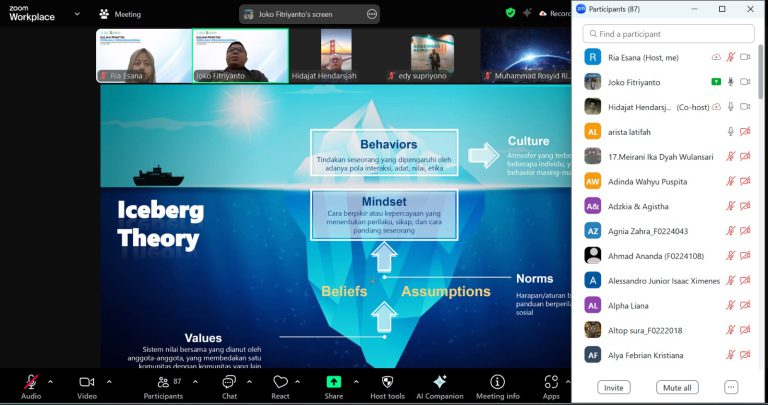
“We encourage our employees to continue developing their hobbies and talents so that their well-being remains a priority,” he explained.
He added that the company supports employees through initiatives focused on physical, financial, and social well-being.
During the discussion session, Joko also reflected on his own career journey, emphasizing the importance of balancing technical expertise with interpersonal skills. He shared that working while pursuing his studies helped him adapt more easily when entering the professional world.
“Technical skills are important, but soft skills are equally essential. My experience interacting with many people made it much easier to adapt when I started my career,” he said.
At the conclusion of the session, Joko reaffirmed Bank Mandiri’s commitment to strengthening its collaboration with FEB UNS through practitioner lectures, internship opportunities, and graduate recruitment. “Whenever recruitment opportunities are available, I encourage you to apply. Every application is part of the learning process. Many UNS alumni have built successful careers at Bank Mandiri,” he noted.
He also encouraged students participating in internship programs to demonstrate their best performance, pointing out that many interns have later been recruited as full-time employees at Bank Mandiri.
The practitioner lecture provided students with firsthand insights into how corporate culture is established, implemented, and transformed within the banking industry. Through the session, participants gained a deeper understanding of the strategic role of organizational culture, the importance of adapting to digital transformation, and the competencies required to succeed in today’s workplace.
The program also supports the Sustainable Development Goals (SDGs), particularly SDG 4 (Quality Education) through practitioner-based learning and SDG 8 (Decent Work and Economic Growth) by strengthening students’ readiness to enter the workforce.