

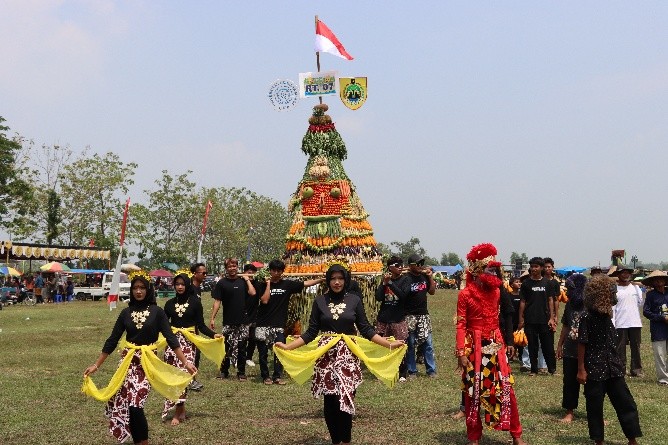
Local Wisdom Research Group of FEB UNS Promotes the Concept of “Cultural Commodification” through Community Engagement
Since 2022, the Community Engagement team from the Local Wisdom Research Group (RG), Faculty of Economics and Business (FEB), Universitas Sebelas Maret (UNS), has been assisting in the establishment of DEWI JAGUAR (Desa Wisata Jagung Kampung Bagor/Corn Tourism Village of Bagor) in Bagor Village, Miri District, Sragen Regency, by introducing cultural commodification as cultural events and tourism attractions.
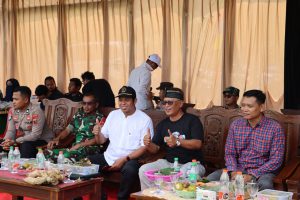
Local Wisdom Research Group Member with the Muspika Miri-Sragen
DEWI JAGUAR is a pioneering tourism village in Bagor Village, built upon the strength of local wisdom. Bagor Village, known as the largest corn producer in Sragen Regency, represents one of the unique cultural assets of the community. DEWI JAGUAR adopts the concept of Community-Based Tourism (CBT).
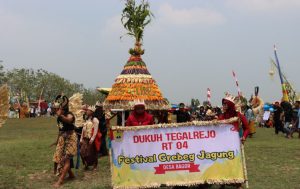
Festivities of Cultural performance and Gunungan in the 2nd Grebeg Klobot Festival
Cultural commodification refers to the commercialization of cultural artifacts through industrial processes emerging in the era of globalization. It involves transforming goods or services that traditionally followed non-market social norms into commodities within market systems. The distinct identity of Bagor as the largest corn producer in Sragen offers local and national appeal, which the Local Wisdom Research Group seeks to explore as a rural tourism attraction.
As a new tourism destination, DEWI JAGUAR requires local cultural traditions that can be showcased as regular cultural events. The Local Wisdom Research Group assumes that these values represent community assets that can be redefined into tourism events based on local wisdom, providing unique attractions for visitors.
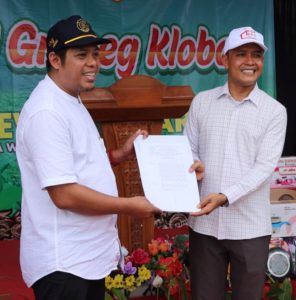
Dr. Sarjiyanto, S.E., M.B.A., Ph.D., officially handing over Rector’s Decree No. 2985/UN27/HK.02/2025 on the Designation of Bagor Village as an Assisted Village of Universitas Sebelas Maret to Bagor Village Head, Mr. Kukuh Riyanto, S.Pd.
Through the framework of commodification, local corn farming traditions can be transformed into high-value commodities that significantly enhance the appeal of Bagor Tourism Village. This idea aligns with expert perspectives, where local traditions and customs—such as the “Grebeg Klobot” corn husk festival—can evolve from agricultural practices into cultural events with financial value, eventually becoming a major tourist attraction.
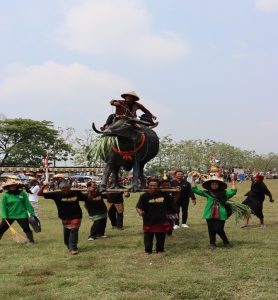 On August 24, 2025, the second “Grebeg Klobot” was held, showcasing significant progress compared to the previous year. The number of gunungan (ornamental mountain-shaped offerings) increased from 13 to 17, with more diverse and creative designs.
“This festivity reflects the commitment of the community in embracing the concept of cultural commodification through Grebeg Klobot, which has now become a cultural identity of Bagor Village and will continue to be preserved as a regular tourism agenda in Sragen Regency,” said Dr. Sarjiyanto, S.E., M.B.A., Head of the Community Engagement Team.
On this occasion, Rector’s Decree No. 2985/UN27/HK.02/2025 on the Designation of Bagor Village as an Assisted Village of Universitas Sebelas Maret was also officially presented.
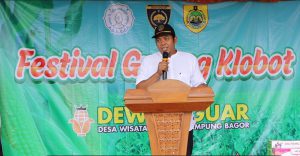
Head of the Community Engagement Team, Dr. Sarjiyanto, S.E., M.B.A., Ph.D., delivering his remarks
“This decree formalizes Bagor Village as one of UNS’s Assisted Villages through the Local Wisdom Research Group of FEB,” he added.
Community engagement activities through the development of DEWI JAGUAR and the cultural commodification of the “Grebeg Klobot” festival are aligned with the Sustainable Development Goals (SDGs), particularly Goal 8 on Decent Work and Economic Growth and Goal 11 on Sustainable Cities and Communities.
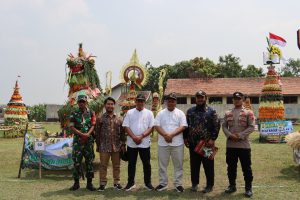
Members of judging panel in the Gunungan Competition of the “2nd Grebeg Klobot Festival”
By optimizing local wisdom as a community-based creative economy, this program not only supports local economic empowerment and job creation but also preserves culture and traditions as part of sustainable tourism development. This initiative demonstrates how local wisdom-based innovation can serve as an intelligent solution for advancing socio-economic progress while maintaining environmental and cultural sustainability.