


FEB UNS Hosted Workshop on the Integration of MBKM, Internship, and Community Service Program (KKN) to Strengthen Program Governance at the Study Program Level
The Faculty of Economics and Business (FEB), Universitas Sebelas Maret (UNS), held a Workshop on the Integration of Merdeka Belajar Kampus Merdeka (MBKM), Internship, and Community Service (KKN) on Thursday, July 10, 2025, at UNS Inn. The event was attended by Undergraduate Study Program Heads, Heads of Academic Subdivisions, Academic Staff and Operators, as well as the Personnel in Charge for the Internship at Study Program level. The workshop aims to build a common understanding and formulate guidelines for the implementation of internships and KKN within FEB UNS, in line with the latest policy of the Ministry of Education, Culture, Research, and Technology.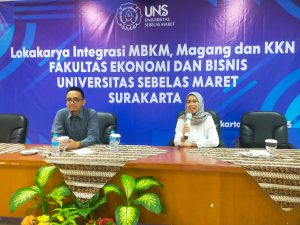
In her opening remarks, Prof. Tri Mulyaningsih, S.E., M.Si., Ph.D., Vice Dean of Academic and Research Affairs, emphasized that internships are one of the key components of MBKM Program, yet varying interpretations and inconsistent information still remain. The shift in terminology and scheme, such as from “MBKM Internship” to “Impactful Internship,” requires adjustments in governance and policies both at the faculty and study program levels.
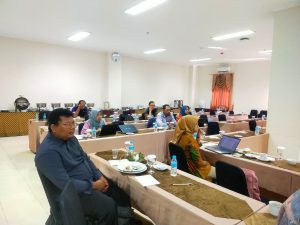 This initiative is a joint-effort undertaken by the Academic Affairs Division (Division 1) and the Student and Alumni Affairs Division (Third Division). In its presentation, the Division highlighted the importance of structuring mandatory internships, which apply generally to all study programs and must be reported to each program. On the other hand, there are also independently managed internships by students within the MBKM framework, now known as Impactful Internships.
“With this workshop, we hope to establish a common understanding among the faculties and study program administrators regarding the forms, procedures, and governance of internships and KKN. In addition, this activity also serves as a starting point for drafting internship implementation guidelines that align with the latest regulations,” said Prof. Tri.
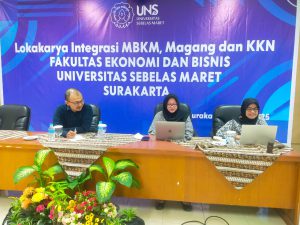 It is important to understand that the current implementation of internships refers to Ministerial Regulation (Permendikbudristek) No. 63 of 2024 on the Implementation of Student Internships. FEB UNS, through Division 3, is committed to preparing and launching the Internship Handbook in the near future. One of the key discussions was the positioning and relationship between Mandatory Internships, MBKM Internships, and Impactful Internships within the curriculum structure and academic policies.
The discussion managed to establish that although terminology and implementation platforms have changed, both the MBKM Internships and Impactful Internships share similarities, particularly in providing opportunities for students to engage in off-campus activities for up to two semesters. Through this workshop, FEB UNS seeks to ensure that the future implementation of internships and KKN can be carried out in an integrated and effective manner, in accordance with student learning needs and the dynamics of national policies.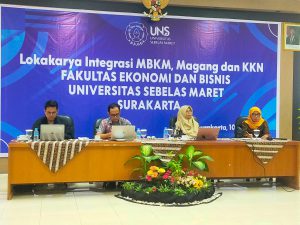
This workshop is also aligned with FEB UNS’s commitment to supporting the achievement of the Sustainable Development Goals (SDGs), particularly SDG 4 (Quality Education), by strengthening curricula based on real-world and community experiences; SDG 8 (Decent Work and Economic Growth), by preparing students with work readiness and skills relevant to industry needs; and SDG 17 (Partnerships for the Goals), by fostering collaboration between universities, businesses, government, and communities in the implementation of internships, KKN, and other MBKM programs.
With a more structured and impactful integration of MBKM, internships, and KKN, FEB UNS hopes to produce graduates who are not only academically excellent but also adaptive, collaborative, and capable of making tangible contributions to sustainable development at the local, national, and global levels.