

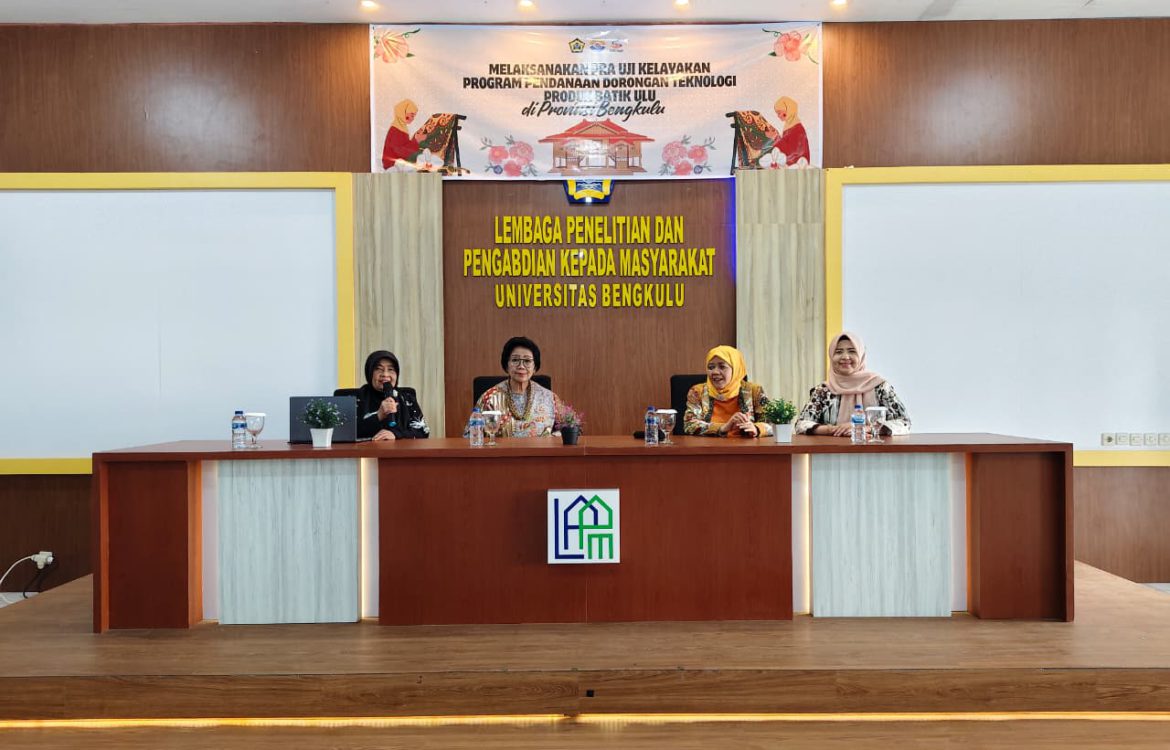
Expert Team Contributions in the Pre-Feasibility Assessment of Batik Ulu Bengkulu Technology Downstreaming
A continuous effort to develop Batik Ulu, as a cultural heritage of Bengkulu through a comprehensive study is carried out by the Expert Team of the Priority Research Downstreaming Program – Technology Acceleration. This assessment examines technology readiness, market potential, regulatory compliance, financial feasibility, and business model formulation to advance future commercialization prospects for Batik Ulu. The activity involves interdisciplinary researchers from various universities, each contributing expertise relevant to the program.
One of the key contributors, Prof. Dr. Rahmawati, M.Si., Ak., plays an essential role, particularly in the areas of finance, investment, and risk management. Her expertise is crucial in analyzing production cost structures, estimating investment requirements, projecting financial feasibility, and identifying risk mitigation strategies for batik MSMEs. Her extensive experience in MSME financial analysis and her portfolio of intellectual property works related to batik further strengthens the methodological rigor and recommendations produced by the team.
Other than Prof. Rahmawati, the expert team includes Dr. Siti Nurlaela, M.Si., Ak., CA. (Chair), with expertise in business models and the batik market; Dr. Ismiyanto, SH., MH., with expertise in legal and regulatory aspects, including intellectual property; Ratna Endah Santosa, S.Sn., M.Sn., specializing in batik design and textile arts; and Prof. Endang Dwi Amperawati, M.M., specializing in marketing and product commercialization.
Within this assessment, Prof. Rahmawati contributes primarily to the financial feasibility analysis and cost structure formulation for the development of new Batik Ulu technology; financial risk assessment related to the use of new dyeing and heating technologies, including the application of natural dyes derived from powdered bovine bone; and the reinforcement of MSME financial management, particularly through training on accounting digitalization and the preparation of sales dashboards. She also engages in evaluating both limited and extensive field trials to ensure cost efficiency and the potential for improved margins for artisans.
The team’s activities also include focus group discussions, problem mapping, technology development for production processes, training on intellectual property and trademarks, and the formulation of new motifs. All activities are conducted together with the Regional Development Planning Agency (Bappeda) of Bengkulu Municipality and Batik Ulu MSMEs to ensure that the proposed solutions can be applied directly in practice.
This assessment is expected to produce an innovative and financially viable downstreaming model for Batik Ulu that enhances the competitiveness of MSMEs, with analytical contributions from Prof. Rahmawati ensuring that each recommendation is supported by sound and sustainable financial considerations.
The activity supports SDG 8 (Economic Growth), SDG 9 (Innovation and Infrastructure), and SDG 12 (Sustainable Production) through MSME capacity development, technological innovation, and cultural preservation.