

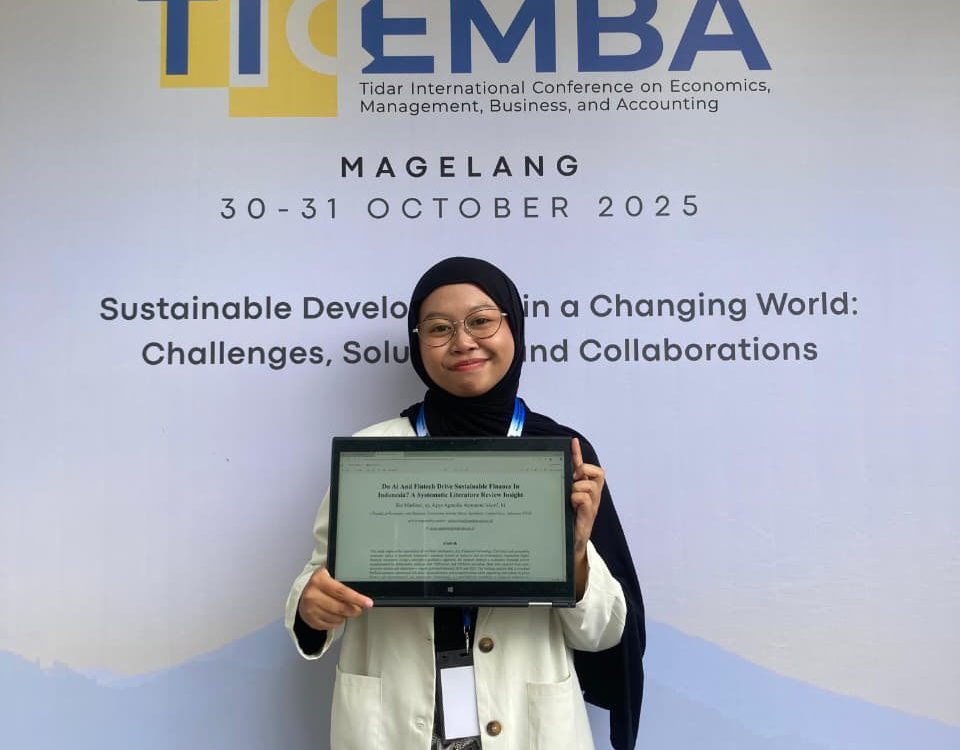
FEB UNS Student Wins Best Favorite Video Presentation at the International TICEMBA 2025
A remarkable achievement is once again accomplished by a student of the Faculty of Economics and Business (FEB), Universitas Sebelas Maret (UNS). Siti Marlina, a student of the Development Economics Study Program, FEB UNS, earns the Best Favorite Video Presentation award at the Tidar International Conference on Economics, Management, Business, and Accounting (TICEMBA) 2025, organized by the Faculty of Economics, Universitas Tidar (FE Untidar) on Thursday, 30 October 2025.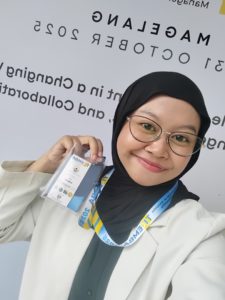
The international conference, conducted in a hybrid format at the General Lecture Hall (GKU) dr. H.R. Suparsono, is attended by 269 participants from various universities and research institutions, consisting of 200 onsite and 69 online participants. Taking on a grand theme of “Sustainable Development in a Changing World: Challenges, Solutions, and Collaborations,” TICEMBA 2025 serves as an important platform for cross-disciplinary academic collaboration in addressing global economic challenges in an era of transformation.
Marlin presents a scientific work entitled “Do AI and FinTech Drive Sustainable Finance in Indonesia? A Systematic Literature Review Insight” as one of the presenter in this international agenda. The article examines the role of Artificial Intelligence (AI) and Financial Technology (FinTech) in supporting sustainable finance in Indonesia through a Systematic Literature Review enriched with bibliometric analysis using VOSviewer and the PRISMA method.
Speaking to feb.uns.ac.id, Marlin explains that her research highlights the contribution of technology to enhancing green economic development. “AI and FinTech play a significant role in accelerating financial inclusion and promoting sustainable economic practices. Through technology, the distribution of funds, risk assessment, and the management of green investments can be carried out more efficiently and transparently,” she states.
The findings indicate that the integration of technology and sustainability forms a critical foundation for strengthening national economic resilience and accelerating Indonesia’s transition toward an inclusive and environmentally conscious digital financial system. For her conference presentation, Marlin produced a communicative and engaging video concept (link: https://www.youtube.com/watch?v=9rzWl3P7Q_Y).
“My video concept uses simple language and a storytelling approach to avoid rigidness. I wanted the audience to feel like they were being taken through a story rather than listening to a formal presentation. I also added subtitles to make the content easier to follow,” she explains.
TICEMBA 2025 becomes a valuable experience for Siti Marlina as it marks her first international conference. “I am very grateful to meet many incredible individuals from diverse backgrounds. Even though most participants were lecturers and postgraduate students, the experience motivated me to learn more and gain confidence,” she says.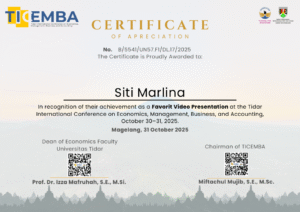
Further, Marlin states that her achievement is made possible under a supervision of FEB UNS faculty, Ayya Agmulia Asmarani Islam, S.E., M.E., “I received substantial guide from Ms. Ayya, starting from the early stages of writing the paper to my conference preparation. Her support was essential in deepening my understanding of the research and preparing myself as a presenter,” Marlin adds.
For Marlin, this award becomes a motivation to maintain her academic achievement. “This award is both an appreciation and an encouragement for me to keep contributing through research. Moving forward, I hope to explore further the intersection of economics, technology, financial inclusion, and sustainability,” she remarks.
This accomplishment reflects the strong research spirit of FEB UNS students in addressing global economic issues through scientific and data-driven approaches. Through TICEMBA 2025, Marlin not only brings pride to FEB UNS but also strengthens the academic reputation of Universitas Sebelas Maret in digital economics, sustainable finance, and financial technology research.
This achievement also aligns with UNS’s commitment to the Sustainable Development Goals (SDGs), particularly in supporting inclusive economic development, technological innovation, and environmentally oriented sustainable development.