

FEB UNS Rural Development Laboratory Explores Community Empowerment Potential in Tuni Coffee-Producing Villages of Maluku
The Rural Development Laboratory of the Faculty of Economics and Business (FEB), Universitas Sebelas Maret (UNS), organized an online Sharing Session via Zoom Meeting titled “Empowering Tuni Coffee-Producing Villages in Maluku: Practitioner–Academic Synergy Based on Local Wisdom” on Tuesday, 30 June 2026. The session featured Yulius Wibowo, Chair of the Advisory Board of the Maluku Coffee Foundation and Chair of the Supervisory Board of the Seribu Negeri Coffee Producers Cooperative of Maluku, along with Andre W.A. Sopolatu, Chair of the Cooperative’s Executive Board.
 In his opening remarks, Yogi Pasca Pratama, S.E., M.E., Ph.D., Head of the Rural Development Laboratory at FEB UNS, explained that the event was part of a series of discussions organized by the Rural Development Laboratory and the People’s Economy Research Group (RG) of FEB UNS to highlight local economic potential across Indonesia, particularly in the eastern regions.
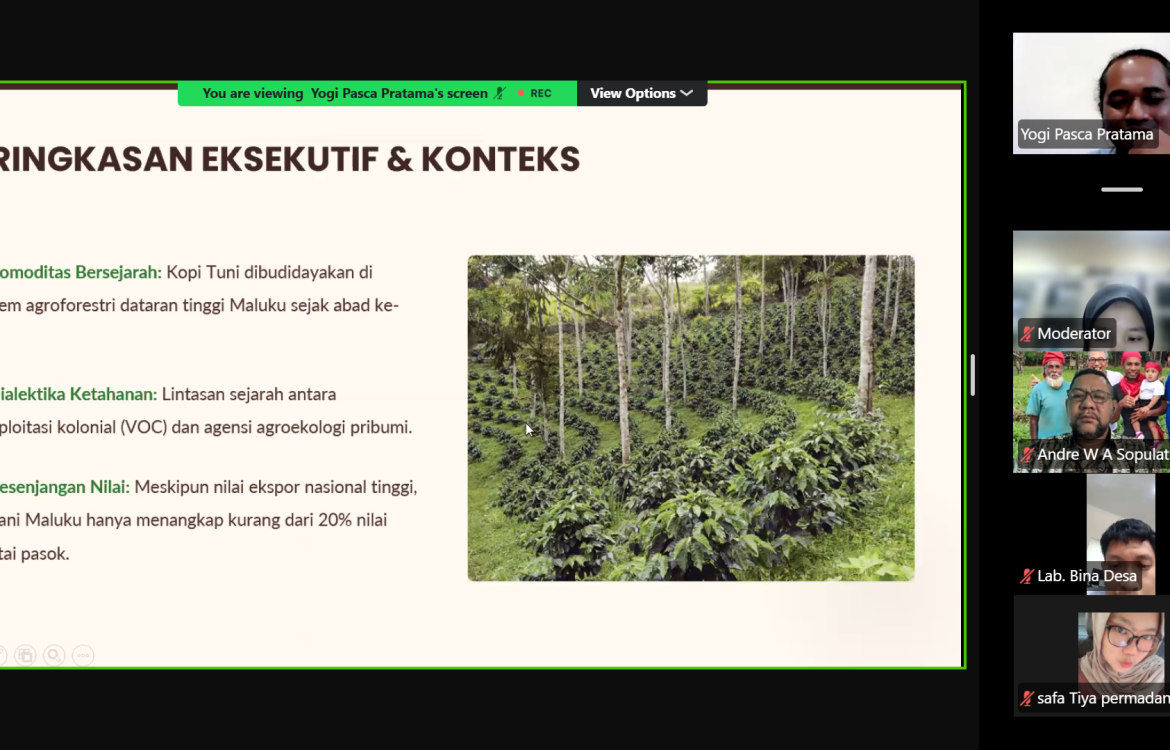
As an introduction, Yogi presented preliminary findings on the history and economic potential of Tuni coffee in Maluku. He noted that Tuni coffee is a historic commodity cultivated in the region since the seventeenth century and possesses significant economic value.
“Coffee has substantial export value, yet communities in Maluku capture only a small share of the supply chain’s total value. Therefore, collaborative efforts are needed to improve governance and enhance farmers’ welfare,” he said.
During the main presentation, Yulius Wibowo shared that his interest in Tuni coffee began after tasting Maluku coffee and discovering its distinctive flavor. His travels across Maluku convinced him that Tuni coffee is an endemic variety that has long been cultivated and recognized by local communities.
He explained that each village produces coffee with its own unique flavor profile, influenced by local environmental conditions and agroforestry cultivation systems that integrate companion crops such as durian, cloves, and cocoa.
“No two villages produce coffee with the same flavor. We want every community to take pride in the coffee grown in its own region,” he remarked.
According to Yulius, previously the low price of coffee sold directly by farmer almost drove Tuni coffee to extinction as many farmers shifted to other commodities. This situation prompted the establishment of the Maluku Coffee Foundation in 2018, which developed a comprehensive roadmap for Tuni coffee development from upstream to downstream activities, including the creation of the Seribu Negeri Coffee Producers Cooperative of Maluku. The foundation is also preparing to establish the Maluku Coffee School as a center for education and capacity building for coffee farmers.
Meanwhile, Andre W.A. Sopolatu explained that the cooperative was established to promote a fairer governance system for coffee farmers. Through technical assistance and improved purchasing mechanisms, farmers have experienced a significant increase in the prices they receive. “Within our cooperative system, we prioritize fairness for our members while encouraging farmers to continue cultivating Tuni coffee throughout Maluku,” he explained.
He added that the cooperative also provides training on cultivation, harvesting, and post-harvest handling to improve coffee quality. Assistance is delivered through a network of coordinators across Maluku, including mountainous and island communities.
 According to Andre, Maluku’s Tuni coffee has gained recognition beyond Indonesia. In 2021, it was showcased at a coffee festival in Athens, Greece, and is now marketed in several countries, including the Netherlands, the United States, Switzerland, Japan, and South Korea. Despite these achievements, limited raw material supply and transportation challenges across the archipelagic region remain significant obstacles to the industry’s development.
Through this Sharing Session, the Rural Development Laboratory of FEB UNS reaffirmed its commitment to strengthening collaboration between academics and practitioners to support community empowerment based on local resources and indigenous knowledge while promoting more equitable governance of agricultural commodities for farmers. The program also contributes to the Sustainable Development Goals (SDGs), particularly SDG 8 (Decent Work and Economic Growth) and SDG 17 (Partnerships for the Goals).