

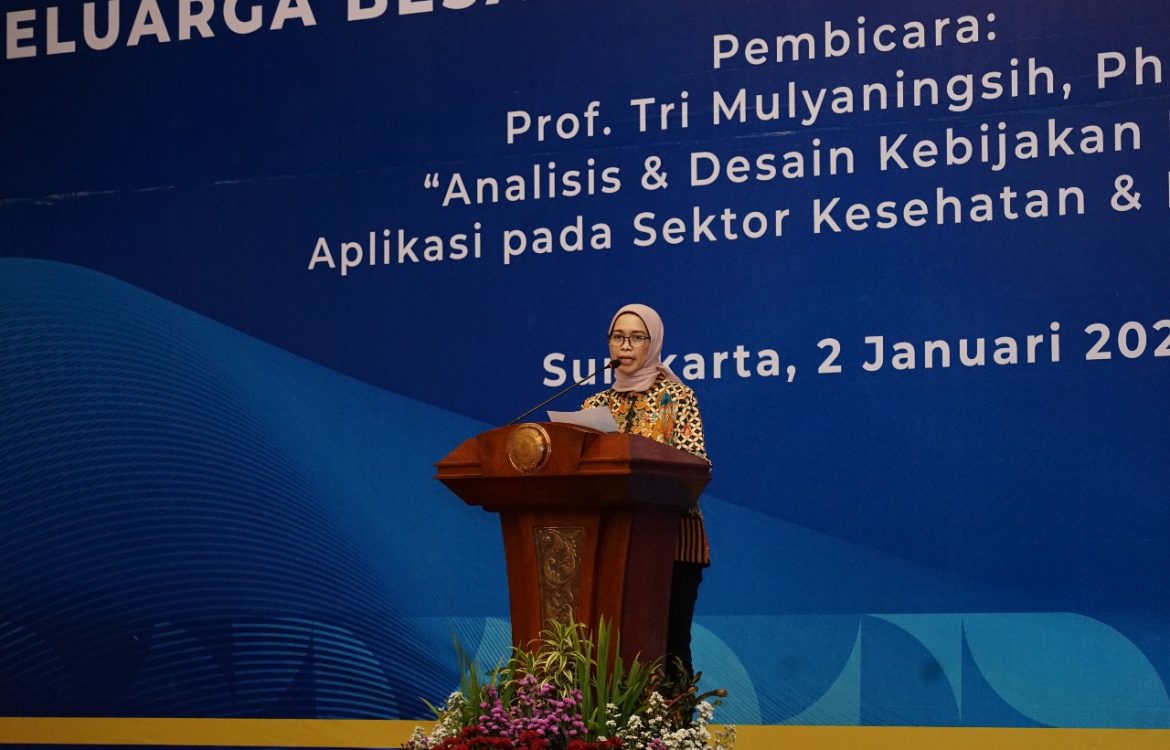
UNS 2025 New Year Gathering: Prof. Tri Mulyaningsih Discusses Public Policy in the Health and Education Sectors
Analysis and Design of Public Policy in the Health and Education Sectors become the topic of a speech delivered by Prof. Tri Mulyaningsih, S.E., M.Si., Ph.D., Professor at the Faculty of Economics and Business (FEB), Universitas Sebelas Maret (UNS), during the 2025 New Year Gathering held at the G.P.H. Haryo Mataram Auditorium on Thursday (January 2, 2025).
On this occasion, Prof. Tri Mulyaningsih shared insights from her research with attendees, which included members of the Board of Trustees (MWA); members of the Academic Senate; members of the Council of Professors; Vice Rectors; UNS Secretary; Rectors from the 2011–2019 and 2019–2024 periods; Deans and the leadership teams from various faculties; members of the UNS Women’s Association (Dharma Wanita Persatuan); representatives from banking institution as UNS partner; and the broader UNS academic community.
At the beginning of her speech, Prof. Tri outlined several development challenges in Indonesia, including income inequality, poverty, and malnutrition. Income inequality is reflected in the Gini Index, indicating that development has not been inclusive. Multidimensional poverty in Indonesia also affects public health and access to education.
“Regarding malnutrition, the long-term effects (according to Barker hypothesis, 1997) affect cognitive ability, academic performance, and social mobility. According to the 2022 health survey, stunting rate among toddlers reached 21.5%. The double burden of malnutrition—undernutrition and overnutrition—has become a national concern,” she stated.
 Disparities in access to higher education in Indonesia are also a major development issue. According to UNESCO (2012), 35% of individuals from wealthier groups have access to universities, compared to only 5% from the poorest groups. Less than 10% of Indonesia’s workforce has attained higher education, significantly lagging behind neighboring countries such as Malaysia (23.4%) and Singapore (50%). Wage disparities (a skills premium of 3.32) indicate greater rewards for educated workers, which widens the economic gap. Additionally, malnutrition reduces the potential productivity of the workforce by 2–3% of GDP and contributes to increased fiscal burdens due to related health issues (e.g., stunting, anemia, diabetes). Economic estimates from the Global Nutrition Report indicate losses of up to USD 3.5 trillion annually.
 Prof. Tri went on to outline three designs of public policy. The first is a progressive policy design, focusing on both individuals and their environments. This approach includes behavior-based interventions (nudges) aimed at changing habits while maintaining freedom of choice. School-based policies are also encouraged, such as providing healthy meals, promoting healthy lifestyles, and introducing nutrition education at an early age.
The second design emphasizes behavioral economics, utilizing the “nudge” concept (Thaler & Sunstein, 2009): structuring choices to influence decisions without coercion. For example, randomized control trials (RCTs) with healthy food vouchers in school cafeterias have proven effective in increasing students’ consumption of fruits and vegetables.
 The third is an effective policy approach for vulnerable groups, particularly targeting adolescent girls. Nutrition during adolescence has significant effects on reproductive development and the quality of future generations. Programs providing free nutritious meals, sanitation, and other services aim to improve the nutritional status of school-aged adolescents.
In addition, policy efforts include expanding scholarship programs and improving access to information. Research indicates that students from low-income backgrounds often hesitate to apply for scholarships due to a lack of information and the absence of role models. The proposed solution is to provide better information and introduce positive role models to increase enrollment.
 In concluding her presentation, the Professor—who currently serves as Vice Dean for Academic and Research Affairs at FEB UNS—summarized the key points as follows: development must support economic growth while improving public access to capacity-building opportunities; however, non-inclusive development leads to a range of issues; these issues can be addressed through public policy; yet, many policies are ineffective or result in inefficient public spending. Policy interventions should target both individuals and their environments—both physical and non-physical (such as schools and households). The behavioral economics approach using nudges is helpful in designing policies that influence public behavior while preserving individual choice.
Meanwhile, UNS Rector Prof. Dr. Hartono, dr., M.Si., affirmed that, as highlighted in Prof. Tri Mulyaningsih’s research, non-inclusive economic development is a root cause of social inequality in Indonesia. This inequality affects access to quality education and adequate healthcare services. UNS remains committed to being part of the solution by implementing innovative programs such as research-based community service initiatives, providing scholarships to students from underprivileged backgrounds, and working in collaboration with strategic partners to enhance inclusivity.