

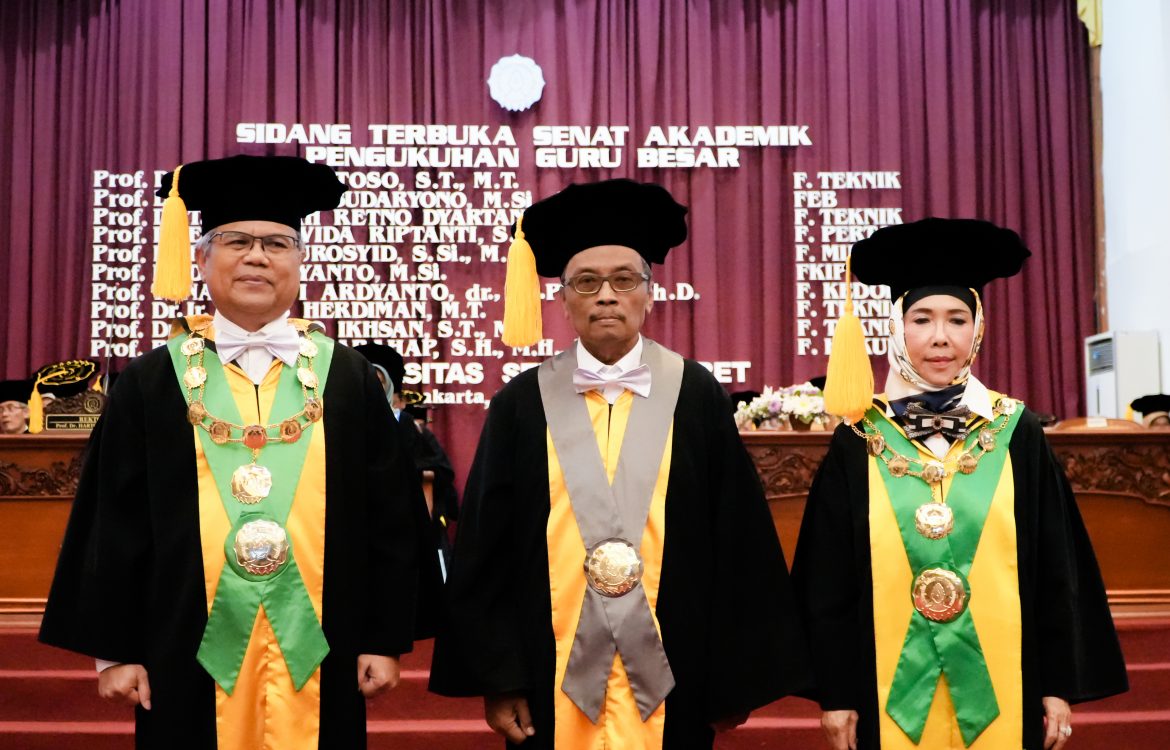
Prof. Eko Arief Sudaryono Highlights the Ethical Dimensions of Tax Avoidance in Inaugural Address
Prof. Dr. Eko Arief Sudaryono, M.Si., Ak., CA., BKP., was formally inaugurated as Professor of Taxation at the Faculty of Economics and Business (FEB), Universitas Sebelas Maret (UNS), during the Open Session of the UNS Academic Senate held on Monday, February 10, 2025, at the G.P.H. Haryo Mataram Auditorium. In his inaugural speech as the 24th Professor at FEB and the 333rd at UNS, Prof. Eko addressed a fundamental issue in Indonesia’s economic and social development—tax avoidance from an ethical perspective, entitled “Tax Avoidance and Ethics: Responding to Moral Challenges in Modern Tax Systems.
According to Prof. Eko, taxation serves as the cornerstone of national development, providing support for essential sectors such as education, healthcare, and infrastructure. Without adequate tax revenue, achieving social welfare becomes significantly more difficult. Beyond its legal status as a civic duty, taxation is also a moral responsibility, one that upholds social justice and contributes to economic stability. “Rampant tax avoidance unfairly shifts the tax burden, perpetuates inequality, and undermines trust in the tax system. This is not merely a legal concern, but an ethical issue with far-reaching consequences for national unity and our collective future,” he emphasized.
 Tax avoidance presents a major challenge to governments worldwide, particularly in developing countries that heavily rely on tax revenue as a primary source of state income. In response, governments have continued to improve their tax systems through digital transformation, expansion of the tax base, and increased public awareness to build fiscal independence and promote economic growth. One of the primary ethical implications of tax avoidance is the reduction in government revenue that could otherwise be allocated to public services such as healthcare, education, and infrastructure. Stakeholders—especially shareholders—may support such practices due to their potential to enhance corporate profits and returns. However, from the perspective of the government and society at large, these actions represent a disregard for corporate social responsibility.
In Indonesia, the phenomenon of tax avoidance continues to pose a significant challenge to state revenue. Both domestic and multinational corporations have exploited ‘tax havens’ to shift income or conceal profits. Other strategies include thin capitalization, whereby companies use loans from subsidiaries in tax haven jurisdictions to reduce their tax liabilities in Indonesia. Additionally, some companies employ complex corporate structures to transfer profits to lower-tax jurisdictions, resulting in significant losses to Indonesia’s potential tax revenue. The Indonesian government has taken decisive steps to address these challenges, notably through smarter tax policy reforms and the strengthening of oversight mechanisms. A major breakthrough in this effort is the implementation of the Automatic Exchange of Information (AEOI), which enables the automatic exchange of financial data between countries. This initiative significantly limits the possibility of cross-border tax avoidance, as Indonesian tax authorities can now access financial data of companies that previously operated beyond their reach.
Prof. Eko further emphasized that tax avoidance is a multifaceted issue situated at the intersection of legal compliance and moral consideration. Both globally and domestically, tax avoidance raises critical questions about corporate social responsibility and fairness within the tax system. While legally, not all forms of tax avoidance are classified as violations, ethical concerns cannot be ignored.
He concluded his address with several strategic recommendations to mitigate tax avoidance. First, instilling tax ethics should begin at an early stage. Second, comprehensive tax policy information is needed to close regulatory loopholes, supported by a modern cultural framework. Third, financial transparency should be promoted through country-by-country reporting to ensure that corporations contribute proportionally. Lastly, he advocated for stronger collaboration among the government, business sector, and civil society to build a fair and dignified tax system.