

P4M FEB UNS Disseminates the 2026 Direction and Priorities, Encouraging Research Collaboration and Strengthening Academic Integrity
Faculty of Economics and Business (FEB), Universitas Sebelas Maret (UNS), held a Virtual Dissemination and Coordination Meeting on the Center for Research and Community Engagement Development (P4M) 2026 Activities, Monday (12/1/2025) via Zoom Meeting.
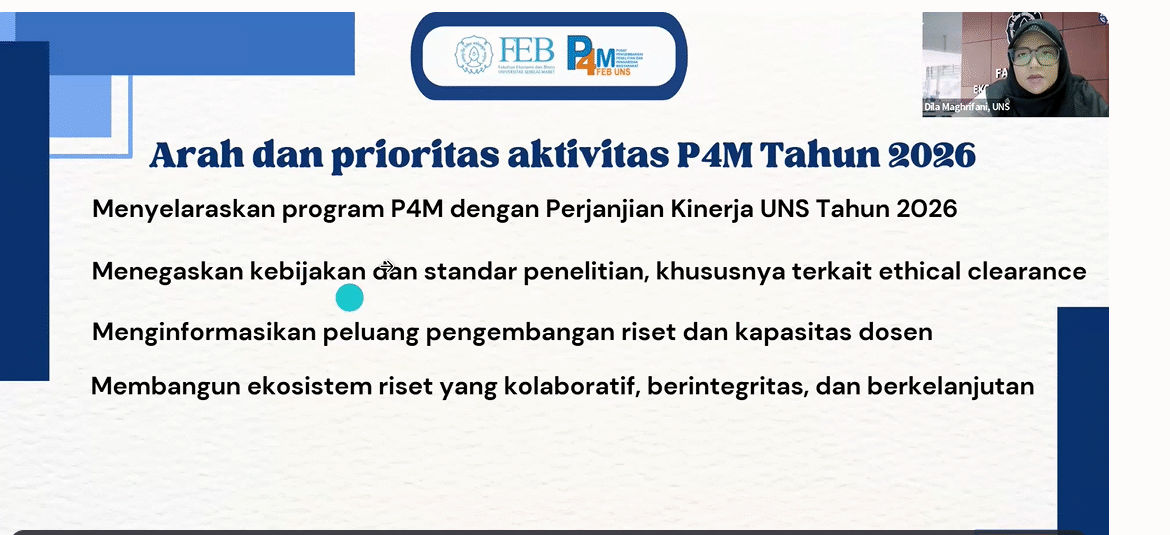
Attended by FEB UNS academic staff, the activity aimed to align P4M programs and activities with the UNS 2026 Performance Agreement, reaffirming research policies and standards—particularly those related to ethical clearance—build a collaborative, integrity-based, and sustainable research ecosystem, and disseminate information on research development opportunities and capacity building for lecturers.
In line with the UNS Performance Agreement for 2026, Dila Maghrifani, S.E., B.Sc., M.Sc., Ph.D., Chair of P4M, explained that the policy direction and strategic priorities of P4M UNS for 2026 focus on four main targets: increasing internationally reputable publications, particularly Q1 journals; strengthening international research collaboration; contributing meaningfully to the achievement of the Sustainable Development Goals (SDGs), especially SDGs 1, 4, and 17; and developing lecturers’ competencies and capacities through upskilling and upgrading programs.
Moreover, P4M UNS introduced a new Key Performance Indicator (KPI) that specifically targets scientific publications with themes related to Javanese culture, reflecting UNS’s commitment to preserving local cultural values through academic work.
In reviewing achievements from the previous year, Dila Maghrifani noted that the quality of FEB UNS lecturers’ publications in 2025 showed a positive trend at the Q1 and Q2 levels. Nevertheless, publication output declined in terms of quantity. Accordingly, lecturers were encouraged to strengthen collaborative research across Research Groups (RGs) and disciplines, pursue larger-scale research grants, and update their research roadmaps to ensure alignment with strategic issues and SDG targets.
Research ethics and integrity constituted a key focus of the dissemination, where she stressed that Ethical Clearance (EC) is a mandatory requirement for all research involving human subjects, the use of personal or sensitive data, as well as social, behavioral, and experimental studies. Research without valid Ethical Clearance cannot be processed further, particularly for publication in internationally reputable journals.
She also clarifies that P4M does not have the authority to issue Ethical Clearance. Lecturers are therefore directed to submit EC applications through the UNS Faculty of Teacher Training and Education (FKIP) Ethics Committee for social and humanities research, or through the UNS Faculty of Medicine Ethics Committee for non-social sciences, health-related, and experimental research. In this context, P4M plays a role in policy dissemination, administrative assistance, and encouraging compliance with research ethics.
On the same occasion, P4M also disseminated three new Standard Operating Procedures (SOPs) issued by LPPM UNS—SOP 001, SOP 002, and SOP 003—concerning the prevention of lecturers’ academic integrity violations. These SOPs comprehensively regulate mechanisms for preventing and reporting misconduct in scholarly outputs, establishment of a transparent and accountable reporting systems for alleged violations, as well as procedures for examination and determination of violation levels with proportionate sanctions.
Through this activity, FEB UNS reaffirmed its commitment to building a collaborative, integrity-based, and sustainable research ecosystem, while strengthening the institution’s contribution to the advancement of knowledge, community engagement, and academic reputation at both national and international levels.