

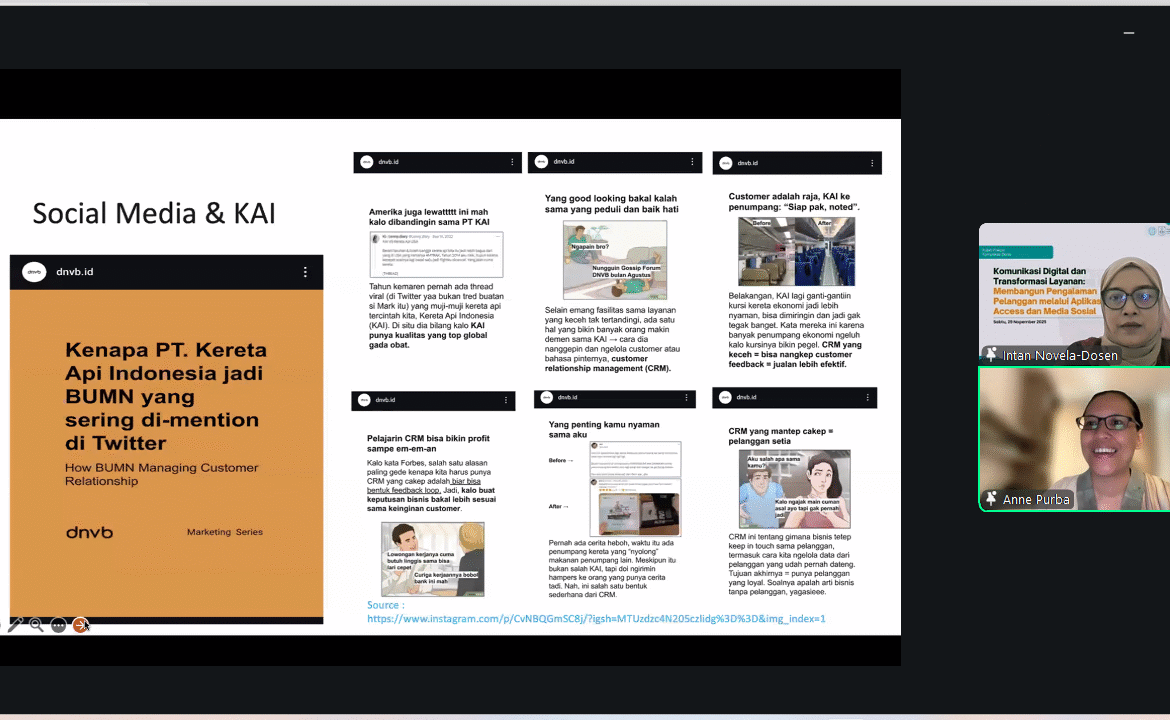
Management Study Program FEB UNS Holds Practitioner Lecture on KAI Services Digital Transformation
Management Study Program, Faculty of Economics and Business, Universitas Sebelas Maret (FEB UNS), organized a Business Communication Practitioner Lecture in collaboration with PT Kereta Api Indonesia (Persero) as an industry partner on Saturday, 29 November 2025. This activity formed part of the Management Study Program’s efforts to enhance the connection between academic theory and professional practice. The practitioner lecture, entitled “Digital Communication and Service Transformation: Building Customer Experience through the KAI Access Application and Social Media,” featured Erni Sylviane Purba, Vice President of Public Relations at PT KAI, as the keynote speaker.
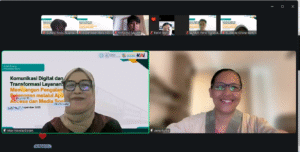 The session was conducted virtually and attended by students of the Management Study Program. It was moderated by Dr. Intan Novela Qurrotul Aini, S.E., M.Si., a lecturer at FEB UNS. During the session, the speaker outlined her career journey, which began in the fields of technology and social media before she joined KAI in 2013 as Manager of CRM and Digital Media. During this period, KAI began implementing social media listening integrated with operational systems, enabling the company to distinguish authentic customer feedback from public opinion and comments generated by non-customer accounts.
The speaker emphasized that social media has become a critical channel for identifying service-related issues. “Every criticism and appreciation must be analyzed. We utilize a 24-hour command center connected to the contact center and CCTV analytics across all stations,” she explained.
She further elaborates that this system enables KAI to detect potential service crises, including the handling of harassment cases in station areas. “Do not expect perpetrators of sexual violence to be able to board trains, particularly in the Jabodetabek area. Our system monitors passenger movement to ensure collective safety,” she stated firmly.
KAI also employs social media listening to accurately identify passenger needs. Feedback concerning the comfort of economy-class trains, toilet facilities, and requests for supporting travel amenities has resulted in tangible service improvements. “From simple comments about seat backrests to requests for separate male and female toilets, all are addressed through innovation,” she explained.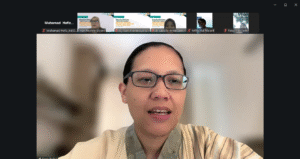
Even investment strategies, such as the provision of water stations, are determined based on customer feedback as part of efforts to reduce plastic waste while improving passenger comfort. In one semester of 2025, KAI recorded more than six million mentions related to railway services; however, after analysis, only 1.58 million were identified as genuine customer feedback. “This is where filtering becomes essential. We must satisfy customers, not merely follow the dynamics of online discourse,” she added.
The speaker also described the management of viral issues, such as the so-called “Tumbler” case. According to her, KAI chose to release clarification at night after observing high levels of discussion during the day. She clarified that temporary removal from duty does not constitute dismissal, but rather serves as a protection mechanism for employees during the clarification process. In addition, she reported that KAI has recovered more than 12,000 lost passenger items valued at over IDR 12 billion, demonstrating the company’s integrity in safeguarding customer property.
KAI currently serves more than 400 million passengers annually, with projections reaching 500 million passengers by the end of 2025. These figures indicate the substantial economic impact of railway services on society. “Railways do not merely transport people; they drive economic activity. Hotels, culinary businesses, and other sectors move in parallel,” she noted.
At the global level, KAI is preparing to offer International Operation and Management Services, including opportunities to operate in Abu Dhabi and other countries. Digitalization, electrification, and long-term strategic development constitute the main focus areas for future growth.
 Concluding the session, the speaker expressed her appreciation for the opportunity to participate at UNS as part of public education efforts. Several KAI communication case studies have become references for undergraduate and postgraduate students. “KAI seeks to demonstrate transparency and readiness to contribute to Indonesia’s economic transformation and global engagement,” she stated.
This public lecture further enhanced collaboration between KAI and the academic community in developing studies on communication, digital transformation, and data-driven public services. This occasion aligns with the achievement of the Sustainable Development Goals (SDGs), particularly SDG 4 (Quality Education) through practice-based industry learning, SDG 9 (Industry, Innovation, and Infrastructure) through the presentation of digital transformation and service innovation in the transportation sector, and SDG 11 (Sustainable Cities and Communities) through the development of safe, inclusive, and sustainable public transportation systems.