


FEB UNS Practitioner Lecture: Safeguarding Project Success through Project Integrated Monitoring & Controlling
Management Study Program and the Master of Management Program, Faculty of Economics and Business (FEB), Universitas Sebelas Maret (UNS), organized a practitioner lecture themed “Safeguarding Project Success through Project Integrated Monitoring & Controlling” on Saturday, 6 December 2025, at the Suhardi Hall, FEB UNS. This activity formed part of the Operations Specialization Course and featured a professional practitioner to enrich students’ understanding of contemporary project management practices.
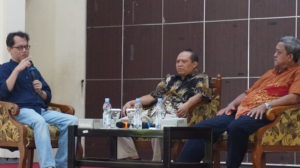 The speaker for this session was Edi Marwanto, Vice President of Business Development at PT National Energy Solutions, who has more than 20 years of experience in construction projects within the oil, gas, and petrochemical sectors. In his presentation, Edi Marwanto emphasized that projects do not merely produce unique deliverables, but also drive change and create value for organizations.
He explained that project failure is often caused by weak control processes, unmanaged changes, and inadequate monitoring of project performance. Data from The Standish Group indicate that large-budget projects face significant failure risks if they are not properly controlled.
The lecture then outlined core concepts in Project Management, including the Project Management Framework, Integrated Monitoring and Controlling, the role of the Project Management Office (PMO), and key recommendations for achieving project success.
 The speaker described the comprehensive project life cycle, beginning with initiating, planning, executing, monitoring and controlling, and concluding with closing. Each phase plays a critical role in ensuring that projects proceed in line with established plans.
The main section of the lecture highlighted the importance of Project Integrated Monitoring & Controlling, which encompasses scope control to prevent scope creep, project schedule control through baseline monitoring, cost control using CPI and CV indicators, quality control to ensure outputs meet specifications, as well as the management of risks, communication, resources, and stakeholders.
Edi introduced the application of Earned Value Management (EVM) as a highly effective method for assessing actual project performance and forecasting final project outcomes. The case studies presented demonstrated how EVM enables early identification of deviations, allowing project teams to design appropriate action plans.
The speaker emphasized the significance of a Project Management Office (PMO) as the center of organizational project governance. The PMO ensures strategic alignment, manages project business processes, develops human resource competencies, and facilitates knowledge transfer, enabling organizations to better manage the complexity of modern projects.
 In closing, Edi Marwanto presented several key recommendations, including the adoption of global project management standards, stronger risk and change management practices, character-based leadership that includes emotional intelligence, and the application of the talent triangle for project managers, comprising technical, leadership, and strategic-business skills.
This practitioner lecture supports the achievement of SDG 4 (Quality Education) through the enhancement of student competencies in project management. In addition, the emphasis on monitoring and controlling practices, project governance, and efficient resource utilization contributes to SDG 9 (Industry, Innovation, and Infrastructure) and SDG 16 (Peace, Justice, and Strong Institutions) through transparent, effective, and sustainable project management practices.