


Fiscal Corner FEB UNS Discusses Central-Regional Fiscal Synergy and Fiscal Resilience Amidst Global Dynamics
The Fiscal Corner at the Faculty of Economics and Business (FEB), Universitas Sebelas Maret (UNS), organized a Fiscal Outlook Series carrying the theme “Strait of Hormuz Impact: Regional Fiscal Resilience Strategies & Alternative Financing Transformation” on Tuesday (9/6/2026). Hosted from the UNS Tower Classroom, the event featuring Dr. Subandono, S.E., M.Sc., Director of the Financial Balance System at the Ministry of Finance of the Republic of Indonesia as the keynote speaker.
The agenda was attended by undergraduate and postgraduate students, alumni, and faculty members who enthusiastically participated in discussions regarding the impact of global geopolitical dynamics on the regional economy and fiscal conditions. This forum serves as a dialogue space between practitioners and academics to comprehend both challenges and opportunities in fiscal management amidst global uncertainty.
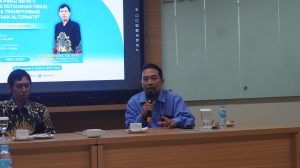 The Dean of FEB UNS, Prof. Bhimo Rizky Samudro, S.E., M.Si., Ph.D., expressed his appreciation in his opening remarks for the presence of Dr. Subandono, who was willing to share knowledge and experiences with the students and attendees. According to Prof. Bhimo, the selected theme is highly relevant to various issues studied in development economics and fiscal policy. He noted that the presence of a practitioner from the Ministry of Finance provides a more comprehensive perspective on how the government manages fiscal policy when facing various global challenges.
“It is an honor for us to bring the Director of the Financial Balance System from the Ministry of Finance to share insights with students and alumni. Activities like this are essential to bring together academic perspectives with the policy practices implemented by the government,” he remarked.
Prof. Bhimo also hoped that the Fiscal Outlook Series would continue as a regular discussion forum featuring strategic issues in the fiscal and regional development sectors. He emphasized that the Fiscal Corner is part of the laboratory ecosystem and center for scientific development at FEB UNS that supports the improvement of educational quality, research, and collaboration with various partners.

Meanwhile, during his presentation, Dr. Subandono explained that current global economic conditions are still influenced by various geopolitical uncertainties, including dynamics in the Strait of Hormuz region, which carry implications for the economic and fiscal stability of various nations. He emphasized the importance of synergy between the central and regional governments to maintain fiscal resilience and ensure that development continues in a sustainable manner. The problem might occur over there, but the impact can reach here at Indonesia, even Solo. For this reason, the central government and local governments must establish and maintain better synergy in responding to various emerging challenges.
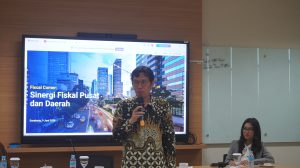 In his presentation, Dr. Subandono explained that Indonesia requires high and consistent economic growth to escape the middle-income trap. Amidst various global shocks, Indonesia’s economy has shown a relatively good performance, with economic growth remaining stable and inflation remaining controlled. He also highlighted the significant role of the state budget (APBN) and regional budgets (APBD) as fiscal decentralization instruments capable of supporting equitable development and public services in various regions. Furthermore, he explained that fiscal transfers to regions are designed to reduce fiscal disparities, enhance the quality of public services, and support the achievement of national development priorities. According to him, strengthening regional fiscal capacity relies not only on transfers from the central government but also on the regions’ ability to optimize local own-source revenue, improve spending quality, and strengthen regional financial governance.
Additionally, Dr. Subandono introduced various alternative financing options for regional development, including the utilization of regional loans, regional bonds, and regional sukuk to support productive infrastructure development. He asserted that creative financing can be a solution for regions to increase fiscal capacity and accelerate development without neglecting the principles of fiscal prudence.
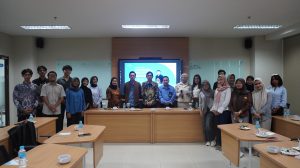
At the end of his presentation, Dr. Subandono emphasized the importance of multi-party collaboration through a penta-helix approach involving the government, higher education institutions, industry, communities, and the media. In this context, universities hold a strategic role in supporting regional fiscal optimization, producing competent human resources, and providing research-based policy recommendations for local governments. The discussion was highly interactive, featuring various questions from the students, alumni, and attendees.
Through this activity, participants gained a deeper understanding of the relationship between global geopolitical dynamics, national fiscal policy, regional fiscal resilience, and various financing innovations that can support sustainable development in Indonesia. This initiative aligns with FEB UNS’s commitment to supporting the attainment of the Sustainable Development Goals (SDGs), particularly SDG 4 (Quality Education) through the provision of learning spaces relevant to public policy issues, SDG 8 (Decent Work and Economic Growth) by strengthening the understanding of sustainable economic growth strategies, and SDG 17 (Partnerships for the Goals) through collaboration between higher education institutions and the government in capacity and development policy growth.