

Bridging Research and Public Policy, FEB UNS Organizes Workshop on Impactful Policy Brief Design
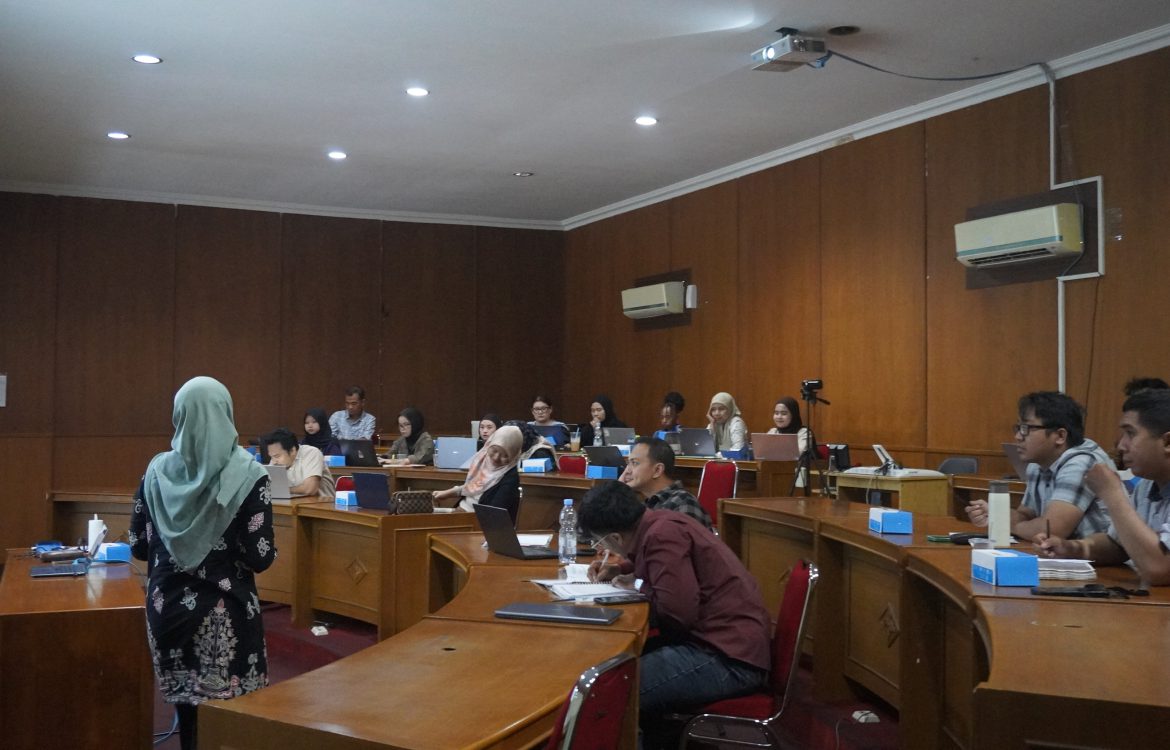
Master in Economics and Development Study Program (MESP), Faculty of Economics and Business (FEB), Universitas Sebelas Maret (UNS), organized a strategic workshop titled “Designing Impactful Policy Briefs for Public Policy Making” on Thursday, June 11, 2026. Held at the Bachtiar Effendi Building, FEB UNS, the event was attended by the faculty members of FEB UNS, MESP students, and representatives from the Solo City Government, Sragen Regency Government, and Wonogiri Regency Government. In his opening remarks, Prof. Suryanto, the Head of the MESP Study Program, expressed his pride in the continuous consistency of academic programs implemented at FEB UNS. Previously, MESP had successfully organized an Environmental Economics workshop featuring a speaker from UGM.
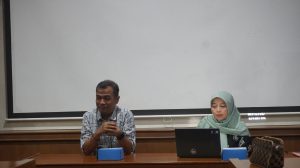
Looking ahead, Prof. Suryanto announced the next major agenda scheduled for June 15–16, 2026. The two-day agenda will focus on Green Economics development, which will later be integrated into a diploma supplement certificate or SKPI (Surat Keterangan Pendamping Ijazah). Master’s students, particularly from MESP, are requested to register immediately.
Regarding the workshop, Prof. Suryanto emphasized the importance of mastering policy brief writing for both academics and government practitioners in Solo, Sragen, and Wonogiri. “We hope there will be a follow-up to this activity, in line with the guidance and high expectations of the Vice Dean. We ask for serious participation from all faculty members and students. If approved in the future, we plan to make this policy brief one of the options to replace the thesis requirement for master’s students,” Prof. Suryanto stated.
As an introduction to the material, Dr. Erda Rindrasih, S.Si., MURP, the speaker from Universitas Gadjah Mada, explained that policy is essentially a decision. Quoting an adage, “policy is whatever government chooses to do or not to do. It is what government does.” She reminded participants to be capable of mapping issues into their proper levels: operational, technical, strategic, political, and ethical levels that extend beyond politics.
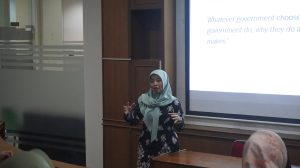
“We must learn to find solutions according to the scale of the problem. We often get caught up arguing over minor operational things, such as the issue of maggots found in the Free Nutritious Meal (MBG) program, when the problem might actually lie at the technical supply chain level, a faulty strategic design from the start, or even within the budgeting (political) realm. Do not let the issue be operational but the solution political. Do not swat a mosquito with a nuclear bomb,” Dr. Erda asserted. She also illustrated how ethical aspects pose complex global challenges due to differences in values across regions or countries, such as views on LGBT, which are accepted abroad but remain unaccepted in Indonesia.
Principles of a Policy Brief: A Light Read Over a Cup of Coffee
Furthermore, Dr. Erda corrected a common misconception in the field where the term policy brief is often interchanged with a policy paper, policy essay, or policy article. A policy brief has highly specific characteristics: concise (4 to a maximum of 8 pages), packaged lightly so that it can be read in just 5 to 7 minutes over a cup of coffee, and written in non-specialist language that is easily understood by a middle school student without complicated foreign jargon.
To compose a good policy brief, Dr. Erda invited participants to practice structured thinking through a case simulation on pharmaceutical independence:
- Understanding Strategic Issues: Listing crucial problems on the surface. For example, high dependency on imported raw materials prevents the national pharmaceutical industry from being independent, meaning that if fuel prices (Pertalite/Pertamax) rise, the price of local medicine is vulnerable to impacts and struggles to compete with imported drugs.
- Shifting to the Root Cause: Discovering the fundamental reasons behind the issue, such as unaligned regulations or suboptimal government budget support.
- Formulating Recommendations: Generating systematic, evidence-based arguments to serve as tools for public policy advocacy.
Supporting SDG Attainment
Through concrete outputs in the form of draft policy briefs from the attending faculty members, students, researchers, and regional practitioners, this initiative by FEB UNS directly contributes to supporting the attainment of the Sustainable Development Goals (SDGs). This is particularly evident in SDG Goal 3 (Good Health and Well-Being through independence in the health and pharmaceutical sectors), SDG Goal 4 (Quality Education), and SDG Goal 17 (Partnerships for the Goals) through close collaboration between university academics and local governments (Solo City Government, Sragen Regency Government, and Wonogiri Regency Government).