

FEB UNS Students Participate in Public Lecture on Digital Financial Literacy and Investment
Faculty of Economics and Business (FEB), Universitas Sebelas Maret (UNS) reaffirmed its commitment to strengthening student capacity by organizing a public lecture titled “Digital Financial Literacy and Investment.” The event was conducted virtually via Zoom Cloud Meeting on Thursday, 25 September 2025, and attended by more than 100 FEB UNS students from various study programs. The lecture featured two distinguished speakers: Fennicia Auliantika, S.E., M.M., CFP®, a certified financial planner and 2025 OJK Financial Literacy Ambassador, and Assoc. Prof. Dr. Dodik Siswantoro, S.E., Ak., CA., CACP., MSc., ACC., from Universitas Indonesia. Their presence aims to enrich students’ understanding of financial management and investment in the digital era.
 In her opening remarks, Prof. Tri Mulyaningsih, S.E., M.Si., Ph.D., Vice Dean for Academic and Research Affairs FEB UNS, emphasized the importance of financial literacy for students to prepare for future professional challenges and the dynamics of the global economy. “For today’s session, two laboratories are collaborating: the Fintech Lab coordinated by Ms. Wahyu Trinarningsih, and the Logistics and Capital Market Lab led by Mr. Arif Lukman Santoso. Both labs are actively developing training programs that lead to competency certifications through UNS’s Professional Certification Institute (LSP) in collaboration with BNSP,” she explained.
Prof. Tri also highlighted that FEB UNS students are expected to graduate not only with academic transcripts and certificate, but also with relevant competency certifications to meet labor market demands. “I encourage all students to make the most of this opportunity to enrich their investment knowledge. I hope for this event to go seamlessly and brings meaningful benefits to all of us,” she concluded.
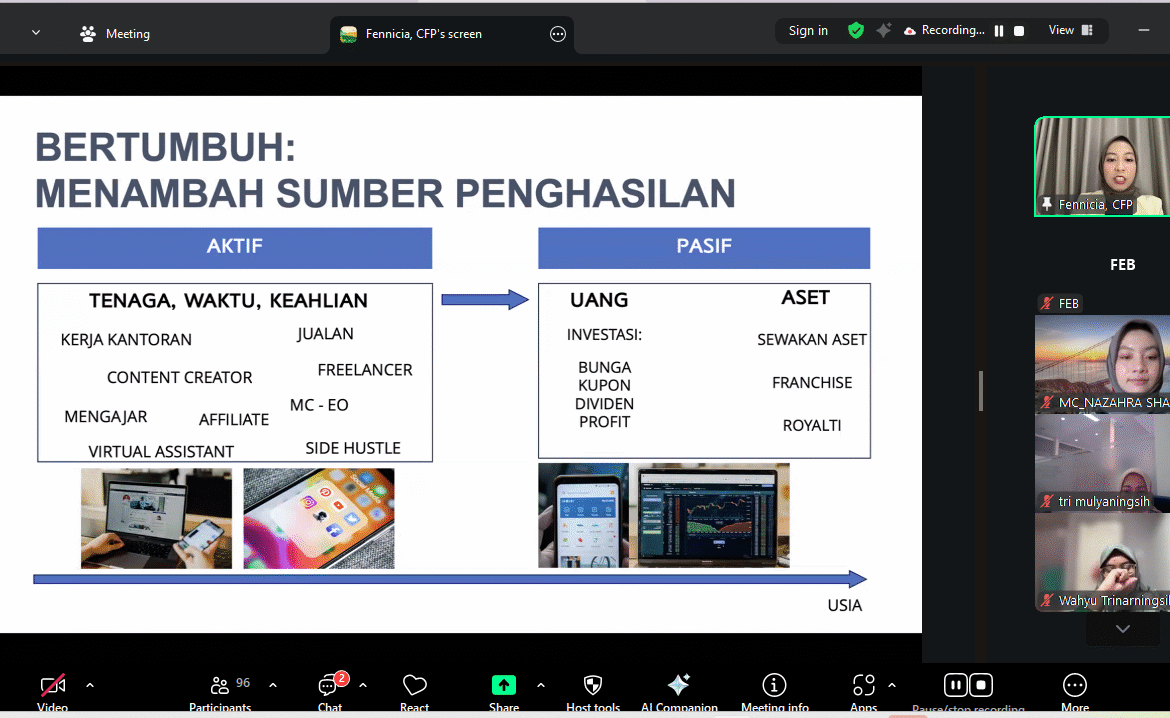
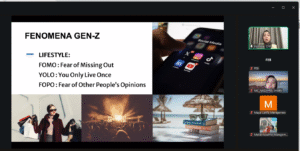
 The first session featured Fennicia Auliantika presenting “Go Digital, Go Financially Wise: Optimizing Fintech for Student Financial Planning.” She addressed how Generation Z is often influenced by lifestyle patterns driven by FOMO (Fear of Missing Out), YOLO (You Only Live Once), and FOPO (Fear of Other People’s Opinions). These habits can lead to impulsive spending behavior, made worse by the easy access to pay-later services and online loans. “It’s not about how much money you have, but how smartly you manage it,” Fennicia stressed.
She provided practical guidelines for students to start early financial planning, including Managing cash flow so that income exceeds expenses; Preparing emergency funds, even in small amounts, to avoid debt in urgent situations; Distinguishing between productive and consumptive debt; Practicing mindful spending using the 40-30-20-10 formula: living expenses, health instalments, savings/investments, and entertainment.
 Fennicia also introduced the use of financial technology tools such as digital banking, investment platforms, and automatic budgeting apps integrated with bank accounts. However, she reminded students to be cautious about data security, use only official apps registered with OJK, and avoid illegal investment schemes that promise unrealistic returns.
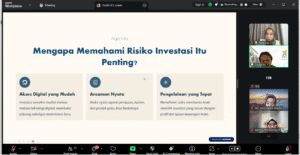
In the second session, Assoc. Prof. Dr. Dodik Siswantoro delivered a presentation titled “Personal Investment in Indonesia: Understanding Risks and How to Manage Them.” He explained that while digitalization has made investing more accessible, it also brings new risks such as platform hacking, the circulation of counterfeit gold online, and various illegal investment scams. “Understanding your personal risk profile is the first step to building a sound and sustainable investment portfolio,” Dodik explained.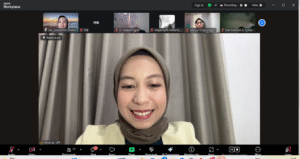
He elaborated on three types of investor risk profiles: conservative, moderate, and aggressive. Conservative investors prefer low-risk instruments, moderate investors seek a balance between risk and return, while aggressive investors are willing to take higher risks for potentially greater gains. Dodik also highlighted the importance of portfolio diversification across instruments such as bonds, sukuk, stocks, and gold. He provided safety tips, including purchasing certified gold, using investment platforms with strong security systems, and avoiding the use of public devices to access financial applications.
“Investment is not only about pursuing high returns, but also about making it a pathway to safe and sustainable financial freedom,” he concluded.
 This public lecture not only broadened FEB UNS students’ knowledge of financial management but also strengthened their readiness to face investment risks in the digital era. The insights provided by both speakers are expected to encourage students to develop smart, critical, and prudent financial mindsets.
The program reflects FEB UNS’s commitment to nurturing a financially literate young generation capable of utilizing technology productively. It also supports the achievement of the Sustainable Development Goals (SDGs), particularly Goal 4 (Quality Education) by strengthening financial literacy, and Goal 8 (Decent Work and Economic Growth) by promoting inclusive economic growth through healthy investment practices.