

FEB UNS Students Explore Financial System Stability with the Indonesia Deposit Insurance Corporation
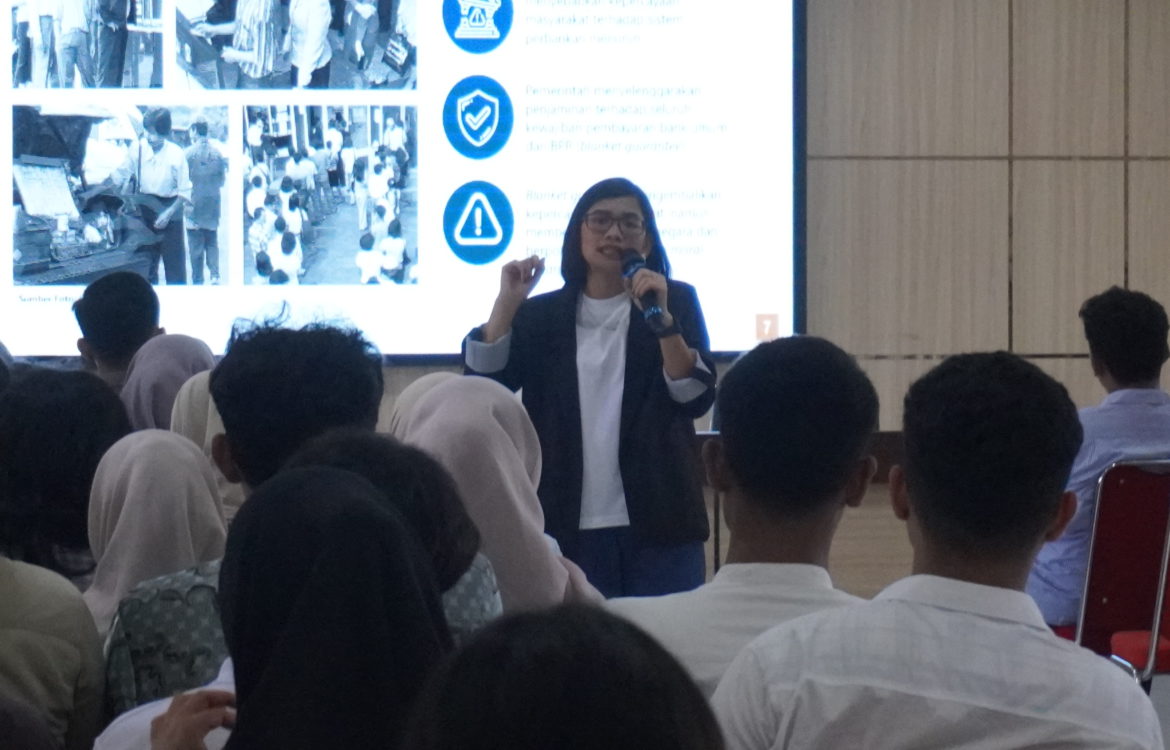
Faculty of Economics and Business (FEB), Universitas Sebelas Maret (UNS), organized a general lecture featuring the Indonesia Deposit Insurance Corporation (LPS) with Ferawaty Marbun, Head of the Banking Premium Calculation and Verification Division of LPS, as the keynote speaker. The event took place at the Soedarah Soepono Hall, FEB UNS, and was attended by more than 200 students from 11 classes across the Management, Digital Business, and Development Economics Study Programs. The lecture aims to strengthen students’ understanding of the national financial system and the vital role of LPS in maintaining its stability.
In her presentation, Ferawaty Marbun explains that LPS was established in response to the 1997/1998 monetary crisis, when public trust in the banking sector declined due to the absence of a deposit guarantee mechanism. “Since its inception in 2005, LPS has ensured the safety of customer deposits and maintained public confidence in the banking system,” she stated.
 Ferawaty outlined LPS’s key functions and mandates, which include guaranteeing customer deposits, resolving failed banks, guaranteeing insurance policies, maintaining financial system stability, and handling the settlement of insurance companies whose business licenses have been revoked. She also discussed regulatory developments that have expanded LPS’s role through several laws, including Law No. 24 of 2004 on LPS, Law No. 9 of 2016 on the Financial System Crisis Prevention and Resolution (PPKSK), and Law No. 4 of 2023 on the Financial Sector Development and Strengthening (P2SK). Over time, LPS’s mandate has grown beyond bank deposit insurance to include insurance policy guarantees, which will take effect in 2028.
The lecture also covered the deposit guarantee mechanism, which protects deposits of up to IDR 2 billion per depositor per bank, provided the deposits meet the 3T requirements: recorded in the bank’s books (tercatat), the interest rate does not exceed LPS’s guarantee rate (tingkat bunga), and the account is not involved in fraud (tidak terindikasi fraud). Through this mechanism, LPS guarantees more than 99.9% of bank accounts in Indonesia, including those in commercial banks, rural banks (BPR), and Islamic banks.
Ferawaty also provides a comparison of the deposit insurance institutions in other countries, such as the Federal Deposit Insurance Corporation (FDIC) in the United States, the Deposit Insurance Corporation in Japan, and the Singapore Deposit Insurance Corporation Ltd. With its role as a risk minimizer, LPS plays a crucial part in preventing systemic crises and maintaining the resilience of Indonesia’s financial sector.
She further discusses the bank resolution process for failed banks, which involves four methods: Purchase and Assumption (P&A), Bridge Bank, Temporary Capital Participation (PMS), and Liquidation. As of August 2025, LPS has completed the liquidation of 127 banks and is handling 18 banks currently in the resolution process.
Through this lecture, FEB UNS students gained practical insights into how economic theory, finance, and risk management are applied within financial institutions. The session also reinforced awareness that financial system stability serves as a foundation for sustainable economic growth.
Concluding the session, Ferawaty emphasized the importance of strengthening financial literacy among young generations. “It is essential to enhance financial literacy, thus, the young generation can understand the role of financial institutions and can contribute to building a sound and resilient economic ecosystem,” she concluded.
This general lecture demonstrated the collaboration between academia and financial authorities in expanding students’ knowledge and competencies. In line with FEB UNS’s vision to become a world-class faculty, the event also contributes to the achievement of the Sustainable Development Goals (SDGs), particularly Goal 4 (Quality Education) and Goal 8 (Decent Work and Economic Growth), by promoting financial literacy and understanding of inclusive and robust financial governance.