

FEB UNS Strengthens Research and Community Engagement Synergy through the 2025 Competitive Grant
The Center for Research and Community Engagement Development (P4M), Faculty of Economics and Business (FEB), Universitas Sebelas Maret (UNS), organized “Coordination Meeting for the Implementation of the 2025 FEB UNS Competitive Grant.” The meeting was conducted virtually via Zoom on Tuesday, October 14, 2025, with the aim to strengthen collaboration among study programs, research groups, and supporting units within FEB UNS, as an effort to increase both the quantity and quality of research and community engagement grant proposals.
In her opening remarks, the Head of P4M FEB UNS, Dila Maghrifani, S.E., B.Sc., M.Sc., Ph.D., stated that the meeting served as a follow-up to the initiatives provided by the UNS Institute for Research and Community Service (LPPM UNS) and marked an important step in strengthening research synergy at the faculty level. “This activity is expected to become a platform for collaboration and communication, as well as to establish a synergy among the entire academic community of FEB UNS. Hopefully, the grant programs facilitated by LPPM can be beneficial and open more opportunities for stronger research and community engagement collaborations in the future,” said Dila.
She further explained that P4M would continue to play a facilitating role for lecturers and research groups in accessing various internal and external grant opportunities.
In his remarks, Prof. Tri Mulyaningsih, S.E., M.Si., Ph.D., Vice Dean for Academic and Research Affairs FEB UNS, emphasized that this coordination was a joint initiative between the Academic Affairs Division and P4M to encourage more active participation of lecturers in grant proposal submissions. “The goal of this activity is simple yet strategic—to increase the number of proposals submitted by FEB UNS faculty members. This year, UNS has received approximately IDR 13 billion in funding for the Equity Grant Scheme, which is a valuable opportunity we should make the most of together,” she stated.
Prof. Tri further explained that the Equity Grant offers significant potential because it is an internal UNS program, meaning the competition is limited within the UNS’s academic community. Therefore, the probability of success is higher than in national-level competitive schemes.
She also noted that several types of Equity Grants specifically target the fields of economics, business, and agriculture—areas that align closely with FEB’s research focus. “We aim to foster synergy among P4M, research groups, and study programs. Through this collaboration, we can direct flagship research to align with the strategic goals of the faculty and the university,” she explained.
Prof. Tri further highlighted that the Equity Grant will be implemented from January to June 2026, in line with the FEB UNS Strategic Plan (Renstra) 2025–2029. She highlighted that this grant serves not only as a funding opportunity but also as part of the faculty’s strategy to achieve its vision. “This activity is fully aligned with the FEB UNS Strategic Plan, which envisions the faculty as globally reputable and inclusive. ‘Global’ means having international competitiveness, while ‘inclusive’ means ensuring that all disciplines and groups progress together. This grant serves as one of the pathways to realize that vision,” she explained.
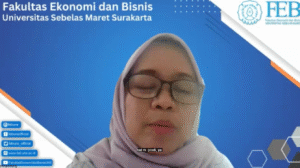 In her presentation, Prof. Tri also elaborated on how grant implementation could support the faculty’s strategic objectives, including enhancing international reputation and integrating research with teaching. She gave examples of grant schemes that could fund collaborative teaching and international research initiatives, such as inviting visiting professors or postdoctoral fellows from reputable overseas universities.
“If we can invite visiting professors or postdoctoral researchers from abroad, they can contribute to the development of teaching materials, research methods, and academic quality assurance. UNS even provides dedicated grant support for such initiatives, including participation in international conferences,” she elaborated.
Additionally, Prof. Tri encouraged that each grant activity be directed toward strengthening the integration of education and research through the dissemination of international research outcomes and the development of research-based teaching materials.
She also highlighted the need for strengthening alumni career development programs and enhancing human resource capacity. “FEB must continue to produce high-quality human resources. This can be achieved through training, international collaboration, and sending staff for further studies abroad—all of which can be linked to ongoing grant programs,” she added.
The coordination activity concluded with a breakout room discussion divided into three fields—Economics, Management, and Accounting. In each session, participants discussed plans for implementing grants in their respective fields, identifying potential collaborative research and administrative support needs.
Through this coordination, P4M FEB UNS hopes that all lecturers and research groups can fully take part in the current competitive grant opportunities to strengthen academic networks, enhance research publications and community engagement, and contribute to the faculty’s overall performance achievements. “We wished that every grant to be not only funding-oriented but also to make a tangible contribution to accomplish FEB UNS’s vision as a globally reputable and socially impactful faculty,” concluded Prof. Tri.