

FEB UNS Rural Development Laboratory Equips Students with Strategic Marketing Tools for Rural Economic Development
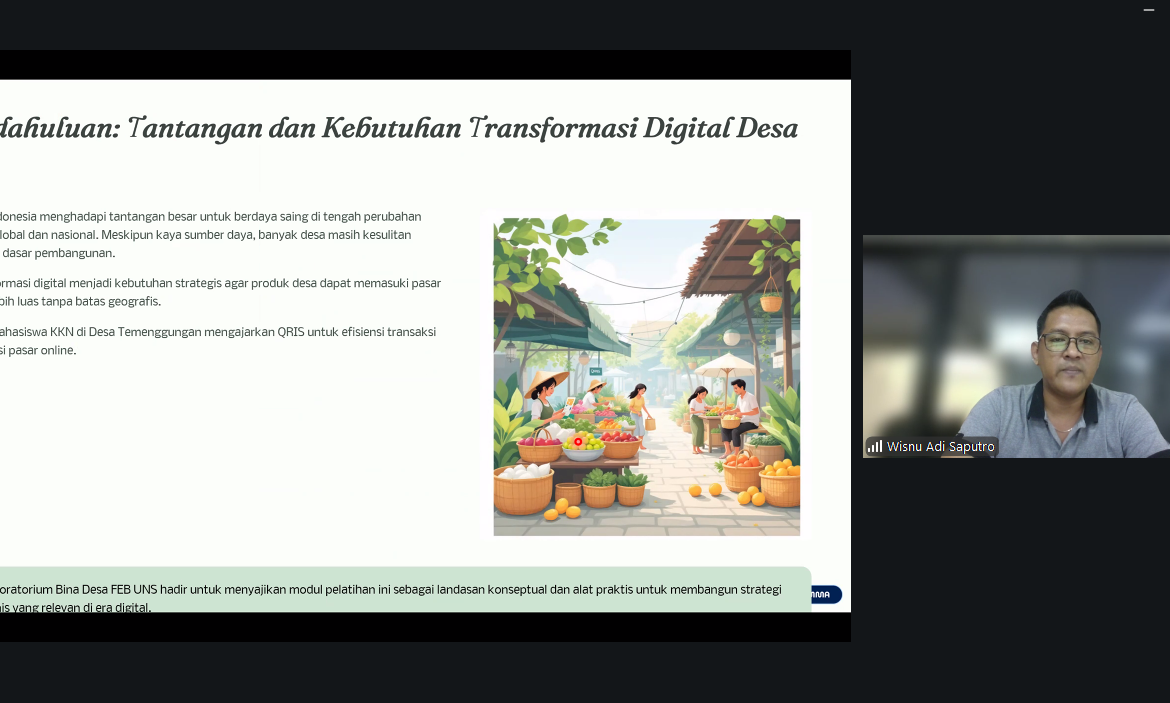
The Rural Development Laboratory, Faculty of Economics and Business (FEB), Universitas Sebelas Maret (UNS), continued its capacity-building initiatives through a virtual training program entitled Strategic Marketing Tools for Rural-Based Enterprises: Building Competitive Rural Economies through Innovation and Collaboration on 17 June 2026. The event, attended by FEB UNS students, featured Wisnu Adi Saputro, Area Sales Manager of PT Gawih Jaya Surabaya, as the keynote speaker.
In his opening remarks, Yogi Pasca Pratama, S.E., M.E., Ph.D., Head of the Rural Development Laboratory, explained that the training was part of an ongoing series of programs designed to strengthen collaboration between academia and external partners.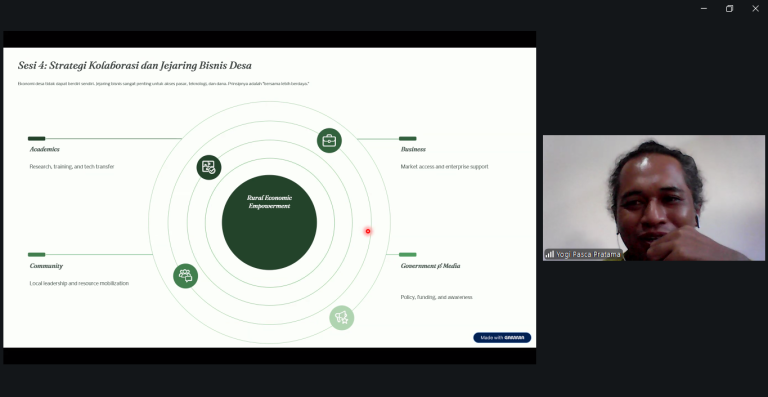
“This event is one of the Rural Development Laboratory’s continuing program series. Tomorrow, we will collaborate with colleagues from HRD Klinik Pratama Sukoharjo, and our next program will involve PLN. We are committed to ensuring that the Rural Development Laboratory continues to serve both internal and external stakeholders in a sustainable manner while delivering meaningful benefits,” he said.
Dr. Yogi added that the laboratory’s partnerships extend beyond training activities and are intended to foster broader collaboration. These include creating internship opportunities for students and inviting industry practitioners to share practical knowledge and professional experience with the academic community.
“In the future, when opportunities arise from partners such as PT Gawih Jaya or other companies, our students will be able to participate in internships. Likewise, practitioners can contribute by delivering sessions relevant to industry needs. Moreover, the challenges faced by companies can become opportunities for collaboration through research, community engagement, and other academic initiatives,” he explained.
During the training session, Wisnu Adi Saputro presented a range of marketing strategies aimed at strengthening the competitiveness of rural-based enterprises amid economic development and digital transformation. He emphasized that understanding local potential is the foundation for developing effective marketing strategies. The training covered local market potential analysis and market segmentation using the SWOT framework and the Value Proposition Canvas (VPC), marketing mix (4P) strategies, local product branding, and the effective use of digital platforms for marketing. Participants were also introduced to digital tools such as WhatsApp Business, Instagram, TikTok, Canva, and various online marketplaces to support product promotion and market expansion. Through practical examples and case studies, students explored how digital technology can connect local potential with broader market opportunities.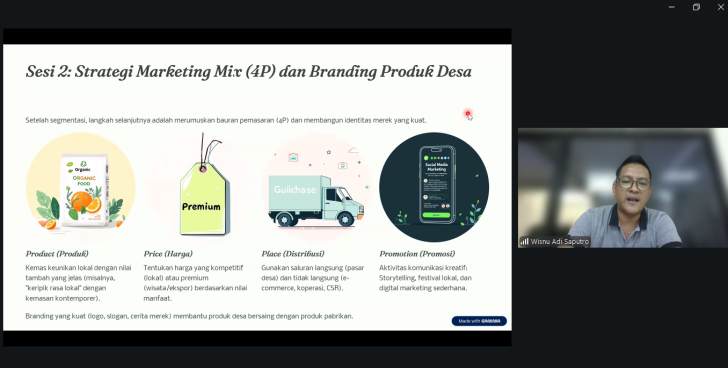
Wisnu also highlighted the importance of building networks and cross-sector collaboration to support rural economic development. According to him, the success of rural enterprises depends not only on product quality but also on their ability to establish strategic partnerships.
“The rural economy cannot grow in isolation. Business networks are essential for gaining access to markets, technology, and funding. The principle is simple: we are stronger when we work together,” he explained.
Concluding the session, Wisnu emphasized that building resilient rural economies requires a shared commitment grounded in innovation and collaboration. “A resilient and self-reliant rural economy can be built through the spirit of collaboration, innovation, and sustainability,” he stated.
Through this program, the FEB UNS Rural Development Laboratory reaffirmed its commitment to fostering a collaborative ecosystem that connects universities, industry, and local communities to promote innovative, adaptive, and sustainable rural economic development.
The program also supports the Sustainable Development Goals (SDGs), particularly SDG 4 (Quality Education) through capacity building for students, SDG 8 (Decent Work and Economic Growth) by strengthening local economic development, and SDG 17 (Partnerships for the Goals) by encouraging multi-stakeholder collaboration for sustainable rural development.