


FEB UNS Research Team Discusses the Role of FinTech in Monetary and Fiscal Policy Responses
Research team of Faculty of Economics and Business, Universitas Sebelas Maret (FEB UNS), conducts a public lecture entitled “FinTech and Monetary–Fiscal Policy Responses” as part of the dissemination of research findings. The activity takes place on Wednesday, 3 December 2025, at the Roedhiro Auditorium, Faculty of Economics and Business, Universitas Jenderal Soedirman (UNSOED), and is attended by more than 70 participants consisting of students from the Development Economics Study Program and academic staff.
The public lecture is motivated by the rapid growth of financial technology (FinTech), which increasingly encourages younger generations to conduct financial transactions digitally. Alongside the rising use of FinTech services and the diversification of digital financial products, the FEB UNS research team highlights the importance of aligning monetary and fiscal policy responses with the dynamics of the digital financial system. This activity is supported by funding from the 2025 DIKTI Fundamental Research Grant.
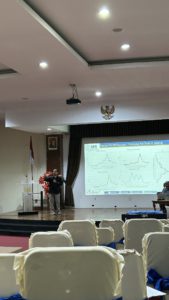 In his opening remarks, the Secretary of the Department of Development Economics, FEB UNSOED, Dr. Agus Arifin, expresses appreciation to the FEB UNS research team for organizing the public lecture. He highlights that the level of student literacy and academic engagement related to FinTech remains relatively behind the level of digital financial inclusion. This condition indicates that segments of society actively use digital financial services without adequate understanding.
During the main presentation session, Arif Rahman Hakim explains that various FinTech platforms are currently available for use by students and the broader public. However, users are advised to exercise caution by ensuring that FinTech providers are registered with and supervised by the Financial Services Authority (OJK).
He also explains that FinTech loan repayment rates remain at a relatively favorable level, reflecting users’ compliance in meeting their repayment obligations. In addition, paylater transactions and the use of QRIS show a significant upward trend within the digital payment system.
Furthermore, the FEB UNS research team emphasizes that monetary policy responses should be directed toward the formulation of a digital payment-based monetary policy framework. Such a framework can serve as guidance for interest rate and inflation control while ensuring systematic governance of the digital payment system that contributes to economic growth.
From the fiscal policy perspective, improvement can be achieved through the development of digital-based state and regional revenue and expenditure systems, both at the level of the State Budget (APBN) and the Regional Budget (APBD), thereby increasing the transparency and accountability of government financial transactions.
Specifically, Malik Cahyadin presents the results of a FinTech user behavior survey conducted in the Special Region of Yogyakarta and Central Java Province from July to early August 2025. In the Special Region of Yogyakarta, the survey involves 351 FinTech users, predominantly female (61.54%), with education levels mainly at senior high school (50.71%) and undergraduate degree (34.47%), predominantly Muslim (93.16%), and largely within their thirties. Meanwhile, in Central Java Province, the number of respondents reaches 585 individuals, also predominantly female (61.03%), mostly Muslim (83.42%), with senior high school education (55.41%), and primarily within the 18–22 age range.
The research findings indicate that key factors influencing FinTech transactions include technological adaptation and adoption capacity, perceived benefits of FinTech for personal needs and micro-enterprises, monthly expenditure levels, and user trust.
Based on these findings, the FEB UNS research team recommends that the Financial Services Authority (OJK) continue to promote digital financial literacy among the public, while FinTech service providers are expected to improve business governance and customer data security systems.
From a sustainable development perspective, this activity and its research outcomes contribute to the achievement of the Sustainable Development Goals (SDGs), particularly SDG 8 (Decent Work and Economic Growth) through inclusive financial system development, and SDG 9 (Industry, Innovation, and Infrastructure) through the development and application of technology within the financial sector.