

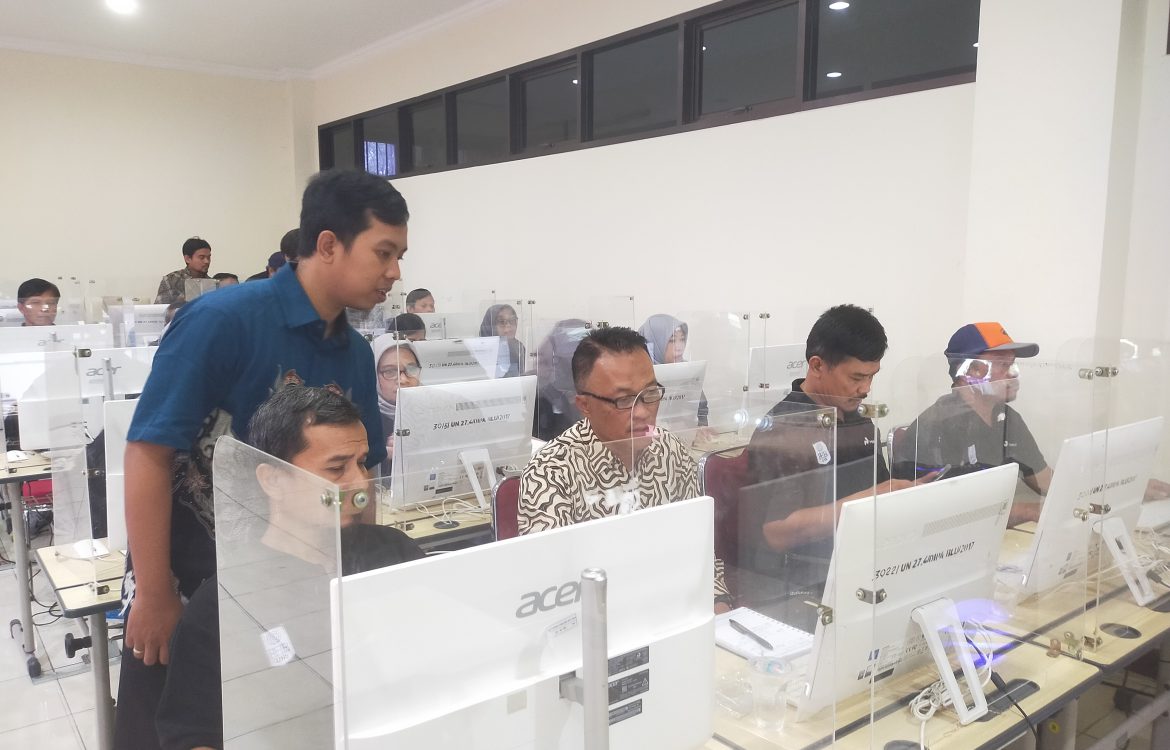
FEB UNS Organizes Digisign Training to Enhance Academic Support Staff Competence in Digital Administration
Faculty of Economics and Business (FEB), Universitas Sebelas Maret (UNS) held a Digisign Training for Academic Support Staff on Friday, July 25, 2025, at Computer Laboratory E, 3rd Floor, Soedarah Soepono Building, FEB UNS. The event was officially opened by Sutaryo, S.E., M.Si., Ph.D., Ak., CA., CRA., CRP., ACPA., Vice Dean for Non-Academic Affairs.
In his remarks, he explained that the previous Digisign training was limited only to several persons in charge (PIC), such as drafters and signers. Therefore, the current training is expanded to include all Academic Support Staff of FEB UNS to ensure a seamless administration and staff readiness in the case of job rotation or position restructuring within the faculty.
“We ask all participants to follow this training seriously, thus you can gain maximum understanding and skills in using Digisign. It is important to emphasize that digital signatures have now become a mandatory policy within the university. Therefore, all outgoing correspondence, whether from the university, faculty, or study programs, are no longer permitted to use manual signatures,” he stressed.
He further emphasized that although some documents had previously been signed manually, going forward all official documents must use digital signatures. Units without drafter access may submit a request, and the faculty will facilitate this need.
“If you encounter difficulties in this process, please report first to your direct supervisor, then through the coordinator, followed by the Vice Dean, and if necessary, to the Dean. Do not make independent decisions. Any wrong decision will certainly cause problems, while even the right decision may not necessarily receive recognition. Therefore, let us safeguard this process together,” he advised.
He also noted that the use of Digisign not only aims to standardize administration but also strengthens internal control systems to ensure that all official documents issued can be accounted for more effectively.
This training also contributes to the achievement of the Sustainable Development Goals (SDGs), particularly SDG 4 (Quality Education) and SDG 16 (Peace, Justice, and Strong Institutions), by strengthening institutional capacity and improving the efficiency of transparent and accountable administrative governance.