

FEB UNS Moves Forward Towards AACSB Accreditation
What is AACSB?
The Association to Advance Collegiate Schools of Business (AACSB) is an international accreditation body that recognizes business schools and accounting programs that meet exceptionally high standards in education quality. Established in 1916 in the United States, AACSB focuses on granting international accreditation to business schools and accounting programs worldwide. Its aim is to enhance the quality of business education through rigorous global standards.
Earning AACSB accreditation provides numerous benefits, including global prestige—as only around 5% of business schools worldwide have received this accreditation. It also signifies high-quality standards, requiring institutions to demonstrate excellence in teaching, research, curriculum development, and faculty advancement. Additionally, graduates from AACSB-accredited institutions are often seen as more competitive in the global job market. Furthermore, AACSB accreditation facilitates broader opportunities for international collaboration and exchanges with other leading institutions.
Several key processes must be undertaken by a faculty to achieve AACSB accreditation. These include submitting an eligibility application to AACSB outlining the institution’s structure, programs, and initial readiness; entering a mentoring phase where an AACSB-appointed mentor helps the institution prepare an initial self-evaluation report (iSER) and develop strategies to meet AACSB standards; compiling and submitting the iSER that outlines how the faculty meets the nine AACSB standards; implementing planned improvements and submitting periodic progress reports; undergoing a peer review visit by an external team to verify alignment with AACSB standards; and finally, receiving an accreditation decision from the AACSB committee, which may grant, postpone, or deny accreditation.
FEB UNS Towards AACSB Accreditation
The Faculty of Economics and Business, Universitas Sebelas Maret (FEB UNS), remains committed to continuously improving the quality of higher education in the fields of economics and business. FEB UNS has been a registered member of AACSB for more than a decade. In line with this, FEB UNS must undertake more determined efforts to advance its transformation toward international standards in education, research, and community service. Under the current leadership of Dean Prof. Bhimo Rizky Samudro, S.E., M.Si., Ph.D., the faculty has made a firm commitment to begin the AACSB accreditation process.

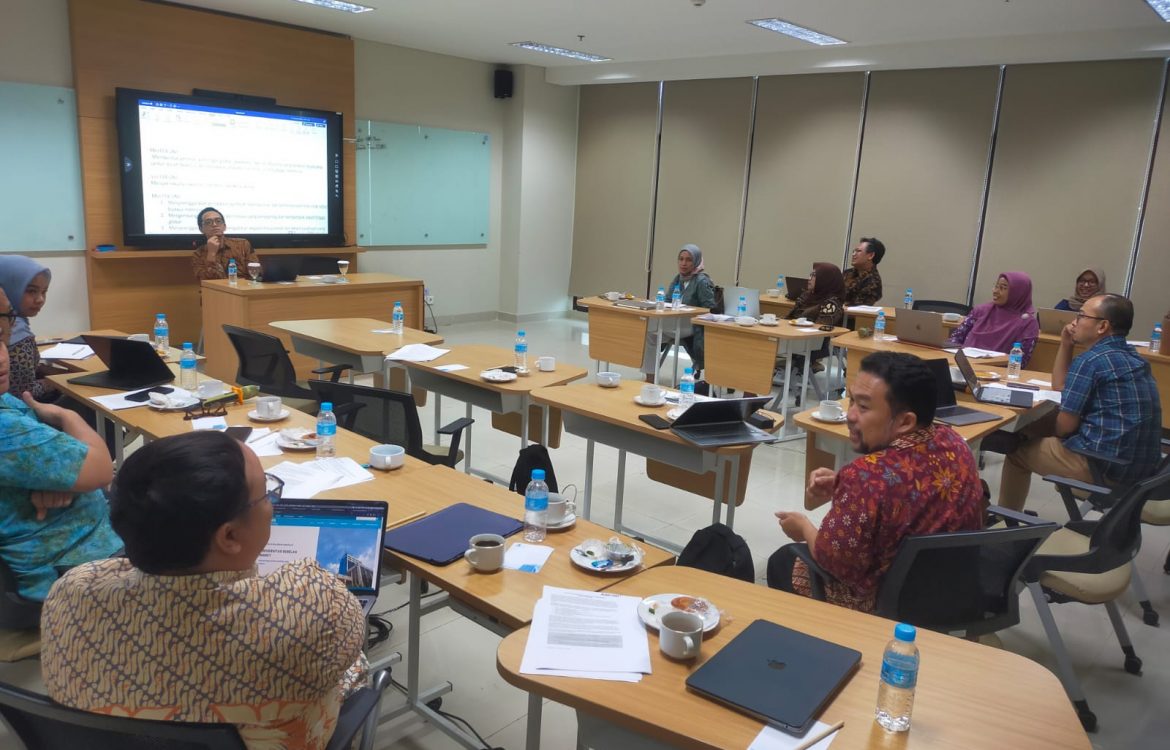
AACSB Eligibility Application Discussion (AACSB Team)
“In this period, I believe we must take this seriously, especially since we have received full support from the university. This will indeed be a long process, possibly taking years, but it must be initiated and carried out immediately. Regardless of who leads the faculty or taskforce in the future, this process needs to begin now and continue moving forward,” stated the Dean during a Focus Group Discussion (FGD) on AACSB Eligibility.
FEB UNS is now actively initiating the Eligibility Application process, which serves as the first step towards achieving AACSB accreditation. This phase marks the faculty’s institutional commitment to continuous development, aligning itself with international standards, and producing graduates capable of competing at the global level. With full support from the faculty members, FEB UNS is prepared to undertake this transformation gradually and systematically.

AACSB Eligibility Application Discussion (AACSB Team)
Tastaftiyan Risfandy, S.E., M.Sc., Ph.D., Vice Dean for Student and Alumni Affairs, emphasized that the AACSB accreditation process is highly selective and requires long-term commitment to improving overall quality. “Since 2010, we have been an AACSB member. Under the Dean’s directive, starting this year, we must begin the process. We need to intensify our efforts, follow the procedures closely, and hopefully the process will run as intended. Hopefully, by the end of this leadership period, we will have obtained the accreditation,” he stated.

AACSB Eligibility Application Discussion with Mandra Lazuardi Kitri, MBA, from ITB
According to him, AACSB differs from other accreditation schemes. Most accreditation processes involve reporting the faculty’s performance and submitting it to the accreditation body. However, AACSB begins with the eligibility application, and the path to full accreditation takes a minimum of five years. During this time, the faculty will undergo assessments by AACSB reviewers and complete several required stages. “We will prepare the eligibility documentation and accreditation report. If this stage is successful, the full accreditation process will commence next year and continue over the following five years. So even as the leadership changes, the accreditation process will remain ongoing. The key is that AACSB will introduce major institutional changes, even if the current Dean Office is not the one to report the final outcomes. It will require dedicated efforts,” he further explained.

AACSB Team after Eligibility Application Discussion
Several initial steps have been taken by the Dean Office, including issuing an official mandate to the AACSB Accreditation Document Team, chaired by Vice Dean for Academic and Research Affairs, Prof. Tri Mulyaningsih, S.E., M.Si., Ph.D., with Tastaftiyan Risfandy, S.E., M.Sc., Ph.D., as secretary, and supported by several other faculty members. FEB has also conducted various FGDs by inviting experts from AACSB-accredited universities, both domestic and international, as well as conducting regular internal discussions involving the Dean Office and taskforce team.
Looking ahead, FEB UNS hopes to achieve AACSB accreditation as recognition of the quality of education it provides. This process is expected not only to enhance the faculty’s international reputation but also to encourage ongoing improvements in the curriculum, research activities, and human resource development. With full support from the academic community, FEB UNS remains optimistic about producing graduates who are prepared to compete globally. This process marks an important momentum in strengthening FEB UNS’s position in the global business education landscape, while also equipping its graduates with high competitiveness at both national and international levels.