

FEB UNS Lecturers Disseminate Findings on FinTech User Behavior in Central Java and Monetary Policy Responses
The development of financial technology (FinTech) has expanded not only public access to lending services but also facilitated financial transactions, both in cash and installment-based. In line with this growth, the Financial Services Authority (OJK) has issued several regulations, from POJK No. 13/2018 on Digital Financial Innovation to POJK No. 40/2024 on Information Technology-Based Co-Funding Services, to enhance oversight of FinTech operations.
FinTech business growth in Indonesia continues to move in a positive direction, although the sector remains relatively small compared to the banking industry. This development encourages academics to study FinTech user behavior and disseminate the findings to students as part of academic learning.
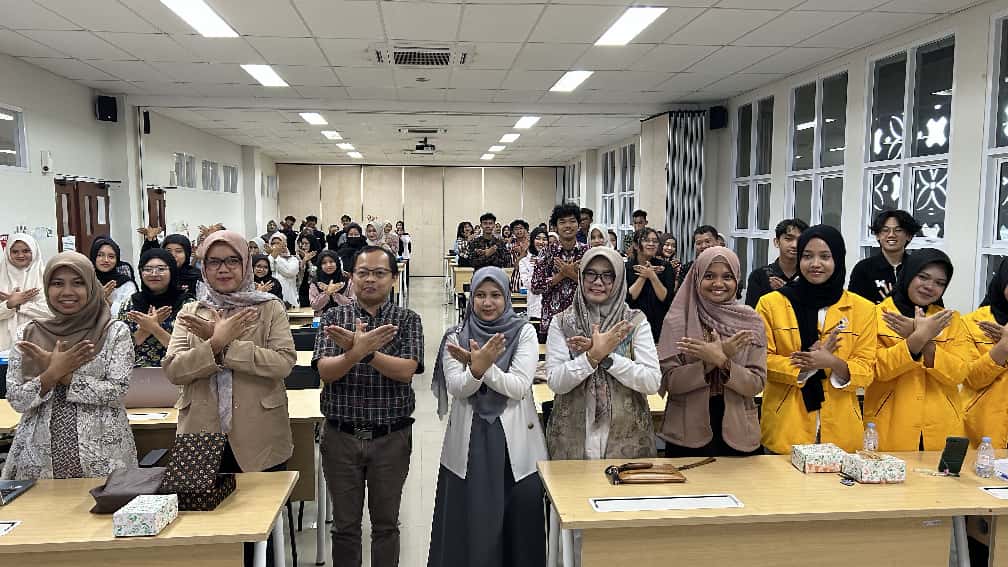
As part of this dissemination effort, lecturers from the Development Economics Study Program, Faculty of Economics and Business (FEB), Universitas Sebelas Maret (UNS) deliver a public lecture entitled “FinTech User Behavior in Central Java and Monetary Policy Responses” on Saturday, 1 November 2025 at the Faculty of Engineering, Universitas Tidar (UNTIDAR). The event is attended by approximately 80 participants consisting of lecturers and students.
The Head of the Development Economics Study Program, FEB UNTIDAR, Dr. Emma Dwi Ratnasari, S.E., M.Si., conveys appreciation for the inter-university collaboration that supports the implementation of the Tri Dharma of Higher Education. “Public lectures such as this serve as an important platform for sharing research findings and enhancing students’ perspectives through direct engagement with researchers,” she said in her remarks.
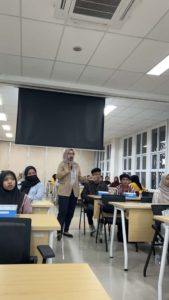 Ika Alicia Sasanti, S.E., M.E., a lecturer of Development Economics at FEB UNS, in her presentation highlights the importance of accurate FinTech literacy for students in the digital era. She emphasizes that FinTech platforms currently operating are regulated by OJK and may serve as relevant topics for academic inquiry. “Students need to understand both the opportunities and risks of FinTech to make productive use of it. A repayment compliance rate exceeding 90 percent shows that the community is becoming more responsible in meeting its financial obligations,” she explained.
She further emphasizes the need for sound business governance and data security to support healthy digital financial inclusion, and she points out the importance of monetary policy that adapts to future developments in the FinTech landscape.
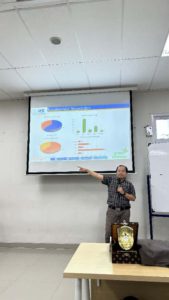 Following this, Malik Cahyadin, S.E., M.Si., Ph.D., a lecturer of Development Economics at FEB UNS, presents findings from his research on FinTech user behavior in the Province of Central Java, funded by the UNS Institute for Research and Community Engagement (LPPM) in 2025. The study is conducted from July to early August 2025 with 585 respondents consisting of formal workers and micro-entrepreneurs.
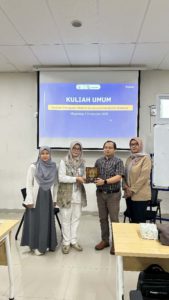 Survey results show that 61.03 percent of respondents are female, 56.41 percent are senior high school graduates, and the majority are aged 17–25 years. Malik explains that financial technology adoption, installment repayment ability, and trust level influence FinTech transaction intensity positively. In contrast, age and gender influence transaction levels negatively. “Beyond literacy, OJK and FinTech service providers must ensure that digital financial services operate in a trustworthy and secure manner. Bank Indonesia should also consider the implications of FinTech for money supply and inflation,” he noted.
This public lecture strengthens academic collaboration between higher education institutions and serves as a platform for integrating research outputs into student learning on digital economics. The dissemination of this research also contributes to the advancement of the Sustainable Development Goals (SDGs), particularly SDG 4 (Quality Education) and SDG 8 (Decent Work and Economic Growth), by promoting financial literacy, digital inclusion, and improved financial governance.