

FEB UNS Faculty Members Disseminate Research Findings on FinTech User Behavior in the Province of Yogyakarta
The development of financial technology (FinTech) in Indonesia maintains its positive trend, although its growth remains slower than the expansion of bank lending. In the Special Region of Yogyakarta (DIY), the two most widely used FinTech services are paylater facilities and online loans. This phenomenon attracts the interest of two lecturers from the Development Economics Study Program, Faculty of Economics and Business (FEB) Universitas Sebelas Maret (UNS), Malik Cahyadin, S.E., M.Si., Ph.D., and Ayya Agmulia Asmarani Islam, S.E., M.E., to conduct an in-depth study on FinTech user behavior in the region. The survey is conducted from July to early August 2025 with funding support from the 2025 DRPM Dikti Research Grant.
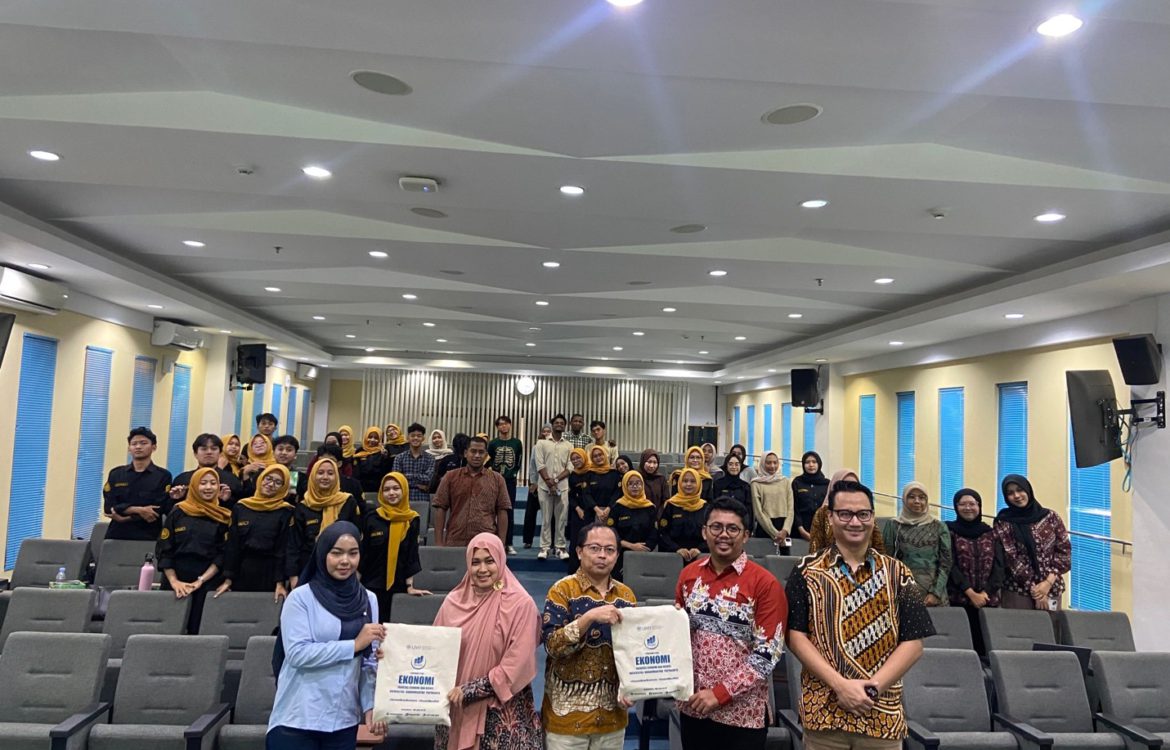
As part of the dissemination process, both researchers serve as speakers in a public lecture entitled “Financial Technology User Behavior in the Province of Yogyakarta in 2025,” held at the Faculty of Economics and Business, Universitas Muhammadiyah Yogyakarta (UMY) on Friday (31/10/2025). The event is attended by approximately 80 participants consisting of students and lecturers from the Development Economics Study Program of FEB UMY.
Opened by the Head of the Development Economics Study Program of FEB UMY, Dyah Titis Kusuma Wardani, S.E., MIDEC., Ph.D., she expresses appreciation for the collaboration between the two institutions. She states, “We would like to thank the lecturers from FEB UNS for delivering a public lecture at UMY. Hopefully, future public lectures and Community Engagement activities between study programs can be strengthened to advance the academic environment and enhance students’ competencies in economics.”
In her presentation, Ayya Agmulia Asmarani Islam explains that the availability of various paylater and online loan platforms reflects the strong potential for digital financial inclusion. However, she also emphasizes the need for vigilance. She explains, “In choosing FinTech service we must only consider valid information issued by the Financial Services Authority (OJK) to avoid fraudulent illegal FinTech practices. Students should pay attention to OJK’s official information, this is an expected forms of financial literacy from an academic community.”
She further notes that survey findings show FinTech users in DIY generally demonstrate good compliance. She adds, “Repayment compliance among FinTech users remains high, indicating that the community tends to fulfill its financial obligations.”
Meanwhile, Malik Cahyadin presents survey results from 351 FinTech users in the Province of Yogyakarta, consisting of students, formal workers, and micro-entrepreneurs. The descriptive results show that 61.54% of respondents are female and 38.46% male; 85.18% are high school and undergraduate graduates; the most common age range is 20–27 years; and the majority are Muslim (93.16%).
Malik highlights that the most influential factor affecting FinTech usage decisions is individuals’ ability to adapt to financial technology and the perceived benefits it provides. “Technology adaptation positively influences FinTech usage decisions, while age and education level contribute negatively to transaction intensity,” he states.
He also provides several recommendations for authorities and industry stakeholders. “OJK and FinTech service providers need to further improve literacy efforts to ensure that the public can make appropriate financial decisions. In addition, FinTech governance and customer data security need to be strengthened in a continuous manner,” he concluded.
This public lecture serves as an academic collaboration between the Development Economics Study Program FEB UNS and the Development Economics Study Program of FEB UMY. Beyond expanding scholarly networks, the activity is also expected to enhance digital financial literacy and raise students’ awareness of responsible financial behavior in the era of financial technology.
This event supports the achievement of the Sustainable Development Goals (SDGs), particularly SDG 4 (Quality Education) through strengthening financial literacy among students, and SDG 8 (Decent Work and Economic Growth) by promoting public understanding of inclusive, secure, and sustainable financial technology use.