

Accelerating Student Publications, Master of Management Study Program FEB UNS Invites International Professor
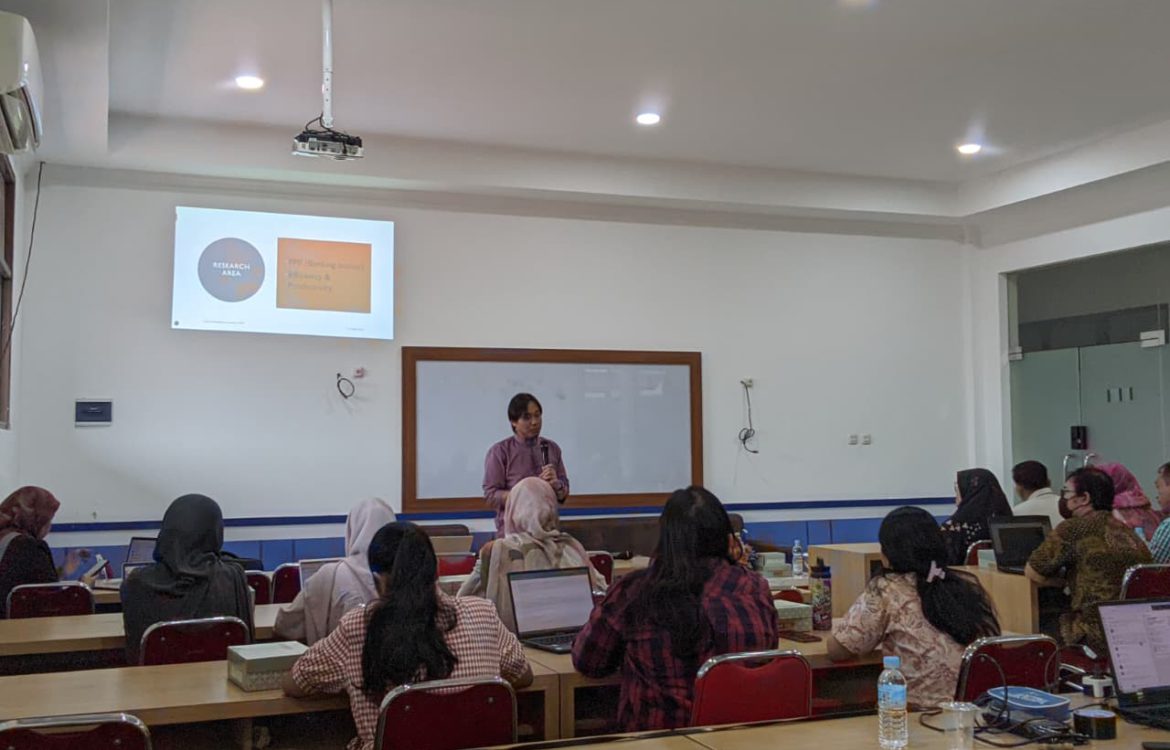
Master of Management (MM) Study Program, Faculty of Economics and Business (FEB), Universitas Sebelas Maret (UNS), Surakarta, in collaboration with the Institutional and Financial Market Research Group (GRISKA), invited Assoc. Prof. Fakarudin Kamarudin, Ph.D., from Universiti Putra Malaysia. The Guest Lecture, titled “A Talk Session: How to Publish in Reputable Journals?” is conducted on Friday, 31 October 2025, at the Soedarah Soepono Building, FEB UNS.
Dr. Lilik Wahyudi, Head of the Master of Management Study Program FEB UNS, opens the session. In his remarks, Dr. Lilik states that the event forms part of the MM program’s agenda to accelerate student publications. “Yesterday we invited an expert in behavioral studies, and today we invited an expert in finance. Please explore the session thoroughly because Assoc. Prof. Fakarudin is an expert in finance,” said Dr. Lilik. He expresses hope that the session will support MM students in achieving successful international publications.
Starting his presentation, Assoc. Prof. Fakarudin explains that the first aspect to understand before pursuing publication is identifying the reason one needs to publish research. “We can consider this from two perspectives: the student’s perspective and the lecturer’s perspective. For students, publication is a graduation requirement. For lecturers, the main reason for publishing is related to KPI (Key Performance Indicator),” he explained.
He further emphasizes that beyond quality, authors should prepare manuscripts by considering three perspectives: the author, the reviewer, and the editor. From the author’s standpoint, key considerations include target, scope, and research team. Alignment between the research topic and the journal’s scope is necessary, as misalignment leads to desk rejection. On the other hand, from the reviewer’s perspective, different elements determine whether an article is suitable for publication. These include novelty (whether the issue presented is relevant and new), the content of the abstract (whether the research objective can be addressed by the chosen methodology), and the empirical analysis (econometrics and results).
 “Meanwhile, for editors, there are three aspects they will consider: similarity, scope alignment, and novelty. Novelty is subjective and concerns new contributions. Its assessment depends on the editor of the journal,” explained Assoc. Prof. Fakarudin.
Assoc. Prof. Fakarudin also reminds participants to be cautious when using artificial intelligence (AI) and highlights the relevance of networking in the publication process. He shares several additional suggestions, including the importance of enhancing researcher visibility in their field of expertise. This visibility can be strengthened by attending international conferences. In addition, serving as a reviewer for reputable journals is an important step toward building professional networks.
The two-hour guest lecture concludes with an interactive discussion session between Assoc. Prof. Fakarudin and participants, most of whom are postgraduate students within FEB UNS.
This guest lecture supports the Sustainable Development Goals (SDGs), particularly Goal 4: Quality Education, by strengthening the academic capacity of students and lecturers in reputable scholarly publication. It also supports Goal 17: Partnerships for the Goals through international collaboration between FEB UNS and Universiti Putra Malaysia.