

FEB UNS Entrepreneurship Laboratory Develops Learning Modules to Strengthen Instructional Standardization
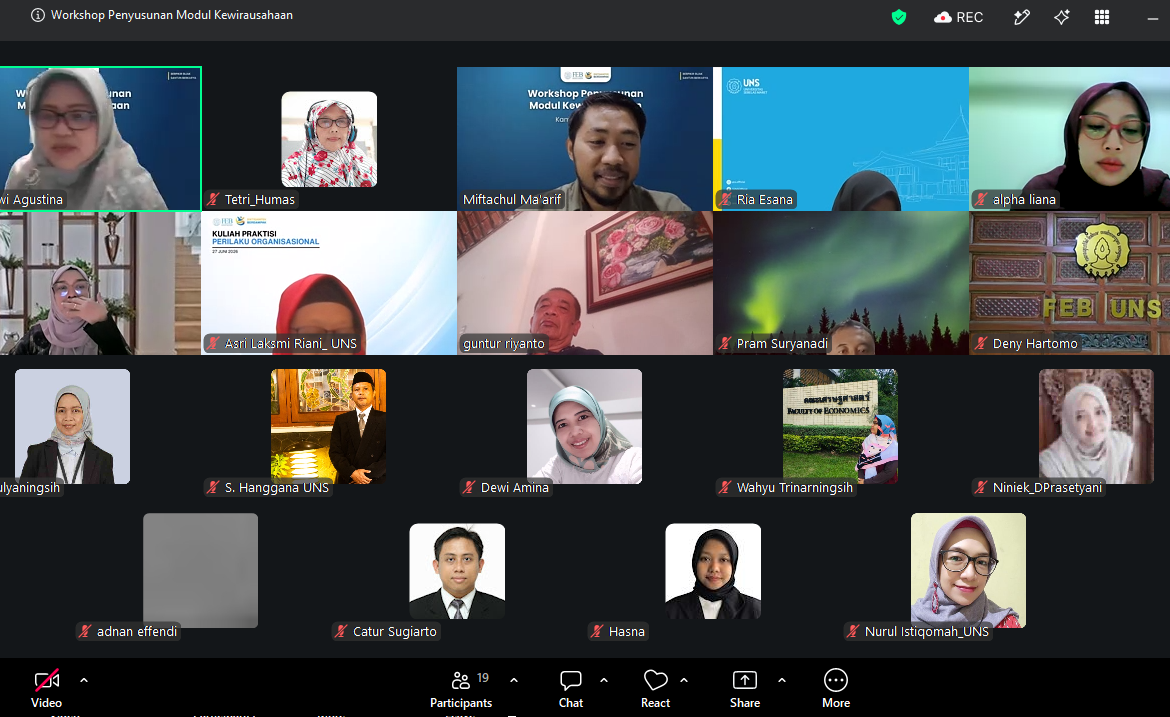
Faculty of Economics and Business (FEB), Universitas Sebelas Maret (UNS), organized a Workshop on Entrepreneurship Module Development on Thursday, July 16, 2026, conducted virtually via Zoom Meeting. The workshop featured Dr. Tri Siwi Agustina, S.E., M.Si., Head of the Center for Entrepreneurship and Industrial Relations (PKRI) at Universitas Airlangga, who shared insights and recommendations for developing entrepreneurship learning modules.
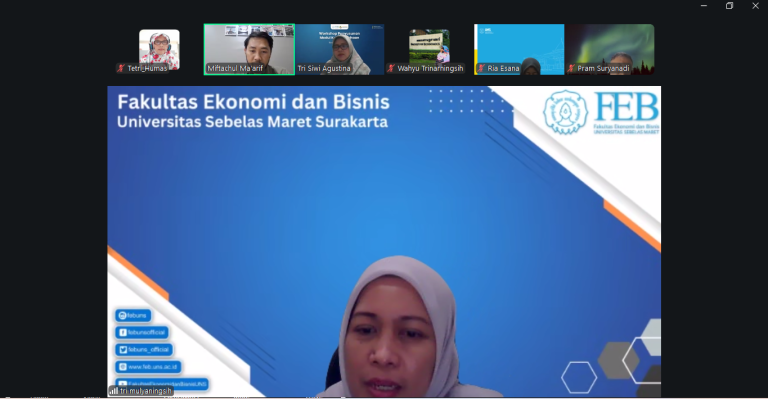
In her opening remarks, Prof. Tri Mulyaningsih, S.E., M.Si., PhD., Vice Dean for Academic Affairs, Research, and Student Affairs at FEB UNS, explained that the workshop was part of the Entrepreneurship Laboratory’s efforts to strengthen its role in supporting academic activities. In addition to organizing various training programs, the laboratory is being developed as a center for more structured and high-quality entrepreneurship education. She noted that the development of the modules aims to establish a standardized learning framework that can be adopted by all lecturers teaching entrepreneurship courses. The modules are expected to be implemented beginning in 2027, ensuring that students receive a consistent learning experience regardless of the class section or lecturer.
 Prof. Tri also explained that the initiative aligns with FEB UNS’s strategic plan, which identifies small business development as one of the faculty’s key priorities. Through a more structured entrepreneurship curriculum, students are expected to develop competencies that support the growth of small businesses while strengthening their readiness for professional careers or entrepreneurial ventures.
During the workshop, the development team organized the curriculum into five submodules: Entrepreneurial Mindset and Characteristics, Business Idea Identification and Opportunity Analysis, Design Thinking and Product Validation, Business Model Canvas, and Strategic Business Model. The modules were developed collaboratively with lecturers responsible for entrepreneurship courses to ensure their relevance to instructional needs.
As the keynote speaker, Dr. Tri Siwi Agustina emphasized that entrepreneurship education is not intended solely to produce entrepreneurs but also to equip students with life skills applicable across a wide range of career paths. According to her, entrepreneurship courses should enable students to identify problems, validate customer needs, design solutions, and communicate ideas effectively.
She also highlighted that the modules should not merely function as collections of instructional materials or textbooks. Instead, they should serve as comprehensive learning resources designed to meet the characteristics and learning preferences of today’s students. Consequently, the modules should consider the needs of Generation Z by incorporating contextual learning approaches and providing learning experiences that encourage critical and creative thinking.
Furthermore, Dr. Tri stressed the importance of distinguishing entrepreneurship education from courses such as introductory business or business planning. She explained that entrepreneurship courses should focus on discovering opportunities, understanding customer needs, developing solutions, and cultivating an entrepreneurial mindset rather than concentrating primarily on business plan preparation.
Through this workshop, FEB UNS aims to produce high-quality entrepreneurship modules that will serve as a shared reference for entrepreneurship instruction. The modules are expected to strengthen the quality of learning, support the development of students’ competencies, and produce graduates who are innovative, adaptable, and well prepared to address challenges in both professional careers and entrepreneurial endeavors.
This initiative also supports the achievement of the Sustainable Development Goals (SDGs), particularly SDG 4 (Quality Education) by strengthening the quality of higher education, and SDG 8 (Decent Work and Economic Growth) by promoting the development of entrepreneurial competencies among students.