

MAKSI FEB UNS Practitioner Lecture Explores BLUD Governance and Financial Reporting in Regional Public Hospitals
Master of Accounting (MAKSI) Study Program, Faculty of Economics and Business (FEB), Universitas Sebelas Maret (UNS), organized a Practitioner Lecture entitled Public Sector Reporting and Module Development: A Case Study of a Regional Public Hospital (RSUD) virtually via Zoom Meeting on 12 June 2026.
The session featured three practitioners from the public sector and the auditing profession: Dr. Eko Hendro Saputro, S.T., M.Kes., Director of the Regional Public Service Agency (BLUD) Jenderal Ahmad Yani Regional Public Hospital (RSUD) in Metro City, Lampung; Fitri Novilia, S.E., M.S.Ak., Interim Head of the Finance Division at the same hospital; and Heru Prasetyo, S.E., M.H., Ak., Auditor at KAP Wartono dan Rekan.
 In her opening remarks, Lulus Kurniasih, S.E., M.S.Ak., Ph.D., Head of the Master of Accounting Study Program, expressed her appreciation to the speakers for sharing their expertise and best practices in public sector financial management, particularly within regional public hospitals.
“This activity is designed to provide insights for our first and second-semester Master of Accounting students. We hope they will gain not only a theoretical understanding but also a clear picture of how these concepts are applied in real-world practice,” she said.
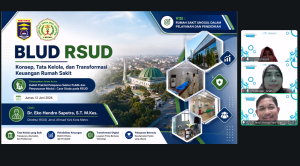 Lulus explained that the Practitioner Lecture forms part of MAKSI’s commitment to delivering more contextual and practice-oriented learning. Through direct interaction with experienced practitioners, students are expected to gain a deeper understanding of how public sector accounting and reporting concepts are implemented in professional settings. In addition to enriching students’ learning experiences through real-world case studies, the program is also expected to strengthen institutional collaboration between FEB UNS and Jenderal Ahmad Yani Regional Public Hospital.
She added that the planned collaboration extends beyond signing a memorandum of understanding (MoU) to developing case-based teaching modules that can be integrated into the MAKSI curriculum. “In addition to establishing an MoU, the MAKSI team will develop a teaching module based on the insights gained from today’s session. The module will be built around real cases and will serve as a valuable learning resource for our students,” she explained.
In the main session, Dr. Eko Hendro Saputro discussed the implementation of the Regional Public Service Agency (BLUD) model in regional public hospitals as a strategy to strengthen governance and public service delivery. He explained that BLUD status provides greater flexibility in financial management while maintaining the principles of accountability and transparency. According to him, the BLUD model has become a strategic instrument for local governments to improve the quality of public healthcare services.
“BLUD is not only about financial flexibility; it is a strategy for strengthening professional, adaptive, and community-oriented public services,” he emphasized.
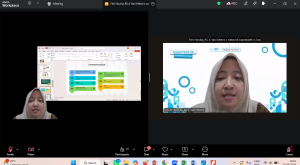 Participants were introduced to key aspects of BLUD financial management, including the preparation of the Business Plan and Budget (RBA), budget implementation, accounting systems, financial reporting, and accountability mechanisms. The session also examined implementation challenges, such as strengthening human resource capacity, harmonizing regulations, and fostering organizational culture that supports more effective governance.
Beyond financial management, the lecture highlighted the importance of digital transformation in hospital administration. The implementation of Hospital Management Information Systems (SIMRS), Electronic Medical Records (EMR), the development of e-BLUD, and the use of management dashboards were presented as essential initiatives for creating modern, integrated, and data-driven hospital governance. Through the case study of Jenderal Ahmad Yani Regional Public Hospital, students gained practical insights into the application of public sector reporting principles.
With material presented by Fitri Novilia, representing hospital financial management, and Heru Prasetyo, as an external auditor, provided students with comprehensive perspectives on financial management, reporting, oversight, and auditing practices within public sector organizations.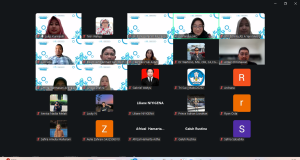
The program also supports the achievement of the Sustainable Development Goals (SDGs), particularly SDG 4 (Quality Education) through practice-based learning, SDG 3 (Good Health and Well-being) by promoting effective governance in public healthcare institutions, and SDG 17 (Partnerships for the Goals) through strengthened collaboration between higher education institutions and public service organizations.