

Visiting Lecturer Series of Development Economics Study Program Discusses Reimagining Social Protection Toward Indonesia 2045
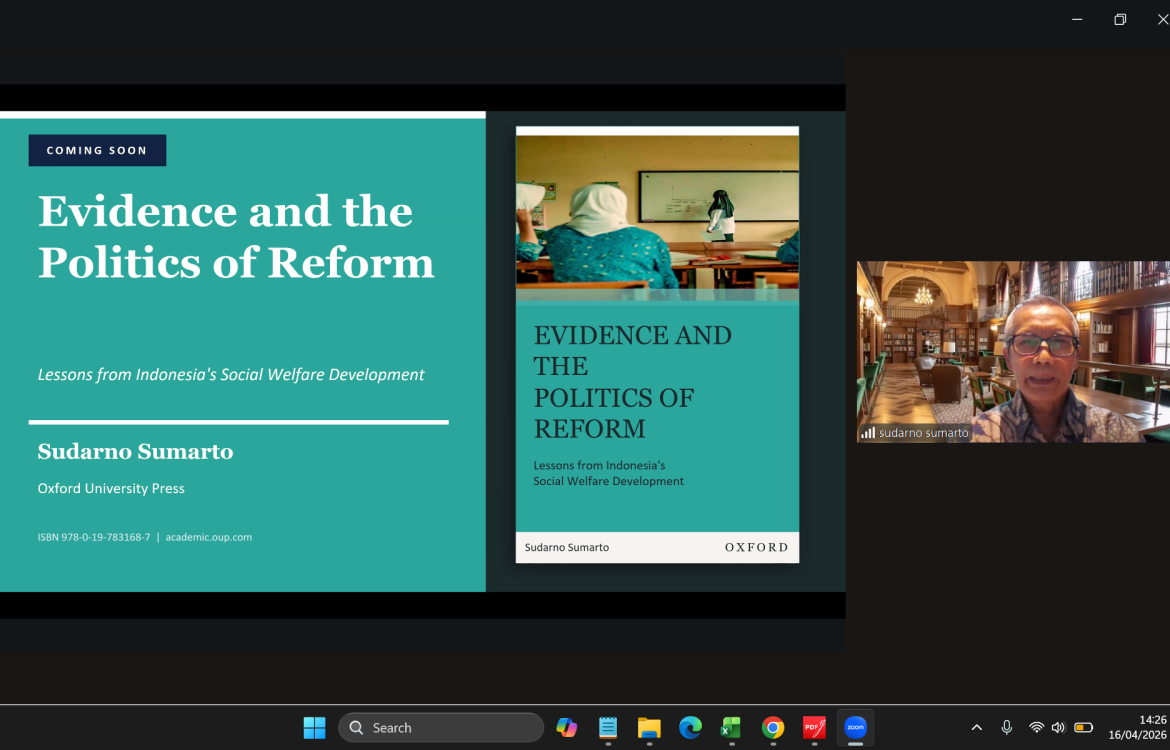
The Development Economics Study Program at the Faculty of Economics and Business (FEB), Universitas Sebelas Maret (UNS), organized the 2026 Visiting Lecturer Series titled “Reimagining Indonesian Social Protection Toward Vision 2045” on Thursday (16/4/2026) virtually via a Zoom Meeting. The event was attended by more than 100 participants consisting of FEB UNS students and faculty members.
The event featured Sudarno Sumarto, an Honorary Senior Research Fellow at The SMERU Research Institute and former Visiting Fellow at the Center for International Development, Harvard University, as the keynote speaker. The Vice Dean for Academic and Research Affairs of FEB UNS, Prof. Tri Mulyaningsih, S.E., M.Si., Ph.D., expressed in her opening remarks that this activity is highly relevant to UNS’s strategic direction, which encourages the strengthening of studies based on the Sustainable Development Goals (SDGs), particularly regarding poverty alleviation through social protection systems. She also hoped that this event would mark the beginning of broader academic collaboration between UNS and the speaker.
The Head of the Development Economics Study Program, Muhammad Yusuf Indra Purnama, S.E., M.Rech., Ph.D., also expressed his appreciation to the speaker for his willingness to share knowledge and experience. “Hopefully, this moment can be fully utilized by all participants to learn directly from the speaker. We are deeply grateful that he could join and share with us on this occasion,” he stated.
In his presentation, Sudarno Sumarto emphasized that social protection is not solely about poverty, but also serves as a foundation for establishing prosperity, justice, and national resilience. He underlined that the social protection system must be viewed as a strategic policy to reduce vulnerability throughout the human life cycle.
The material delivered encompassed five main aspects: the urgency of social protection, current conditions in Indonesia, structural traps and vulnerability, the importance of evidence-based policy, and the future design of the social protection system. He asserted that evidence should serve as the primary foundation for policy formulation, rather than a mere complement.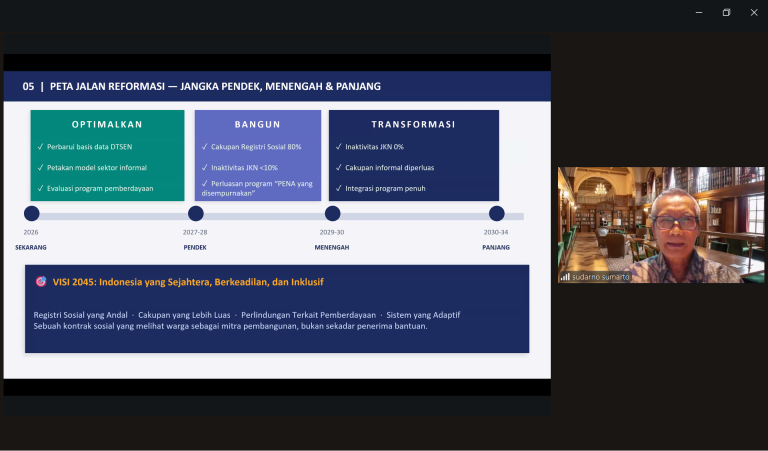
Furthermore, Sudarno Sumarto explained that although Indonesia has succeeded in lowering poverty rates, significant challenges remain, such as the dominance of the informal sector, fiscal constraints, climate change risks, and the high number of vulnerable groups. This group consists of individuals living just above the poverty line who are highly susceptible to falling back into poverty if economic shocks occur.
In the policy context, he highlighted four key questions that must be addressed: the appropriate type of assistance, the target recipients, the distribution mechanism, and the impact of the assistance program. The presentation concluded with three strategic pillars of reform: strengthening data management, increasing coverage and compliance, and economic empowerment, all of which must be anchored on solid data and strong evidence. The event then proceeded with an interactive discussion session between the participants and the speaker, which ran dynamically and constructively.
This activity is closely linked to the Sustainable Development Goals (SDGs), particularly SDG 1 (No Poverty), SDG 8 (Decent Work and Economic Growth), and SDG 10 (Reduced Inequalities). Through the strengthening of an inclusive and evidence-based social protection system, Indonesia is expected to realize more equitable welfare toward the Vision of Indonesia 2045.