

Undergraduate Management Program Introduces Exciting Topic of Creative Thinking Learning
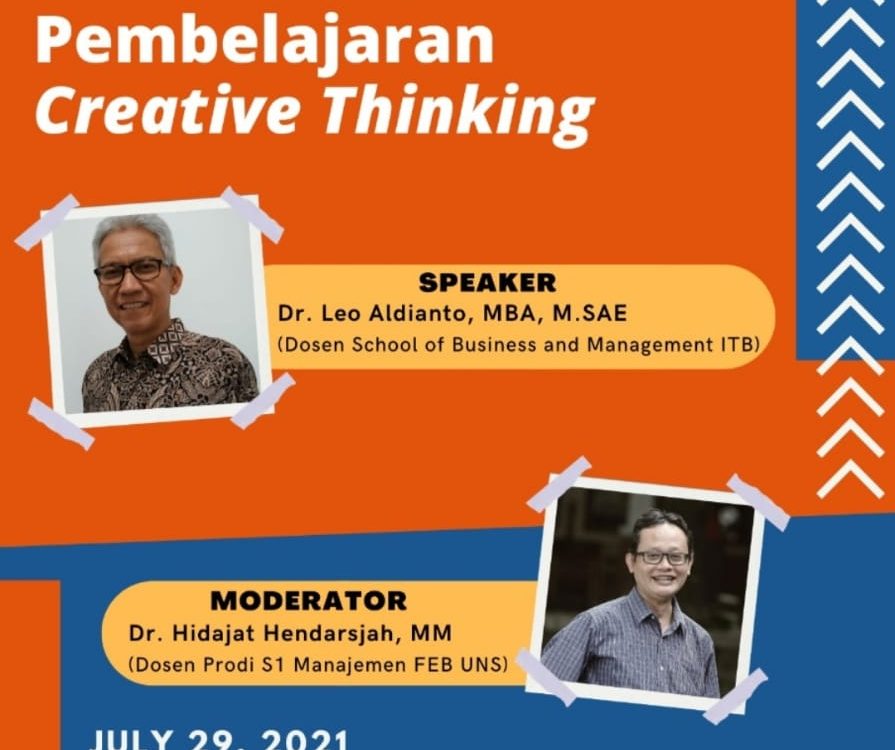
The Technical Assistance for Creative Thinking Learning became an engaging topic in the recent agenda hosted by the Undergraduate Management Program, Faculty of Economics and Business (FEB), Universitas Sebelas Maret (UNS), on Thursday, July 29, 2021. The event, attended by faculty members and students from various programs, featured Dr. Leo Aldianto, MBA., M.SAE., a lecturer from the School of Business and Management, ITB.
Summarizing insights from various experts, Dr. Leo stated that creativity is the process of creating something new, unique, and useful. Meanwhile, creative thinking is the ability to think in new, original, and conscious ways, departing from habitual routines, and different approaches, deviating from the ordinary, and abandoning conventional ideas.
 “What may affect and crucial in fostering creative thinking is how one typically works, behaves, and acts. Additionally, the creative process begins with preparation, generating ideas, and selecting prioritized ideas for implementation. Ultimately, there must be a tangible outcome, whether a physical product, concept, or idea. Most importantly, the environment must be designed to facilitate creativity,” explained Dr. Leo.
Teachers should encourage students to generate new ideas, expand upon them, be flexible, provide detailed suggestions, and diversify their approaches.
Examples of courses integrating creative thinking include Creativity & Innovation, Start-up Creation (a series of courses), Design Thinking, and Introduction to Business. Fundamental courses can also incorporate creative thinking. Essentially, in all course aspects, students should be encouraged to apply creative thinking, enhancing their skills and applying them directly to problem-based and project-based learning.
“In basic courses like Human Resource Management, Finance, and Accounting, the main focus remains on introducing creative thinking. Students must think of alternative ways and apply them. As they are still learning, they can utilize resources such as articles, magazines, books, papers, or the internet to explore various company issues,” Dr. Leo emphasized.
“The direct application in problem-based learning starts from identifying local issues to those faced by companies. Recently, we invited two companies to present their challenges. Seventy-two students were divided into 8 (eight) groups, each tackling problems from Company A and Company B. By the evaluation stage, the companies themselves assessed the students’ work,” he added.
The process of creative problem-solving involves several steps: identifying the problem, gathering facts and opinions, rephrasing the problem, brainstorming possible solutions, evaluating them, implementing the chosen solution, and assessing the results. (Humas FEB)