

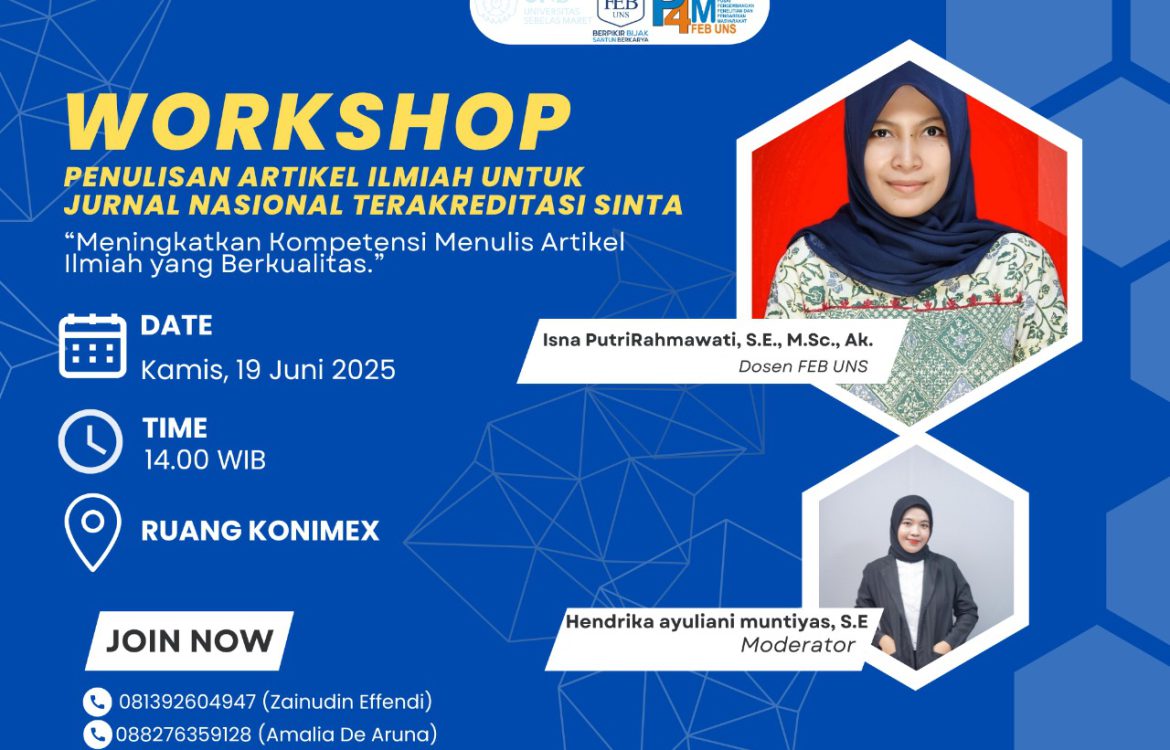
P4M FEB UNS Invited Managing Editor of Jurnal Akuntansi dan Bisnis in Scientific Writing Workshop for SINTA-Accredited National Journals
The Center for Research and Community Engagement Development (P4M), Faculty of Economics and Business (FEB), Universitas Sebelas Maret (UNS), organized a Scientific Article Writing Workshop for SINTA-Accredited National Journals on Thursday, 19 June 2025, at Konimex Room, Bachtiar Effendi Building, FEB UNS.
Attended by more than 40 students and lecturers, the workshop featured Isna Putri Rahmawati, S.E., M.Sc., Ak., the Managing Editor of Jurnal Akuntansi dan Bisnis, faculty member at FEB UNS, and experienced advisor for students aiming to publish in SINTA-2 accredited journals.
 In her opening remarks, Dila Maghrifani, S.E., B.Sc., M.Sc., Ph.D., Head of P4M, emphasized that the workshop aimed to enhance participants’ skills and understanding in preparing high-quality scientific articles aligned with the standards of SINTA (Science and Technology Index) accreditation. The session was also designed to equip participants with effective publication strategies to increase the acceptance rate of their manuscripts in indexed journals.
“We are fortunate to welcome Mrs. Isna today, who consistently guides her students in publishing their undergraduate theses into academic journals. This not only benefits the students but also contributes to broader academic discourse. Every year, student publications are successfully produced under her mentorship. I encourage everyone to make the most of today’s session,” she noted.
In her presentation, Isna encouraged the mostly undergraduate student participants to pursue publication of their academic work in SINTA-accredited national journals. She highlighted the importance of such publications: for lecturers, it supports performance evaluation, academic promotion, and certification; for students, it enhances their academic profile, provides added value to their portfolio, and supports Study Program and university accreditation.
“Many undergraduate portfolios focus on internships. I strongly recommend making scientific publication part of your portfolio. When applying for jobs or civil service positions, candidates are often asked: ‘What have you created? What have you published?’ That is where your article can make a difference,” she emphasized.
 Isna shared her experience of supervising five to eight students each year. Typically, two of the student’s articles will be successfully published in SINTA-2 journals, while the rest were published in SINTA-3, 4, or 5 journals. Her approach aims to ensure that students’ academic work does not remain idle in repositories or personal files but contributes to scholarly discussions.
She also explained that the latest accreditation guidelines have made publication more competitive. Journals now prioritize author diversity, topic relevance, adherence to author guidelines, and alignment with the journal’s scope. Moreover, titles must reflect the article’s key findings.
Isna offered specific tips for successful publication in SINTA journals: select up-to-date topics relevant to the journal’s scope; clearly highlight novelty in both the introduction and conclusion; use recent data, robust methods, and appropriate statistical analysis; strictly follow the journal’s formatting and author guidelines; and uphold academic integrity by avoiding plagiarism and refraining from the use of AI in writing.
The workshop is expected to encourage students and faculty to publish quality articles that contribute meaningfully to academic and professional communities.