

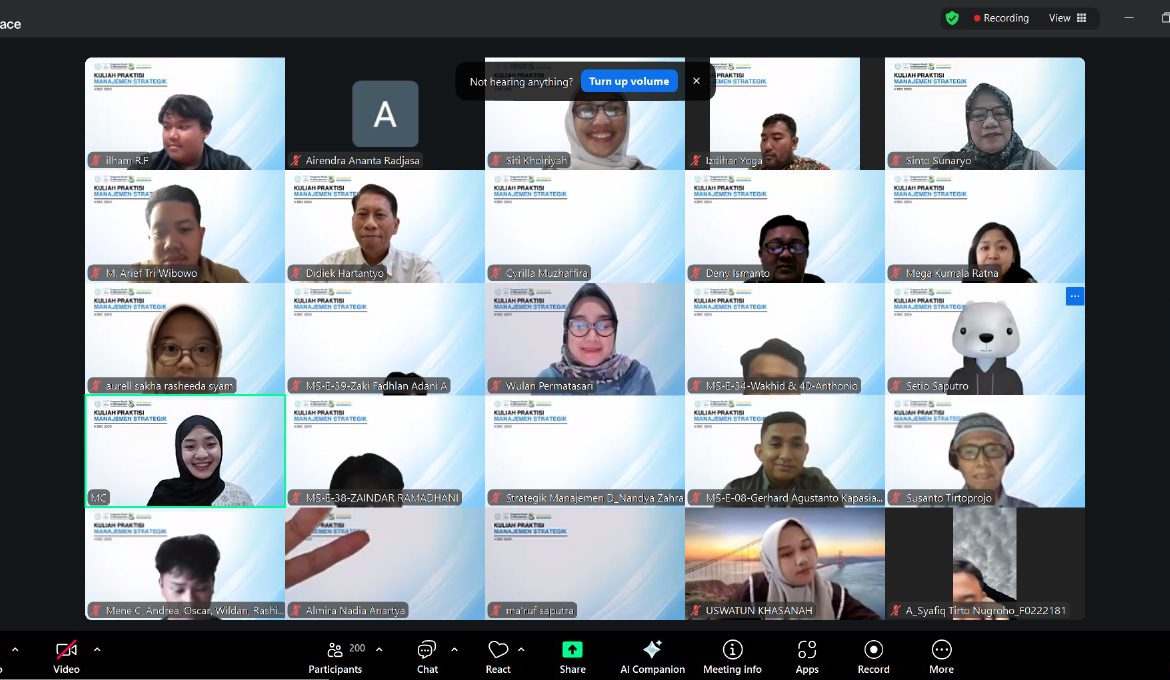
Management Study Program Presents Industry Expert in Strategic Management Guest Lecture
Management Study Program, Faculty of Economics and Business (FEB), Universitas Sebelas Maret (UNS), organized a Guest Practitioner Lecture for the Strategic Management course entitled “Strategy Evaluation: Measuring Performance and Conducting Strategic Revision” on Thursday, 4 December 2025. This occasion featured Dr. Didiek Hartantyo, M.B.A., a strategic management practitioner who shared empirical experience related to Dynamic Strategic Evaluation and its implementation at PT Kereta Api Indonesia (Persero).
In his presentation, Dr. Didiek emphasized that recently, organizations operate within a hyper-dynamic environment, characterized by rapid change and uncertainty arising from political and geopolitical conditions, global and domestic economic factors, disasters, and shifts in customer behavior. These conditions require companies to conduct strategy evaluation that is no longer static and periodic, but dynamic, continuous, and adaptive. To address these challenges, six approaches were presented.
First, Dynamic Strategic Evaluation, which refers to strategy evaluation conducted continuously and in real time, rather than relying solely on annual cycles. Second, Data-Driven Strategic Review emphasizes the use of big data, data analytics, and artificial intelligence as the basis for decision-making, enabling strategy evaluation to be more accurate and predictive. The third approach is Adaptive Permanent Evaluation, which assesses organizational capabilities through sensing, seizing, and transforming capabilities to ensure the organization can detect change, capture opportunities, and adapt structurally. Fourth, Strategic Ambidexterity Evaluation refers to an organization’s ability to maintain operational efficiency and stability while simultaneously pursuing innovation and transformation amid policy dynamics and global economic conditions.
Furthermore, ESG-Integrated Strategic Evaluation positions environmental, social, and governance aspects as core components of strategy evaluation to ensure sustainability and stakeholder trust. Finally, Scenario-Based Strategy Evaluation (SBSE) is applied to assess organizational readiness in facing various future possibilities, particularly under conditions of extreme uncertainty such as during a pandemic.
In the implementation session, PT Kereta Api Indonesia (Persero) was presented as a concrete example of the application of these six approaches from 2016 to 2025. The transformation began with strengthening organizational foundations and revising the Corporate Work Plan and Budget (RKAP) during 2016–2017, followed by the achievement of an AAA rating from Pefindo in 2017. KAI also issued bonds in 2017 and 2019 as a form of transparency and cost-efficient financing, while gaining public trust through its involvement in financing the Jabodebek LRT project.
During the COVID-19 pandemic period (2020–2021), KAI implemented crisis management through service adaptation, reinforcement of health protocols, and operational efficiency. Although the company experienced losses for two consecutive years, it successfully recovered and recorded a profit of IDR 444 billion in 2022. Entering the 2020–2025 period, KAI continued to develop dynamic strategic evolution through continuous strategy evaluation to maintain performance, safety, efficiency, and service quality.
This practitioner lecture reaffirmed that dynamic, adaptive, and data-based strategy evaluation is a key requirement for the sustainability of modern organizations. The six strategic evaluation frameworks presented were not only academically relevant but also demonstrably applicable in national corporate practice.
This lecture support SDG 8 (Decent Work and Economic Growth) through the strengthening of corporate performance and sustainability, SDG 9 (Industry, Innovation, and Infrastructure) through strategic transformation and innovation in the transportation sector, as well as SDG 12 (Responsible Consumption and Production) and SDG 16 (Strong and Accountable Institutions) through the integration of ESG principles and transparent governance.