

Inaugurated as Professor at UNS, Prof. Agung Prabowo Calls for Reframing Corporate Governance in Indonesia
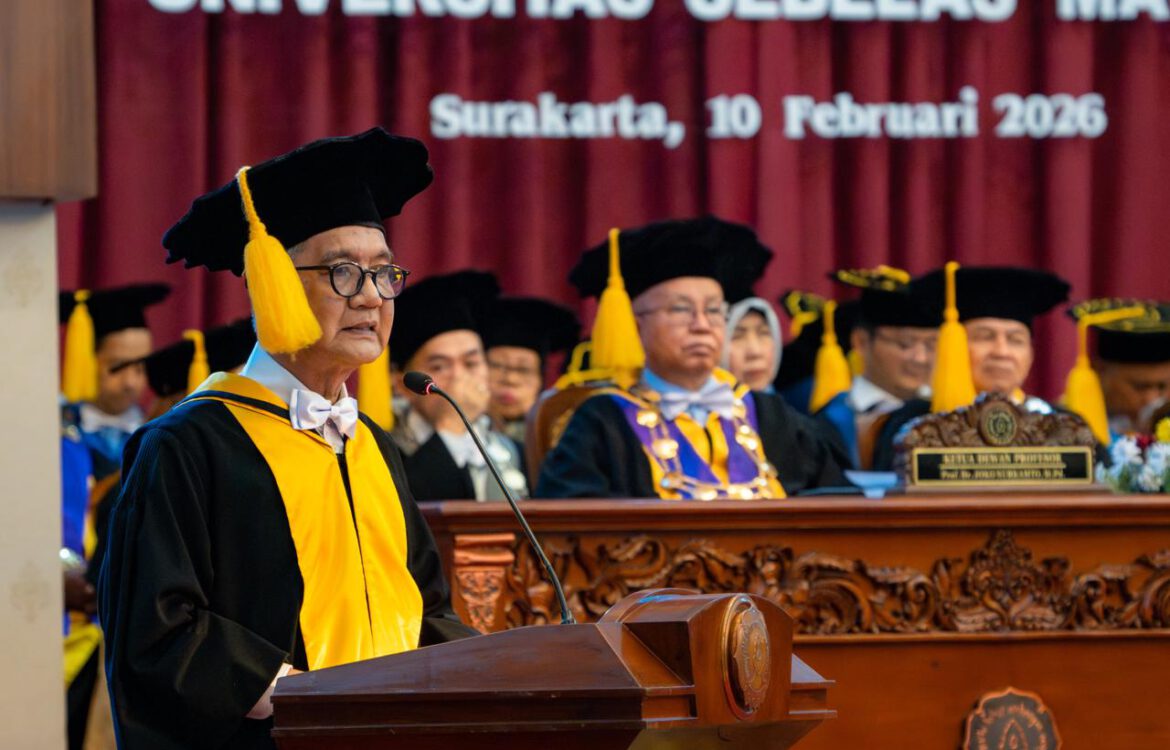
Universitas Sebelas Maret (UNS) held a Professorship Inauguration Ceremony at the G.P.H. Haryo Mataram Auditorium on Tuesday (10/2/2026). Prof. Drs. Muhammad Agung Prabowo, M.Si., Ph.D., Ak., was officially inaugurated as Professor in Financial Accounting and Corporate Governance by the Rector of UNS, Hartono, together with five other newly appointed professors within the university.
In his scientific oration entitled “Resetting the Discourse on Corporate Governance in Indonesia: Theoretical Foundations, Development Dynamics, and Multidimensional Empirical Evidence,” Prof. Agung emphasized the necessity of reframing perspectives on the practice of Good Corporate Governance (GCG) in Indonesia, so that it does not merely focus on regulatory compliance and formal structures.
He explained that the theoretical foundation of corporate governance originates from Agency Theory, which addresses conflicts between owners and managers. However, in the Indonesian context—where concentrated ownership structures and family-controlled businesses are prevalent—the governance issue shifts toward conflicts between controlling shareholders and non-controlling (minority) shareholders. Consequently, the protection of minority shareholders becomes a central issue in the national corporate governance discourse.
Drawing on empirical studies, Prof. Agung highlighted that the existence of formal governance mechanisms, such as independent commissioners, audit committees, and regulatory instruments, does not automatically guarantee effective oversight. Governance quality is substantially influenced by individual board characteristics, substantive independence, competence, and internal power dynamics within the firm.
He further discussed the evolving corporate governance paradigm, which is increasingly integrated with sustainability issues. Governance is no longer assessed solely on financial performance but also on social and environmental accountability. Empirical evidence indicates that leadership characteristics, board members’ educational backgrounds and expertise, as well as ownership structures, significantly affect the quality of sustainability reporting and corporate responsibility practices.
In his concluding remarks, Prof. Agung asserted that corporate governance reform in Indonesia requires a contextual approach that takes into account domestic economic structures, ownership characteristics, and national corporate culture. A “one size fits all” approach is insufficient to address the complexity of governance practices in Indonesia.
He called for strengthening substantive board independence, enhancing the quality and integrity of corporate management, and ensuring the protection of minority investors as the foundation of fair and sustainable governance.
The ideas presented in the oration are aligned with the Sustainable Development Goals (SDGs), particularly SDG 8 (Decent Work and Economic Growth), SDG 12 (Responsible Consumption and Production), and SDG 16 (Peace, Justice, and Strong Institutions), through the advancement of corporate governance that is grounded in integrity and long-term orientation.