

FEB UNS Shares Strategic Experience in Managing International Classes with FMIPA UNS
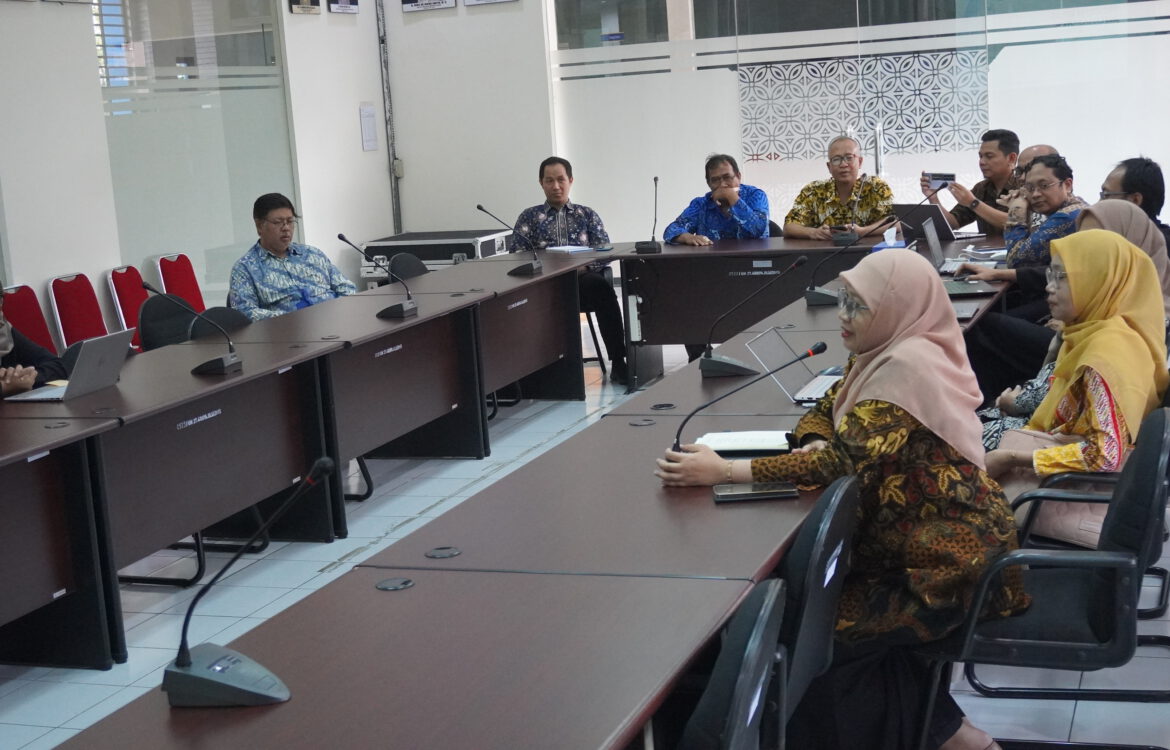
Faculty of Economics and Business (FEB), Universitas Sebelas Maret (UNS), received a benchmarking visit from the Faculty of Mathematics and Natural Sciences (FMIPA) UNS in preparation for the opening of its International Class program. The meeting took place on Thursday, 19 February 2026, at Meeting Room 1 of the Soeharno TS Building, FEB UNS. As the pioneer faculty in the implementation of International Classes at UNS, FEB serves as the primary reference for other faculties seeking to establish similar programs.
In his remarks, the Dean of FEB UNS, Prof. Bhimo Rizky Samudro, S.E., M.Si., Ph.D., elaborated on the challenges encountered by FEB since pioneering the International Class program in 2021, noting that its success is contingent upon a sound legal framework and a strong commitment from human resources. “We are sharing our experience regarding the initial challenges when FEB was establishing its international class. Starting from class management to student recruitment strategies. The details of its legal foundation and implementation up to the present will be conveyed by the Vice Dean for Academic Affairs,” said Prof. Bhimo.
He also highlighted the importance of periodic curriculum reviews by relevant bodies such as LPPMP to maintain quality standards.
 The Dean of FMIPA UNS, Prof. Dr. Desi Suci Handayani, S.Si., M.Si., conveyed that FMIPA is preparing to open two international classes, for the Chemistry Study Program and Biology Study Program respectively. This visit conducted following a direct recommendation of the Vice Rector for Academic and Research Affairs, thus, FMIPA could learn from FEB’s experience.
“Today, we visit FEB to learn how to develop an ideal curriculum. Our hope is that these international classes will genuinely attract foreign students, not only Indonesian students,” said Prof. Desi.
She further highlights the importance of understanding the curriculum structure and the Credit Student Abroad (CSA) calculation mechanism to ensure a well-prepared implementation at FMIPA.
 The Vice Dean for Academic and Research Affairs of FEB UNS, Prof. Tri Mulyaningsih, S.E., M.Si., Ph.D., then provided a detailed presentation on the regulatory framework governing the International Class program, ranging from Rector’s Regulation No. 21 of 2024 on the Implementation of Undergraduate Programs to the specific provisions of Rector’s Regulation No. 32 of 2025 on the Implementation of International Class Programs. The program is further strengthened by Rector’s Decrees issued in 2025 formally establishing the International Class and Double Degree programs for three study programs: Accounting (No. 1518/2025), Management (No. 1686/2025), and Development Economics (No. 1687/2025).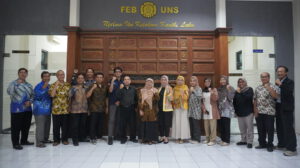
In terms of pedagogy, full English-medium instruction is complemented by a contemporary curriculum grounded in Outcome-Based Education (OBE), ensuring a student-centered learning approach that prepares graduates for the complexities of the global labor market. Prof. Tri also highlighted the mandatory international mobility requirement for International Class students, who are facilitated to participate in student exchange programs, summer courses, and visits by international professors through a network of partner universities spanning Asia, Europe, and Australia.
To support these efforts, FEB UNS continuously promotes the program through digital materials including e-leaflets, prospectuses, and international mobility guides, all publicly accessible via FEB’s social media platforms. The subsequent discussion session provided an opportunity for the FMIPA leadership delegation, led by Dean Prof. Dr. Desi, to explore further aspects of international class management.
FEB’s readiness to accompany other faculties in this endeavor reflects its commitment to the global agenda, particularly SDG 4 (Quality Education), ensuring the expansion of international education standards across the university, and SDG 17 (Partnerships for the Goals) strengthening internal inter-faculty synergy to accelerate institutional internationalization and advance the university’s vision of achieving world-class standing.