

Book Review on the P2SK Law Explores Indonesia’s New Financial Services Architecture
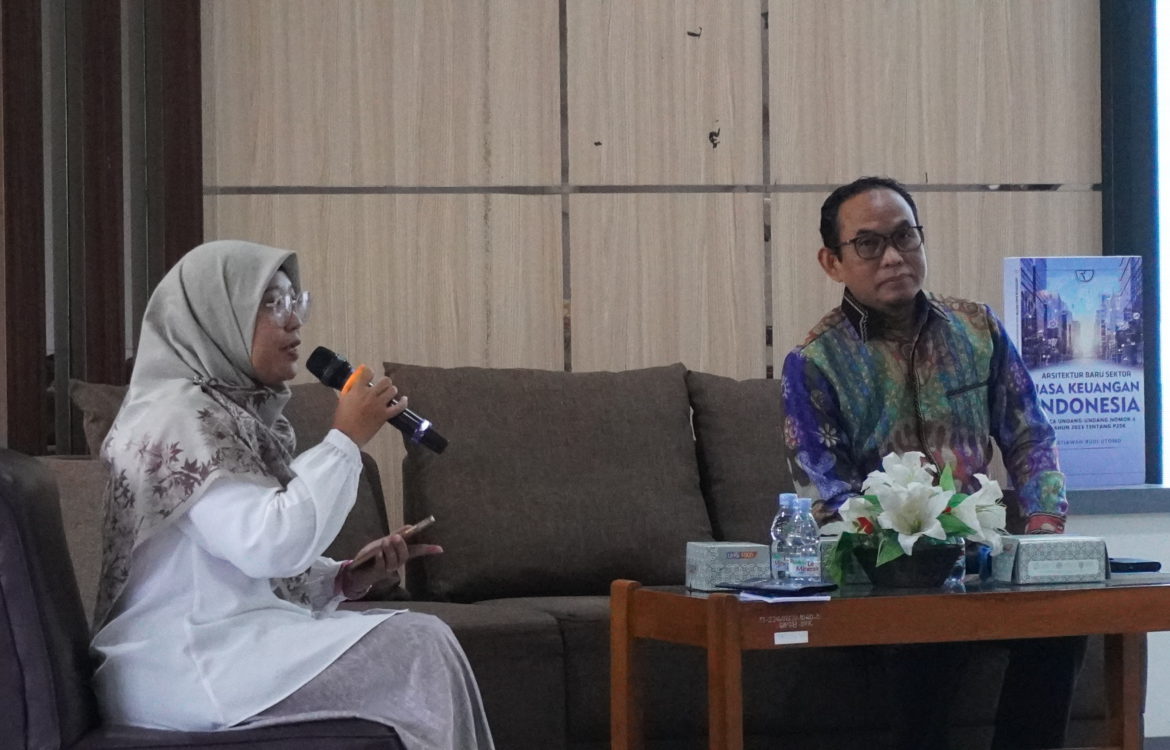
Management Study Program, Faculty of Economics and Business (FEB), Universitas Sebelas Maret (UNS) held a Book Review session entitled “The New Architecture of Indonesia’s Financial Services Sector After Law Number 4 of 2023 on the P2SK Law” on Monday, 24 November 2025 at the Soedarah Soepono Hall, FEB UNS. The event invited the author of the reviewed book, Setiawan Budi Utomo, Senior Executive Researcher (Director), Research Specialist, and Lecturer at OJK Institute. The session was moderated by Arum Setyowati, PhD., one of the lecturers at FEB UNS.
 This academic forum served as a platform to examine the major transformation of Indonesia’s financial services sector following the enactment of the P2SK Law, an omnibus regulation that restructures institutional architecture, supervisory scope, and the direction of national financial development.
Dr. Sinto Sunaryo, S.E., M.Si., SHRM.CP., Head of the Management Study Program, stated in her remarks that the current activity is expected to provide academic enrichment and expand students’ understanding. She highlighted the importance of bringing perspectives that align with Indonesia’s regulatory context, especially the policy landscape of the financial sector after the introduction of the P2SK Law.
“We encourage various perspectives from academics and practitioners, thus creating link and match between the two point-of-views. Students should not only learn theories but also understand how these theories operate within the Indonesian context. Please make the most of this event, ask as many questions as needed, and we hope Mr. Setiawan can share insights that help students understand the realities of the national financial sector,” she said.
The P2SK Law as a Milestone in National Financial Reform
In his presentation, Setiawan explained that prior to the enactment of the P2SK Law, Indonesia’s financial services sector faced several challenges, including fragmented regulations, overlapping mandates, weak coordination among authorities, and low financial inclusion in various regions. At least 17 sectoral laws operated independently, highlighting the urgent need for harmonization through an omnibus approach.
The P2SK Law, enacted in January 2023, represents a major leap in financial sector reform following the establishment of the Financial Services Authority (OJK) in 2011. Containing 341 articles, the regulation introduces institutional strengthening, broader supervisory coverage, digital governance, consumer protection, and the advancement of sharia finance and sustainable financing.
 Institutional Transformation and Coordination Strengthening
One of the key components of the P2SK Law is the enhancement of cross-authority coordination among OJK, Bank Indonesia, LPS, and the Ministry of Finance through the Financial System Stability Committee (KSSK). The Committee now holds a stronger legal basis for crisis prevention, early intervention, and policy protocol formulation during systemic stress.
The supervision of financial services cooperatives and Microfinance Institutions (LKM) has also shifted under OJK’s authority, creating a more integrated supervisory structure. This change is significant because many cooperatives and LKM previously operated without adequate governance standards.
Banking Reform and the Emergence of Digital Banks
 In the banking sector, the speaker emphasized that the P2SK Law adopts a more systematic risk-based supervision through three categories: normal, intensive, and special supervision. The Law also supports the consolidation of BPR/BPRS, the strengthening of sharia banking structures, and the acceleration of digital service transformation. The emergence of digital banks has become a strategic development. The P2SK Law provides clearer governance guidelines related to minimum capital, cybersecurity, digital know your customer (KYC) mechanisms, and technology risk management. The Law also encourages the integration of environmental, social, and governance (ESG) principles into financing portfolios as part of the transition toward sustainable finance.
Non-Bank Financial Sector and Financial Technology Innovation
 Regulation transformation extends to the non-bank sector, including insurance, pension funds, financing companies, and venture capital firms. These industries are required to improve governance, enhance digital transformation, and strengthen service transparency.
Regarding technology, the speaker described how the P2SK Law regulates Financial Sector Technology Innovation (ITSK), including fintech, e-wallets, peer-to-peer lending, insurtech, and digital assets. The regulation covers licensing, personal data protection, real-time digital reporting, and the development of regulatory sandboxes and innovation hubs that facilitate collaboration between regulators and industry players. Consumer protection in the digital ecosystem is also a central focus, particularly through algorithm transparency, limitations on personal data access, and the establishment of AI-based complaint channels.
Financial Inclusion, Cooperatives, and Sharia Finance
The P2SK Law introduces strategies to expand financial inclusion, particularly for women, MSME actors, persons with disabilities, and communities in underdeveloped regions. Local governments are encouraged to integrate inclusion programs into their medium-term development plans and regional budgets. With regard to cooperatives and LKM, the book highlights the need for governance improvements, reporting standardization, human resource certification, and strengthened oversight to prevent predatory practices conducted under the guise of cooperatives. The P2SK Law also places significant emphasis on sharia finance, including alignment with the halal ecosystem, sharia compliance mechanisms, and the development of sharia-based financing instruments.
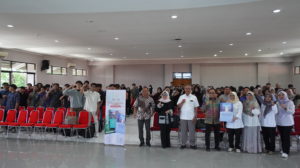 The discussion session was highly interactive, with questions from participants regarding implementation challenges, digital transformation readiness, and the role of students in contributing to the financial sector’s governance in the future. “The success of the P2SK Law depends heavily on human resource capacity, the harmonization of derivative regulations, and the ability of financial institutions to adapt to technology,” Setiawan said.
This activity supports SDG 8 (Decent Work and Economic Growth) through enhanced literacy of the financial sector, SDG 10 (Reduced Inequalities) through improved access to inclusive finance, and SDG 16 (Peace, Justice and Strong Institutions) through strengthened understanding of financial governance and institutional regulation.